Key Statistics
- Robinhood disclosed 13.6 billion event contracts traded in Q2 2026; this is a contract count, not dollar volume.
- Robinhood reported $156 million in event-contract revenue for Q2 2026.
- Robinhood reported 6.1 billion event contracts in July 2026 and 4.7 billion in August 2026, a 23% monthly decrease.
Figures and examples retain the report's original period, scope and source definitions. Consult the analysis and references below before making comparisons.
How should investors compare prediction markets in 2026?
Compare the exchange, the customer interface and the contract separately. Kalshi is a U.S. event-contract exchange. Polymarket operates distinct U.S. and international platforms. Robinhood and other brokerages distribute contracts through exchange infrastructure, so their activity can overlap with venue totals. A useful comparison measures executable liquidity, outstanding risk, revenue and settlement quality alongside trading volume.
Evidence review: October 3, 2026. This update separates verified 2026 disclosures from the original December 23, 2025 investment thesis. Financial observations below have their own reporting periods. They do not form an industry-wide volume estimate or a live ranking.
| Model | Operating role | Investor question | Evidence |
|---|---|---|---|
| Kalshi | U.S. event-contract exchange with distribution partners | Can liquidity and contract integrity scale across customer channels? | Kalshi / Public, Sep 24, 2026 |
| Polymarket US | QCX LLC, a CFTC-designated contract market | What products and protections apply to this specific venue? | CFTC designation record |
| Polymarket International | Separate blockchain-based platform outside restricted jurisdictions | How do market rules, collateral and resolution operate? | Operator transparency statement |
| Robinhood | Brokerage access and exchange relationships | How much activity and revenue reaches the distributor? | Q2 2026 results |
The original thesis was that prediction markets would reach a wider audience through familiar financial apps. By October 2026, the more useful question is how that distribution translates into recurring revenue and durable liquidity. Robinhood's published financial and monthly operating results now provide a dated reference point. They also show why a single annualized headline can conceal variation between event cycles.
Product design remains central. A customer may encounter an event contract inside a brokerage, but the exchange rules, settlement process and available jurisdictions still matter. The September 2026 developments reviewed below support a closer examination of those layers, rather than treating every prediction-market app as the same business.
Prediction market size: dated figures and definitions
There is no verified, comparable industry-wide market-size total in this review. Adding exchange volumes to broker-distributed contracts can count the same activity twice. Trading volume is also distinct from platform revenue, open interest, deposited collateral and the number of people trading. The table below therefore preserves each publisher's unit and reporting period.
| Measure | Reporting period | Reported value and unit | Source |
|---|---|---|---|
| Robinhood event contracts traded | Q2 2026, ended June 30 | 13.6 billion contracts | Jul 29, 2026 results |
| Robinhood event-contract revenue | Q2 2026, ended June 30 | US$156 million | Jul 29, 2026 results |
| Robinhood event contracts traded | July 2026 | 6.1 billion contracts | Sep 10, 2026 release |
| Robinhood event contracts traded | August 2026 | 4.7 billion contracts; down 23% month over month, as reported | Sep 10, 2026 release |
Robinhood defines its event-contract metric as contracts bought or sold through its Prediction Markets Hub. This is a contract count, not the dollars paid for those contracts, a count of unique trades or a count of users. Quarterly revenue is neither annual revenue nor an industry revenue estimate. No Kalshi or Polymarket market-share percentage is inferred from these figures.
What the main prediction-market metrics actually measure
| Metric | What to record | What it cannot establish alone |
|---|---|---|
| Trading volume | Executed activity during a stated interval; specify contracts, shares or US dollars and the counting convention | Unique users, net capital inflows, economic profit or retention |
| Open interest | Outstanding, unsettled positions at a stated time; specify contracts or a clearly defined dollar equivalent | Cumulative turnover or cash newly deposited during the period |
| Market depth and spread | Executable size and bid/ask prices at a timestamp, ideally for several trade sizes | Historical activity or persistent liquidity outside the snapshot |
| Revenue | Fees and other income under the operator's reporting definition, for a stated period | Trading volume, participant winnings or net profit |
| Active accounts or wallets | Unique identifiers meeting a disclosed activity threshold during the period | Verified people, representative demographics or cross-platform uniqueness |
Kalshi's market-data documentation exposes separate volume and open-interest fields. CME's open-interest explainer likewise distinguishes traded contracts from contracts still outstanding. Our comparison framework adds an investor requirement: match the interval, contract unit and counting method before comparing venues. Without that reconciliation, a larger headline need not indicate more committed capital or better execution.
Regulation and contract integrity: the 2026 evidence
Registration and the suitability of an individual contract are separate questions. The CFTC's register identifies QCX LLC, doing business as Polymarket US, as a designated contract market with a July 9, 2025 designation date. That record establishes the venue's status; it does not resolve every contract-specific, geographic or distribution issue. CFTC venue record.
A more recent example is the CFTC's September 22, 2026 staff advisory on mention markets. The agency highlighted contracts whose outcomes depend on a person's statements, appearances or interactions, and the resulting manipulation risk. It emphasized contract-specific analysis and the obligation to list contracts resistant to manipulation. This is a concrete reason to assess who can influence an outcome and what independently verifiable evidence determines settlement. CFTC advisory announcement.
The investment implication is analytical, not a statement that every contract is permitted everywhere. Review the venue rulebook, product terms and jurisdiction together. A distribution partnership can expand reach while leaving classification, market surveillance, customer protection and resolution risk with multiple parties. This review does not offer a state-by-state legal determination.
Historical charts from the original 2025 analysis
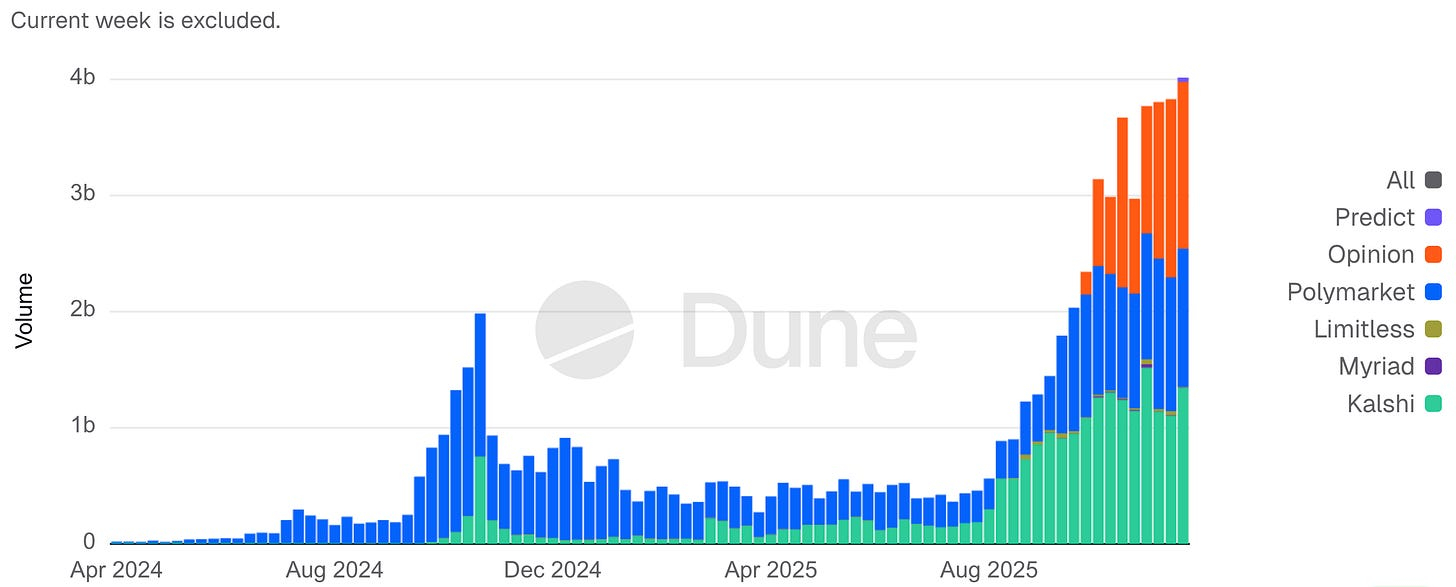
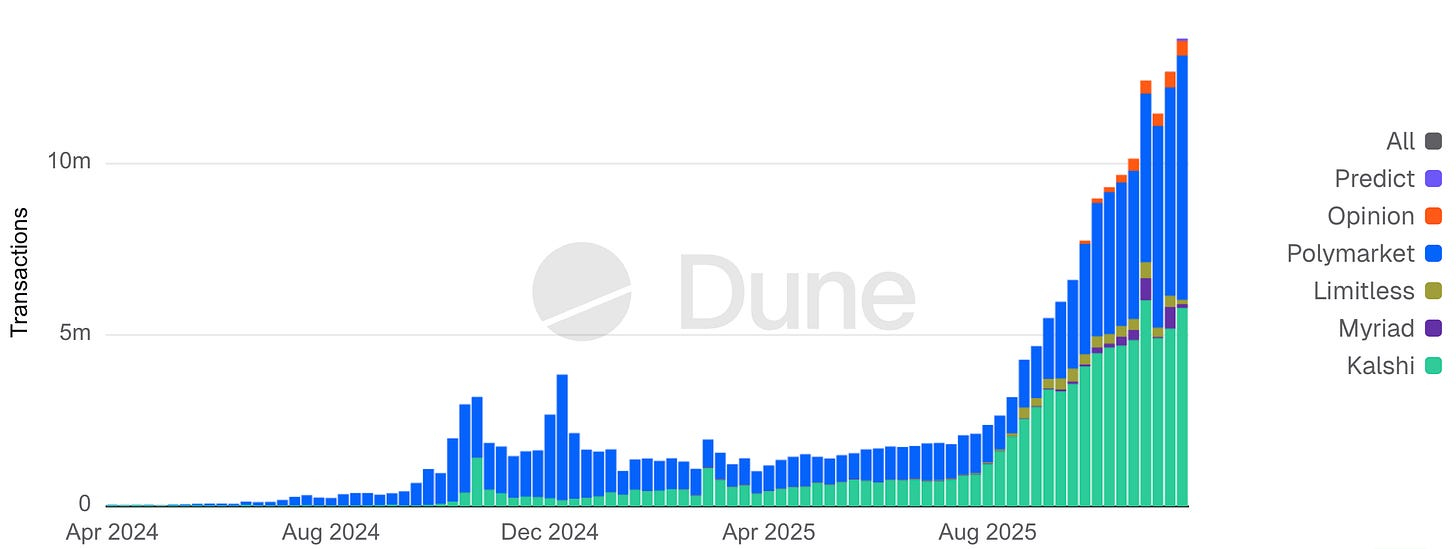
The two charts below show the earlier 2024–2025 expansion. They are retained as historical illustrations, not October 2026 data. The image does not expose a reproducible final observation date or a complete counting methodology; it should not be used to calculate current platform shares. Original dashboard reference: Prediction Markets on Dune.
Global Comparables
Historical context: this section retains the original December 23, 2025 analysis. Reported figures and announced plans refer to that period and were not reverified as current operating results in the October 2026 evidence review.
Outside the U.S., established betting exchanges and newer licensing regimes show that liquid event markets can exist under gambling supervision, but with constrained economics and product scope. The UK’s Betfair Exchange demonstrates that depth is achievable under a betting license, though profitability remains limited by strict consumer protection rules. In Asia, wagering is largely channeled through state monopolies or offshore venues, reflecting strong underlying demand but also persistent enforcement and integrity challenges. Latin America is moving toward formalization, with Brazil opening a regulated betting market in January 2025 to convert a long standing gray market into taxed, supervised activity.
The broader pattern is consistent across regions: regulators are closing loopholes. Sweepstakes and social casino models that relied on free tokens and prize mechanics are being restricted or banned across multiple jurisdictions, raising the compliance bar for any product operating near the gambling boundary. Globally, the direction of travel is toward tighter supervision, not permissive gray zones.
Polymarket US and International must be analyzed separately
Describing Polymarket only as an offshore onchain venue is no longer sufficient. Its operator distinguishes a U.S. exchange from a separate international blockchain-based platform, with different access and operating arrangements. The U.S. venue is corroborated by the CFTC registration record. Polymarket platform disclosure and CFTC register.
For an investor, the relevant unit is the actual trading venue. Identify the legal entity, the applicable contract rules, the collateral arrangement, how orders execute and how disputes are decided. Onchain trade records can make parts of activity observable, but they do not by themselves establish a trader's identity, the accuracy of every reported metric or the absence of misconduct.
Market resolution also deserves separate diligence from transaction settlement. A blockchain may record a transfer successfully while participants still disagree over which outcome satisfies a contract. Clear question wording, named evidence sources and a documented dispute process matter to both liquidity providers and end users. Those same design issues reappear when a prediction market is used to govern an organization, as examined in our futarchy and Umia research.
Prediction-market users: behavior is not demographic evidence
This review does not establish a representative age, income, gender or investor-type profile for Kalshi, Polymarket or the whole sector. No comparable, population-level survey is presented here. Wallet activity, visits to a website and an interview with a successful trader cannot substitute for such evidence.
Sports, politics and macroeconomic releases create different trading calendars, but that does not prove two fixed types of users. The same person can trade across categories. A high-turnover sports contract can be driven by market makers, repeat retail trading or a small number of large participants; a long-dated political contract can hold open interest for much longer without attracting more people.
A useful behavioral study would disclose its date range, venue coverage, unit of observation and exclusions. It would measure retention by acquisition cohort, concentration of trading and profit, repeat activity after major events, trade size and category overlap. Onchain work should explain how it treats multiple wallets, intermediary wallets and potentially non-economic activity. Account data should distinguish opened, funded and actually trading accounts.
Until those controls are available, participant archetypes remain hypotheses. Investors should ask whether activity survives the end of an election or tournament and whether fees exceed acquisition and incentive costs. Those questions provide a stronger test of business quality than an unsupported claim about who the average prediction-market user is.
After the 2026 World Cup: what should a post-event review test?
The World Cup is no longer an upcoming catalyst. FIFA records the tournament as running from June 11 to July 19, 2026, with 48 teams and 104 matches. Our December 2025 thesis treated it as a prospective stress test; that forecast must now be separated from observed platform performance. FIFA post-tournament review, July 20, 2026.
The latest monthly disclosure used above shows lower Robinhood contract activity in August than July. This alone does not demonstrate a World Cup effect. It covers all event contracts, not a tournament-specific cohort, and other sports calendars, product launches, market conditions and customer behavior may have contributed.
To assess the tournament properly, compare similar market types before, during and after it. Measure spreads and executable depth near kickoff, order and cancellation failures, time from final result to market resolution, disputed outcomes, withdrawal times and retained traders after the event. Separate new customers from existing traders moving between categories.
We do not have a comparable, independently verified cross-platform dataset for World Cup contract volume, outages, resolution disputes or post-tournament retention in this review. The tournament's completion is verified; a claim that every venue passed the operational stress test is not.
The original long-term question remains useful: can infrastructure built around bursts of attention support consistent liquidity and credible settlement? The post-event answer requires operating evidence. Audience size and tournament records cannot supply that evidence on their own.
Payments & Settlement Innovation
Historical context: this section retains the original December 23, 2025 analysis. Reported figures and announced plans refer to that period and were not reverified as current operating results in the October 2026 evidence review.
The convergence thesis extends into payments, where stablecoins are increasingly used as operational infrastructure rather than speculative assets. Most crypto native prediction markets rely on USD stablecoins for funding and settlement, and regulated platforms are now testing similar rails. In December 2025, Visa launched a U.S. pilot enabling banks to settle transactions 24/7 using Circle’s USDC on chain, following earlier cross border stablecoin experiments begun in 2023. In event driven markets, stablecoins offer clear operational advantages where permitted: instant deposits and withdrawals, global reach without currency conversion, and settlement that aligns with continuous trading hours.
In practice, stablecoins function primarily as settlement middleware. Users treat them as a faster mechanism to move value in and out of platforms, while operators benefit from lower payment failure rates, improved liquidity management, and near instant settlement. As a result, stablecoin policy debates carry second order implications for prediction markets. Restrictions on stablecoin rails increase friction and slow withdrawals, while regulatory clarity enables deeper integration by mainstream betting and brokerage platforms.
This trajectory faces policy resistance. Christine Lagarde warned in 2025 that private stablecoins pose risks to monetary stability and reiterated support for a state backed digital euro. The European Central Bank’s November 2025 Financial Stability Review similarly cautioned that expanded stablecoin use in payments could undermine bank funding and complicate policy transmission. The most likely 2026 outcome is incremental integration: more sportsbooks accepting stablecoin deposits and payment processors bridging cards to crypto, alongside tighter safeguards such as licensing, reserve audits, and disclosure requirements rather than wholesale endorsement of crypto native payment rails.
Macro Liquidity Backdrop
Historical context: this section retains the original December 23, 2025 analysis. Reported figures and announced plans refer to that period and were not reverified as current operating results in the October 2026 evidence review.
A skeptical lens is essential when evaluating the 2025 boom: easy money can inflate speculative markets. The Federal Reserve’s late-2025 shift toward ending quantitative tightening may modestly improve liquidity conditions into 2026, which matters insofar as it affects risk appetite rather than direction of adoption. For prediction markets, liquidity influences participation intensity, more cash can translate into higher trading volumes, while tighter conditions can dampen speculative activity at the margin.
That said, 2025 volume growth occurred during a period of elevated rates, suggesting prediction markets are not primarily a liquidity-driven phenomenon. The more useful framing is to treat macro liquidity as an accelerator, not a driver. Baseline adoption is better explained by secular factors: mainstream distribution through brokerages and sportsbooks, product simplification, and growing cultural acceptance of event-based trading. Monetary conditions affect amplitude, how aggressively users deploy capital, but do not determine whether adoption occurs.
This distinction matters for platform strategy. Tighter liquidity could compress volumes without invalidating the convergence thesis, while easier liquidity could amplify engagement and accelerate consolidation in favor of platforms with regulatory clearance, distribution, and settlement control. Macro shocks may still shape short-term behavior, particularly around event contracts tied to economic releases, but they function as volatility inputs rather than structural determinants. In short, liquidity conditions frame outcomes, they do not define them.
Brokerage distribution: a stronger thesis, with overlapping economics
A September 24, 2026 announcement from Kalshi and Public gives the distribution thesis a concrete new example. Public members can access Kalshi event contracts, while Public's AI agents can use event-market data in investment strategies. This establishes an announced product integration; it does not establish its revenue, usage or trading performance. Kalshi / Public announcement.
Prediction markets can therefore serve two related functions: a place to trade an event outcome, and a source of information for decisions elsewhere. A probability feed may be useful even when the customer does not trade the underlying contract. The commercial questions become who owns the customer relationship, who supplies liquidity, who collects fees and whether the information retains value after costs and execution constraints.
The original distribution argument still holds as an investment hypothesis. Existing brokerage relationships, funding rails and customer trust may lower acquisition friction. But a large registered audience is not evidence that users will trade, remain active or generate profitable revenue. Broker traffic also must not be added mechanically to exchange traffic when both report the same underlying execution.
Specialist venues may retain advantages in liquidity, market design and settlement credibility, while distributors capture attention and customer access. Either side can face concentration risk if it depends on a small number of counterparties or event categories. To understand the broader brokerage strategy, see our separate Robinhood Q3 research.
Our investment test: can the operator retain users and earn sustainable fees after the headline event, while preserving executable liquidity and trustworthy resolution?
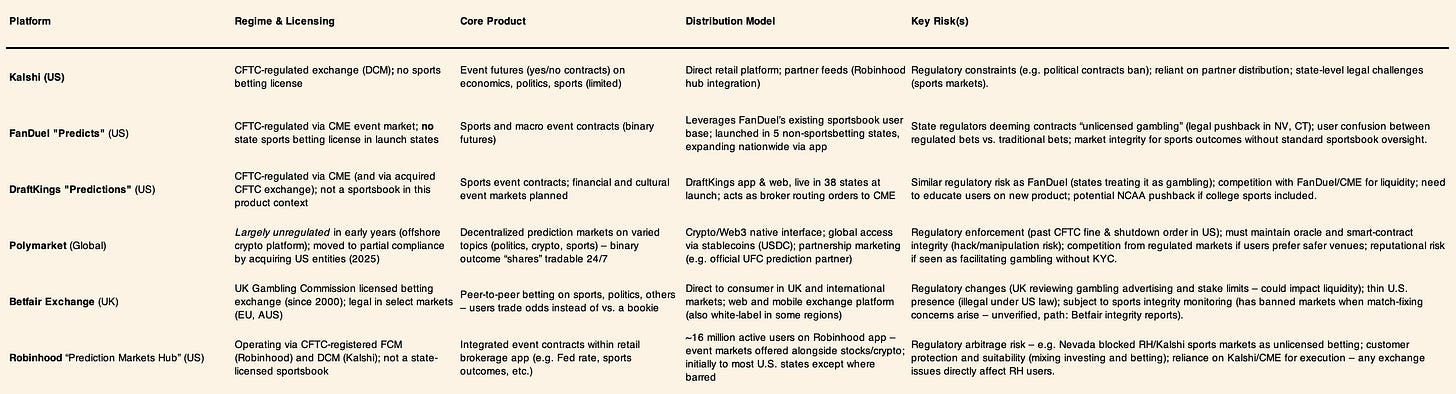
Historical comparison below: retained from the original December 2025 analysis. Product availability, distribution arrangements and stated geography are period-specific and are superseded by the dated venue distinctions above where applicable.
Opinion Trade (Opinion Labs): Macro-Native On-Chain Challenger
Historical context: this section retains the original December 23, 2025 analysis. Reported figures and announced plans refer to that period and were not reverified as current operating results in the October 2026 evidence review.
Opinion Trade (by Opinion Labs) positions itself as a macro-first, on-chain prediction venue, with markets that resemble rates and commodities dashboards rather than entertainment-led event betting. The platform launched on BNB Chain on October 24, 2025 and by November 17, 2025 had surpassed $3.1 billion in cumulative notional volume, averaging roughly $132.5 million in daily notional volume in its early weeks. During the period from November 11 to 17, it reportedly led major prediction venues with approximately $1.5 billion in weekly notional volume, while open interest reached $60.9 million as of November 17, placing it behind Kalshi and Polymarket at that point in time.
On the infrastructure side, Opinion Labs announced a December 2025 partnership with Brevis to integrate zero-knowledge-based verification into settlement workflows, with the stated goal of reducing trust gaps in market resolution. The company also disclosed a $5 million seed round led by YZi Labs, formerly Binance Labs, alongside additional participants, providing both capital and strategic adjacency to the BNB ecosystem. Finally, the platform’s explicit geofencing of the United States and other restricted jurisdictions underscores a defining 2025–26 tradeoff for on-chain prediction markets: rapid global liquidity formation constrained by regulatory perimeter design.
Consumer Prediction Markets as an ICO 2.0 Distribution Channel
Historical context: this section retains the original December 23, 2025 analysis. Reported figures and announced plans refer to that period and were not reverified as current operating results in the October 2026 evidence review.
Sport.Fun, formerly Football.Fun, provides a concrete example of how consumer prediction markets are being used as a new generation of token distribution infrastructure, an emergent “ICO 2.0” model embedded directly into live, revenue-generating consumer applications. Launched in August 2025 on Base, the platform initially focused on football fantasy-style event trading before expanding into NFL markets. By late 2025, Sport.Fun reported more than $90 million in cumulative trading volume and over $10 million in platform revenue, indicating meaningful product-market fit prior to any public token issuance.
The general capital-formation question is developed further in The Public Round Returns: how should a live product, public auction, treasury and governance system fit together? A successful token sale and a durable consumer business remain separate tests.
The company raised a $2 million seed round led by 6th Man Ventures, with participation from Zee Prime Capital, Sfermion, Devmons. The investor mix reflected a growing appetite for consumer-facing crypto applications that blend financial primitives with entertainment-style engagement, rather than infrastructure-only theses. Importantly, capital was deployed after demonstrable user activity and monetization, reversing the sequencing of earlier ICO cycles where token sales preceded real usage.

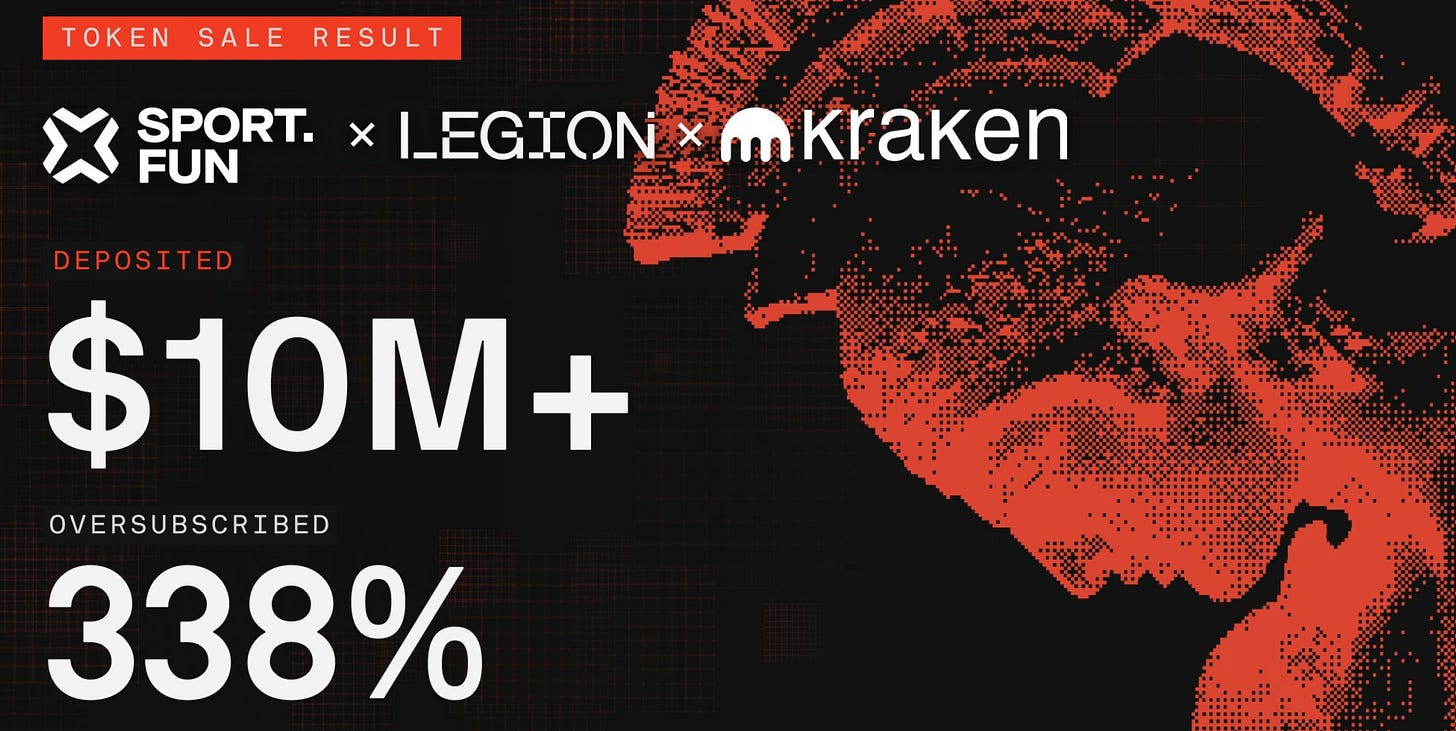
Sport.Fun’s public token sale for $FUN, conducted between December 16 and 18, 2025, further illustrates this shift. The sale was executed through Kraken Launch alongside the merit-based Legion distribution path, attracting more than 4,600 participants and over $10 million in aggregate pledges. Average participation size was approximately $2,200 per wallet, and demand exceeded the $3 million soft cap by roughly 330 percent. The final raise totaled $4.5 million at a $0.06 token price, implying a fully diluted valuation of $60 million, with 75 million tokens sold following a greenshoe expansion.
Token economics were structured to balance liquidity with post-launch stability. The sale terms scheduled a 50% unlock at the January 2026 token generation event, followed by six months of linear vesting. Those announced terms are retained here as historical context, not a verification of subsequent execution. This design contrasts with the immediate full unlocks common in earlier ICO cycles and reflects lessons learned from prior volatility-driven collapses. The token sale functioned less as a speculative financing event and more as an extension of an existing consumer market, effectively allowing users to invest in the platform they were already actively trading on.
Prediction Markets 2026 FAQ
How should prediction-market activity be compared in 2026?
Compare the same reporting period and unit across venues. Separate contract count, dollar volume, open interest, market depth and revenue. Broker activity may overlap with exchange activity, so this review does not publish a combined industry total or a current volume league table.
How are Kalshi and Polymarket different?
Kalshi is a U.S. event-contract exchange. Polymarket has separate U.S. and international platforms. Compare the specific venue, rules, access, collateral and resolution process rather than treating the Polymarket brand as one uniform operating model.
What did the 2026 World Cup prove about prediction markets?
The tournament has finished, but its size alone does not prove platform reliability or lasting adoption. A post-event review needs market-level evidence on liquidity, outages, disputed settlement, withdrawals and retained traders. This report does not claim a verified cross-platform operational result.
Are prediction markets a standalone product or a feature?
They can be both. Specialist exchanges supply markets and liquidity, while brokerages distribute access and may use event prices as inputs to other products. Commercial results depend on customer retention, execution quality, fees and the allocation of responsibilities.
Conclusion
The October 2026 evidence supports a more precise version of the original thesis. Prediction markets increasingly connect exchanges, brokerages and information products, but a bigger distribution network does not automatically produce durable economic value. Investors need comparable units, dated disclosures, clear venue boundaries and contract-level integrity.
The next useful test is repeatable performance after a major event: retained customers, executable liquidity, sustainable revenue and reliable resolution. This report treats unverified industry totals and demographic profiles as unanswered questions. The original 2025 case studies remain historical context; the dated evidence review above is the basis for the current assessment.
Sources
Primary sources for the October 3, 2026 evidence review
- Robinhood Q2 2026 results and metric definitions, July 29, 2026
- Robinhood August 2026 operating data, September 10, 2026
- Kalshi / Public prediction-market integration, September 24, 2026
- CFTC mention-market advisory announcement, September 22, 2026
- CFTC designated-contract-market record: QCX LLC / Polymarket US
- Polymarket disclosure distinguishing US and International platforms, reviewed October 3, 2026
- FIFA post-tournament review, July 20, 2026
- Kalshi market-data API documentation, reviewed October 3, 2026
- CME Group: volume and open-interest definitions
Historical source list from the original 2025 analysis
The references below are retained for provenance of the historical sections. General homepages and archived images do not independently substantiate a current 2026 statistic.
- https://x.com/footballdotfun
- https://www.reuters.com/
- https://polymarket.com/
- https://kalshi.com/
- https://app.opinion.trade/
- https://dune.com/datadashboards/prediction-markets
- Information technology at the Olympic Games - Boris Sakac
Risk Disclaimer
insights4.vc and its newsletter provide research and information for educational purposes only and should not be taken as any form of professional advice. We do not advocate for any investment actions, including buying, selling, or holding digital assets.
The content reflects only the writer’s views and not financial advice. Please conduct your own due diligence before engaging with cryptocurrencies, DeFi, NFTs, Web 3 or related technologies, as they carry high risks and values can fluctuate significantly.
Note: This research paper is not sponsored by any of the mentioned companies.
Published by the insights4vc research team. See our research methodology, source standards and corrections policy. Dates and measurement periods are stated in each analysis.