Key Statistics
- In 2024 alone, 297 such rounds raised £324 million, down from 569 rounds and £773 million at the 2021 peak.
- The first comprehensive post-implementation dataset found that 181 active providers raised €4.25 billion across 21 member states in 2024.
- In 2016, the digital bank raised £1 million in 96 seconds, according to its own retrospective.
Figures and examples retain the report's original period, scope and source definitions. Consult the analysis and references below before making comparisons.
Startup capital formation is becoming public earlier, but openness alone is not the decisive change. Equity crowdfunding proved that customers wanted to finance companies they used. ICOs added global distribution and early liquidity, then exposed weak links among tokens, treasuries, operating entities and governance.
The rebuilding that followed introduced verification, allocation rules, vesting, auctions and onchain treasuries. The emerging question is whether these pieces can function as one market architecture: broad enough for communities, legible enough for professional allocators, and disciplined enough to direct real organizations. The result may be less a revived ICO than an early version of a programmable public venture market.
Partner Highlight

At insights4vc, we pay attention to teams building the infrastructure behind emerging market categories.
Umia is developing a new operating model for token-native ventures. The platform brings fundraising, legal formation, treasury management and governance into one integrated system, enabling projects to launch with clearer structures and more accountable decision-making from day one.
To learn more about Umia, contact office@insights4.vc
1. Private Markets and the First Community Rounds
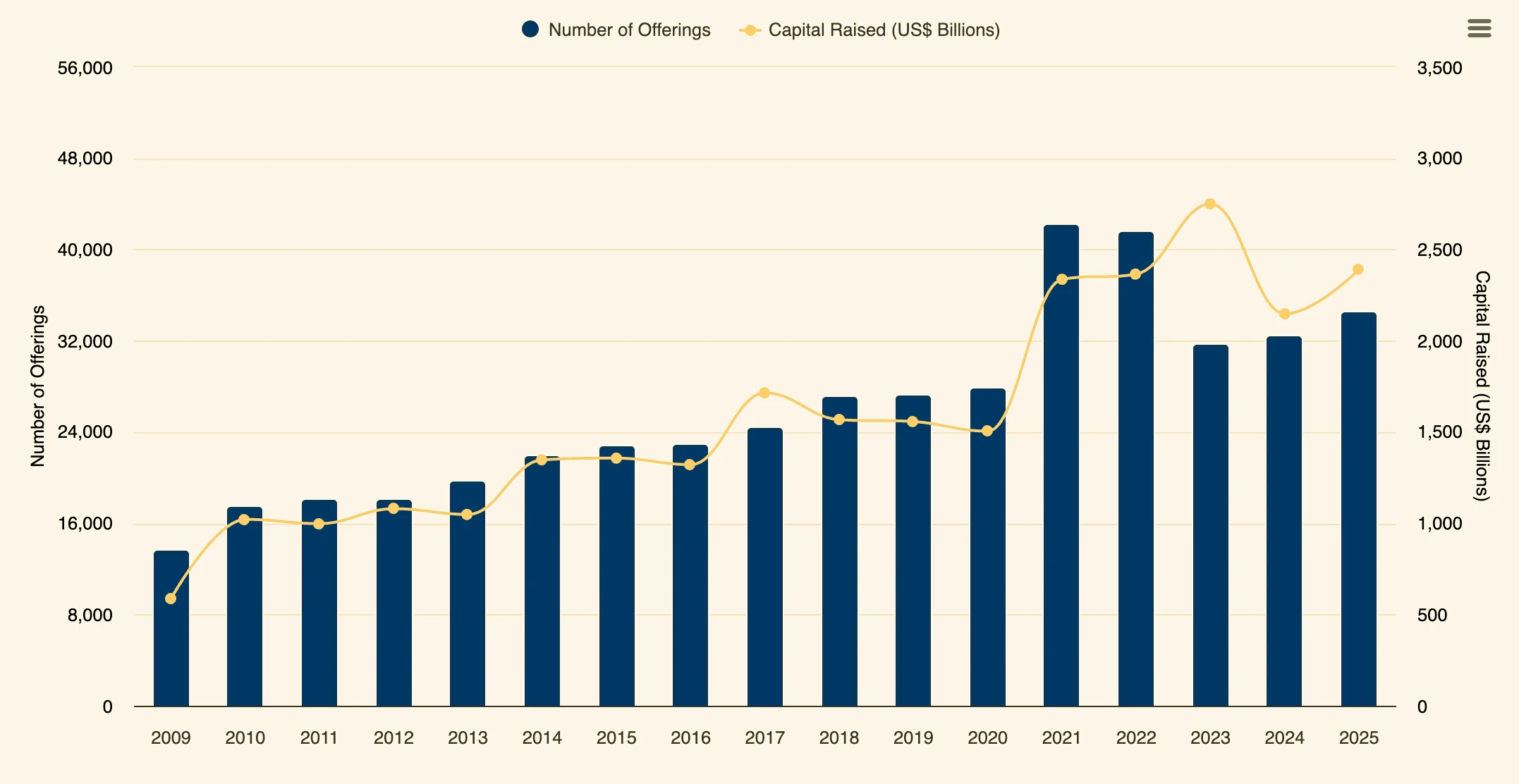
Startup finance was designed around a small number of informed, contractually protected participants. Founders, employees, angels and venture funds could tolerate long holding periods, negotiate information rights and absorb the cost of diligence. Private-placement rules reinforced that structure. In the United States, most venture rounds rely on exemptions from public registration, while access has often turned on accredited-investor status. The broader Regulation D market, which includes funds and established issuers as well as startups, recorded 34,553 offerings and $2.4 trillion of capital raised in 2025, according to the SEC’s latest market data.
Regulation D Offerings: Number of Offerings and Capital Raised
Adding thousands of smaller participants to an individual startup round still creates practical costs across cap-table administration, communications, consents and investor relations.
The tradeoff became more consequential as companies accumulated greater scale before entering public markets. Under its updated reporting-issuer methodology, the SEC counted 3,714 US-domiciled exchange-listed companies in calendar 2025 and 3,600 during the rolling four-quarter period ending in the first quarter of 2026.
Number of Reporting Issuers by Calendar Year (2004 - 2025)
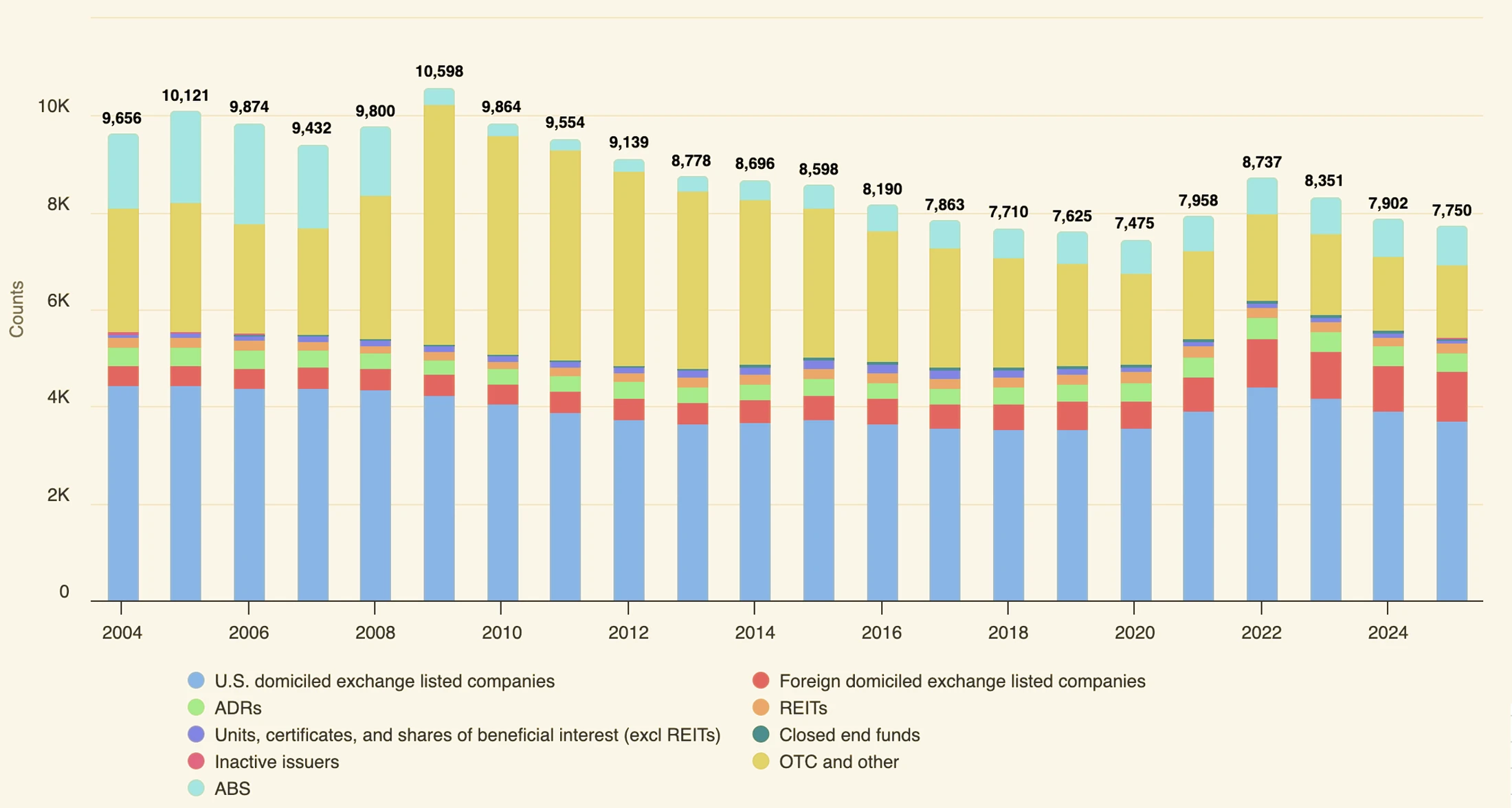
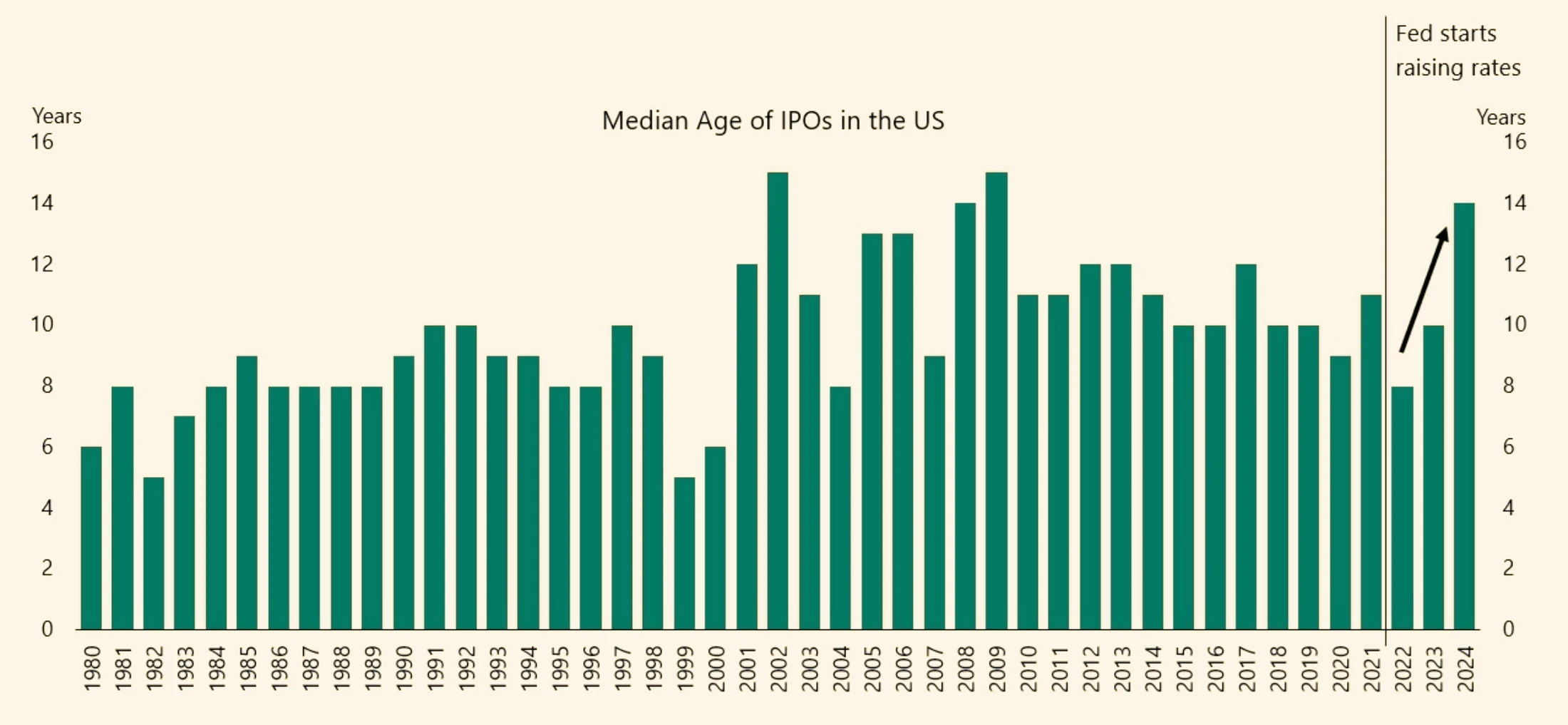
These figures are not directly comparable with older CRSP series that used a broader definition of public companies, but they provide the latest official snapshot. Morningstar and PitchBook estimate that the median age of private companies reaching an IPO increased from 6.9 years in 2014 to approximately 11 years by early 2026. Apollo, using a different Jay Ritter dataset, puts the current median at 14 years. The precise estimate depends on the sample, but the capital-market consequence is consistent: more operating growth and valuation formation can occur before a public listing.
The median age of companies going public: Currently 14 years (Source: Apollo)
Private secondaries, tenders and employee-liquidity programs have expanded in response. Startups using Carta conducted 396 tender offers in 2025, 62% more than in 2024, while almost 20% involved companies at Series E or later. Yet Carta still characterizes IPO and liquidity conditions as challenging. Tenders provide controlled liquidity windows, not continuous trading or open price discovery.
Equity crowdfunding offered the first durable bridge between private-company ownership and wider participation. Crowdcube and Republic Europe, formerly Seedrs, helped make the United Kingdom an early center, while Wefunder and Republic developed around US exemptions. Beauhurst estimates that 2,514 UK companies completed 4,254 rounds involving equity-crowdfunding platforms between 2014 and 2024. In 2024 alone, 297 such rounds raised £324 million, down from 569 rounds and £773 million at the 2021 peak. These totals measure entire rounds involving a crowdfunding platform, not only capital contributed by retail participants. The median crowdfunding round was £500,000 in 2024, compared with £1.72 million for rounds involving private-equity or venture-capital firms. Beauhurst’s data therefore show both the model’s reach and its continued concentration in smaller financings.
The European Union subsequently created a common authorization and cross-border passport under the European Crowdfunding Service Providers Regulation. The first comprehensive post-implementation dataset found that 181 active providers raised €4.25 billion across 21 member states in 2024. Equity represented 12% of that total, while loan-based and debt-based projects accounted for most activity; 88% of participating investors were classified as retail. ESMA’s 2025 market report shows that the regulatory passport expanded the addressable market, but did not turn crowdfunding primarily into an equity market.
In the United States, Regulation Crowdfunding became effective in 2016. By December 31, 2025, issuers had initiated 9,461 non-withdrawn offerings. Of these, 4,303 reported proceeds totaling $1.546 billion, with an average reported raise of $359,000. The SEC notes that reported proceeds are likely a lower-bound estimate because some completed offerings did not file sufficiently detailed progress reports. These are the latest available SEC statistics.
Current Regulation Crowdfunding rules allow an issuer to raise up to $5 million over a rolling 12-month period, require transactions to pass through a registered broker-dealer or funding portal, impose purchase limits on non-accredited investors and generally restrict resales for one year. The SEC’s current overview captures the central compromise: participation can be broad at issuance, while transferability and secondary liquidity remain constrained.
Platforms have used nominee and crowdfunding-vehicle structures to prevent thousands of participants from appearing directly on an issuer’s cap table. That improves administration, but does not eliminate reporting obligations, investor communications or coordination with subsequent institutional rounds. Bulletin boards, private transfers and periodic secondary windows can facilitate liquidity without becoming continuous markets.
Monzo captured both the appeal and the limits of the model. In 2016, the digital bank raised £1 million in 96 seconds, according to its own retrospective. Nearly 2,000 Crowdcube members participated at a reported £29 million valuation. Monzo repeated the model in December 2018, raising £20 million from 36,000 customers as part of a wider institutionally led financing; after the round opened to new participants, the remaining capacity was filled in under three hours.
The company subsequently demonstrated how much operating scale could accumulate before a public listing. For the financial year ending in 2026, Monzo reported 15.2 million customers and £1.7 billion of revenue, up from £880 million two years earlier. Its most recent confirmed private-market pricing event was an October 2024 employee secondary sale that valued the bank at £4.5 billion, or approximately $5.9 billion. The transaction provided real liquidity to participating employees, but only through a controlled window involving selected investors. Monzo’s operating data and the secondary-sale terms reported by Reuters illustrate the distinction.
Communities demonstrated that they wanted access to companies they already used. Ownership expanded, and secondary mechanisms improved, but continuous liquidity and continuous price discovery did not.
2. The Liquidity Gap and the ICOs
Crowdfunding changed who could enter a round, not the private security's lifecycle. Transfers still depended on law, company approvals, platform arrangements and willing counterparties. Nominee structures simplified cap tables but added an intermediary. New rounds, tenders and controlled secondaries provided episodic reference prices, not a continuous market.
The growth of venture secondaries is evidence of demand, not proof that the gap has closed. Carta, citing PitchBook, estimated $61.1 billion of VC secondary volume in the 12 months through June 2025, versus $58.8 billion for VC-backed IPOs. Yet direct deals remain bespoke and information-intensive. A larger release valve is still not a public order book.
Crowdfunding proved that communities wanted access to startup ownership. Crypto asked a more radical question: what if the asset could be globally distributed and liquid from the beginning?
The 2016 to 2018 ICO cycle was the first large-scale test. One widely cited PwC and Crypto Valley Association dataset counted 552 ICOs raising $7.0 billion in 2017, then 537 raising $13.7 billion in the first half of 2018 alone. A broader academic compilation estimated $21.6 billion for all of 2018. The difference is methodological: databases varied in coverage dates, treatment of ongoing sales, currencies and inclusion of very large offerings. Internet-native issuance nonetheless became a market measured in tens of billions of dollars within two years. The World Federation of Exchanges and Small Business Economics provide the respective series.
The largest launches demonstrated the mechanism's reach. Protocol Labs reported a $205 million Filecoin sale on CoinList in 2017 using SAFTs. Block.one's EOS sale ran for a year and raised what the SEC later described as several billion dollars globally. These sales could aggregate participants across jurisdictions, settle programmatically and support exchange trading soon after distribution.
Those were genuine capital-market advances. ICOs combined fundraising, network distribution and prospective product use in a single digital instrument. They also reduced geographic coordination costs and gave communities a direct economic role before a conventional exit.
For allocators, however, liquidity compressed several risks rather than resolving them. A quoted token price could update continuously while the treasury, software rights and operating entity remained opaque. Participants had to underwrite technology, legal perimeter, supply, governance and management incentives separately, often without the contractual protections or reporting cadence of a venture round.
But the token often floated above an incomplete organization. Disclosure ranged from detailed technical papers to little more than a narrative. Treasury controls were frequently discretionary. Legal responsibility could be divided among a foundation, a software company and pseudonymous contributors, while intellectual property and revenue remained elsewhere. Token voting did not necessarily govern the operating entity, and liquid prices could reward promotion long before delivery. Regulators also rejected the idea that a token label displaced securities law. The OECD's assessment identified information asymmetry, governance, cybersecurity and regulatory treatment as central constraints.
The first ICO era was therefore neither a failed idea nor a complete market. It solved distribution and settlement before it solved the organization being financed.
3. Rebuilding Structured Public Token Distribution
The market's response was to reintroduce intermediation selectively. Private token rounds and SAFTs separated early financing from network launch. Exchange launchpads added account verification, issuer screening and distribution. Community sales introduced lockups, vesting, wallet caps, lotteries and contribution scoring. KYC, sanctions checks and jurisdictional exclusions narrowed access, but made the actual perimeter more explicit.
CoinList was the clearest bridge between ICO-era openness and structured distribution. It began with the Filecoin SAFT, later supported auctions and community sales for networks including Solana, Celo, Flow and Mina, and combined issuance with custody, staking and trading. CoinList now reports more than $1.2 billion raised across more than 85 completed raises on its current platform. Its formats were not uniform: fixed-price sales, auctions, community allocations and different lockups could be matched to a project's distribution objective.
That model improved process but did not make every round public. A verified-account sale may exclude jurisdictions. A community round may reserve supply for prior users. A private Echo group may admit only qualified participants. A sale can have thousands of purchasers while remaining gated.
Nor did structure guarantee operating quality. Vesting could slow supply, identity checks could define eligibility and allocation rules could reduce concentration, but none proved product-market fit. The intermediary improved issuance discipline while reintroducing discretion over which projects and participants entered the market.
The distinction matters in the current revival. Coinbase acquired Echo in October 2025 for approximately $375 million in cash and stock. Echo's Sonar product supported issuer-hosted public sales, while its private groups served qualified participants. Coinbase framed the transaction as part of a stack spanning creation, fundraising and secondary trading.
Coinbase Token Sales then brought verified-account distribution back to US users for the first time since 2018. Monad's November 2025 sale drew 85,800 participants in 70 countries and $269 million of commitments. Commitments are demand indications, not the same as proceeds raised. Allocation used a "filling up from the bottom" algorithm that first satisfied smaller requests, while unused USDC was returned. Participants needed a verified Coinbase account in a supported country, and rapid post-sale disposals could reduce future allocations.
Kraken Launch, introduced with Legion in September 2025, applies another filter. Legion's reputation system evaluates social, developer and onchain activity for merit-based allocations, with remaining supply distributed through sale-specific rules. By August 10, 2026, Kraken listed YieldBasis, Sport.Fun and Squid as completed. Kraken's live page confirms their status, while its launch announcement describes the combined exchange and Legion model.
The structural change is not "ICO 2.0." It is the conversion of an undifferentiated public sale into a configurable process with identity, eligibility, allocation, vesting and disclosure layers. Openness is becoming a design parameter rather than a binary label.
4. Auctions Move Price Discovery Inside the Round
Traditional venture rounds usually establish valuation through negotiation among a founder, a lead investor and a limited syndicate. Wider participants accept that negotiated price. Onchain auctions can move price formation into the fundraising mechanism itself.
Uniswap's Continuous Clearing Auction (CCA) is a multi-period auction. Each bid specifies a budget and a maximum acceptable token price. Supply is released gradually across the auction window. At each clearing moment, the available tranche goes first to bids with the highest maximum prices, and successful bids at that moment clear at the same price. Unfilled supply rolls forward. A bid stops filling once the clearing price exceeds its maximum, and unused budget is refundable.
This is not a conventional uniform-price auction in which every successful participant necessarily pays one final price. The clearing price can change across moments, so a participant's average execution price depends on when the bid was active and filled. The final discovered price then informs the post-auction liquidity strategy. Uniswap's launchpad can use proceeds and a token allocation to initialize a Uniswap v4 pool, connecting price discovery to a live secondary market. The Uniswap documentation describes these as composable auction, distribution and liquidity functions.
The bid ceiling reveals a reservation price, while the budget limits capital at risk. Together, the orders form a demand schedule that can be audited after the round rather than reconstructed from private negotiations.
Aztec provided the strongest completed test. Its contributor track began accepting bids in November 2025, while verified public bidding ran from December 2 to 6 under the official sale terms. The auction used ZKPassport and Predicate for identity and sanctions screening, so "public" did not mean ungated or jurisdiction-free. Uniswap reports that the sale raised $59 million from approximately 17,000 bidders verified across 191 countries. Those are issuer and Uniswap-reported results, not an independent judgment that the clearing price represented fair value.
The mechanism reduces first-come races and last-second sniping, exposes parameters onchain and creates an auditable demand curve. It does not eliminate concentrated bidding, strategic maximum prices, identity constraints or post-migration volatility. Its output is a market-clearing price under defined rules, not a fundamental valuation.
Price discovery itself is becoming programmable capital-market infrastructure.
5. From Programmable Fundraising to the Programmable Venture
Fundraising is one event in a much longer institutional system. A conventional venture uses separate providers and documents for its legal entity, financing, cap table, bank accounts, treasury controls, board decisions, secondary transfers and eventual exit. Crypto initially connected issuance and liquidity, but often left the rest fragmented.
The emerging onchain stack can be mapped as:
venture setup → fundraising & price discovery → distribution → liquidity → treasury → governance
This is a functional map, not necessarily a strict transaction chronology. Formation, distribution, treasury funding and liquidity migration can occur together at settlement, while governance persists after it.
For participants and professional allocators, integration may produce observable treasury flows, market prices, earlier transferability and explicit capital-allocation procedures. For founders, it may reduce handoffs among disconnected systems and automate settlement, vesting and routine treasury operations. Auctions could reduce the lead investor's role in initial price setting without eliminating the functions that sophisticated investors perform: diligence, signaling, strategic support, governance and follow-on capital.
The analytical unit also changes. A venture may contain legal equity or corporate interests, a liquid token, treasury rules, governance markets and contracts with an operating team. These layers may overlap economically without being interchangeable. VCs and liquid funds will need to underwrite distribution, circulating supply, vesting, liquidity formation, treasury permissions, governance-market depth and legal execution alongside product and team quality.
The risks are equally integrated. Liquid prices can pull management toward short horizons. Thin conditional markets can amplify manipulation. Public distribution can worsen adverse selection when disclosure is weak. Smart contracts introduce technical failure modes, while employees, intellectual property, banking and regulated counterparties remain subject to legal authority. Equity and token conflicts may become more visible, not less.
This is an institutional experiment, not a proven replacement for venture capital. Projects will choose among traditional venture financing, community equity, private token rounds, public sales, auctions and hybrids according to their regulatory perimeter, network design and need for active community distribution.
6. Futarchy and MetaDAO
Programmable fundraising asks markets to price an issuance. Futarchy asks whether markets can also inform strategy. Robin Hanson's shorthand is: "Vote on values, but bet on beliefs". An organization first defines the objective it cares about. Traders then price an asset conditional on alternative decisions, putting capital behind forecasts rather than recording preferences alone.
For a token project, consider a proposal to change fees. One market trades the token as if the proposal passes; another trades it as if the proposal fails. If the pass market persistently prices the token above the fail market, participants are collectively forecasting a more favorable outcome under adoption. The crucial word is conditional. These are not ordinary prediction markets about an external event; the market result helps determine which event occurs.
That design also narrows the objective. A token-price comparison can aggregate beliefs about token value, but it may not capture employee retention, regulatory risk or long-duration research unless traders expect those effects to reach price. Choosing the measured objective remains a governance decision outside the market itself.
The limits of this delegation are examined in Can Markets Govern Companies?, including manipulation risks, the difference between signals and authority, and the legal arrangements required to turn a market outcome into company action.
MetaDAO has turned that concept into live governance on Solana. Its standard proposal model is binary. A proposal creates a pass market and a fail market. Prices feed lagged time-weighted averages, or TWAPs, rather than resolving from a manipulable final trade. Team-sponsored and external proposals use different thresholds, and organizations can configure their rules. The pass and fail TWAPs determine whether execution proceeds. MetaDAO's finalization documentation explains the lag and thresholds.
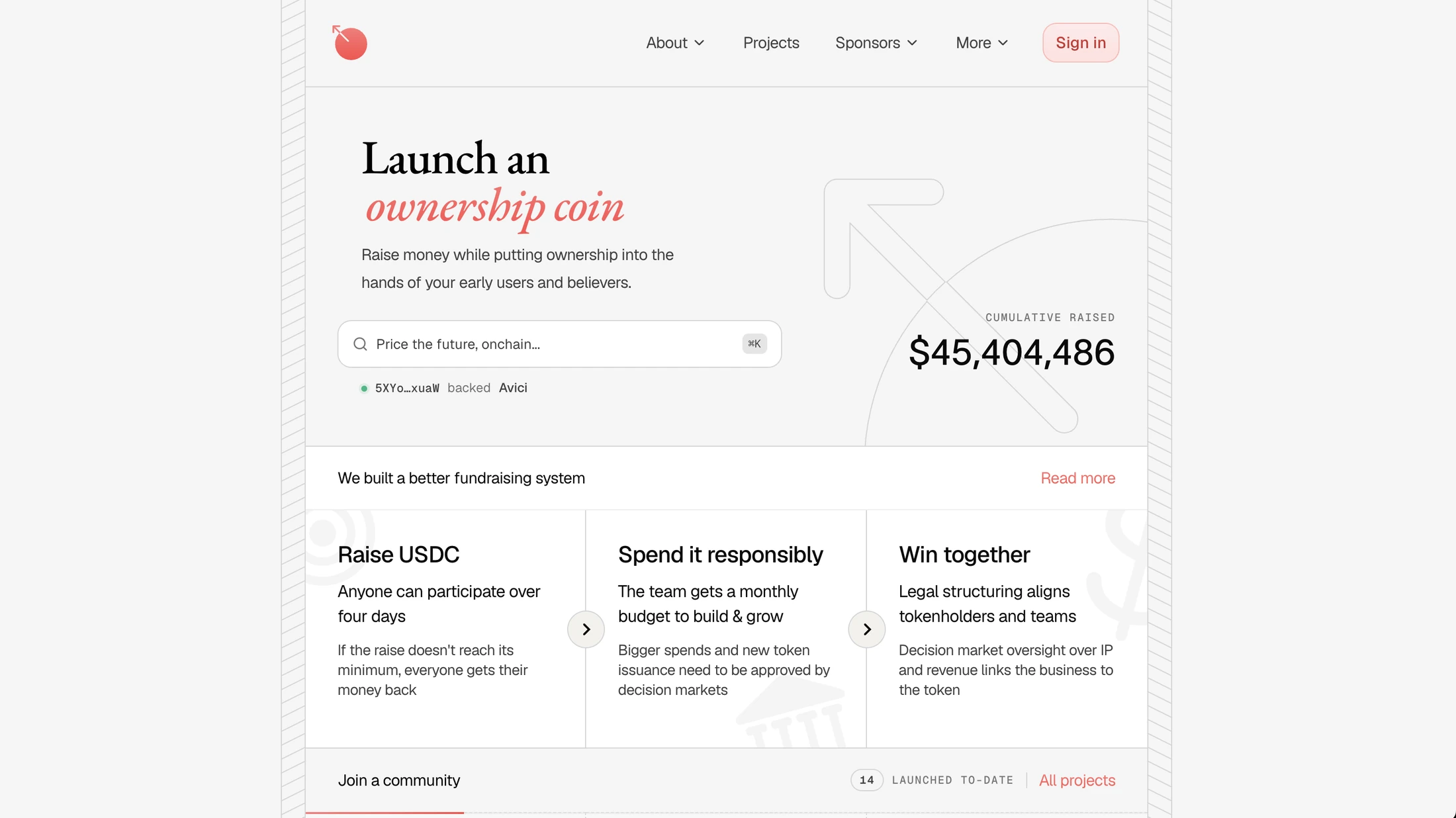
This has moved beyond a laboratory. MetaDAO reported $45.4 million of cumulative capital raised as of Mid-August 2026. Its documentation records 96 proposals for 14 organizations since November 2023, including decisions for Jito, Flash and Sanctum. The activity data show live coordination, though proposal count does not establish decision quality.
MetaDAO is therefore category-validating, not a foil for later systems. It demonstrates that fundraising, locked treasury rules and binary decision markets can coexist. Its open questions are the ones institutional allocators should care about: how much informed capital enters each proposal, how concentrated the traders are, whether lagged TWAPs resist manipulation, and whether the selected actions improve operating performance. Market governance becomes an empirical variable rather than a governance philosophy.
7. Umia: Integrating Auctions, Treasury and Multi-Outcome Governance
Umia is an EVM-native operating stack for token-native ventures, incubated by Chainbound. It combines formation, Tailored Auctions, a noncustodial treasury and decision-market governance by design. Umia is the platform and protocol; UMIA is its protocol token and planned first live demonstration.
Why Umia
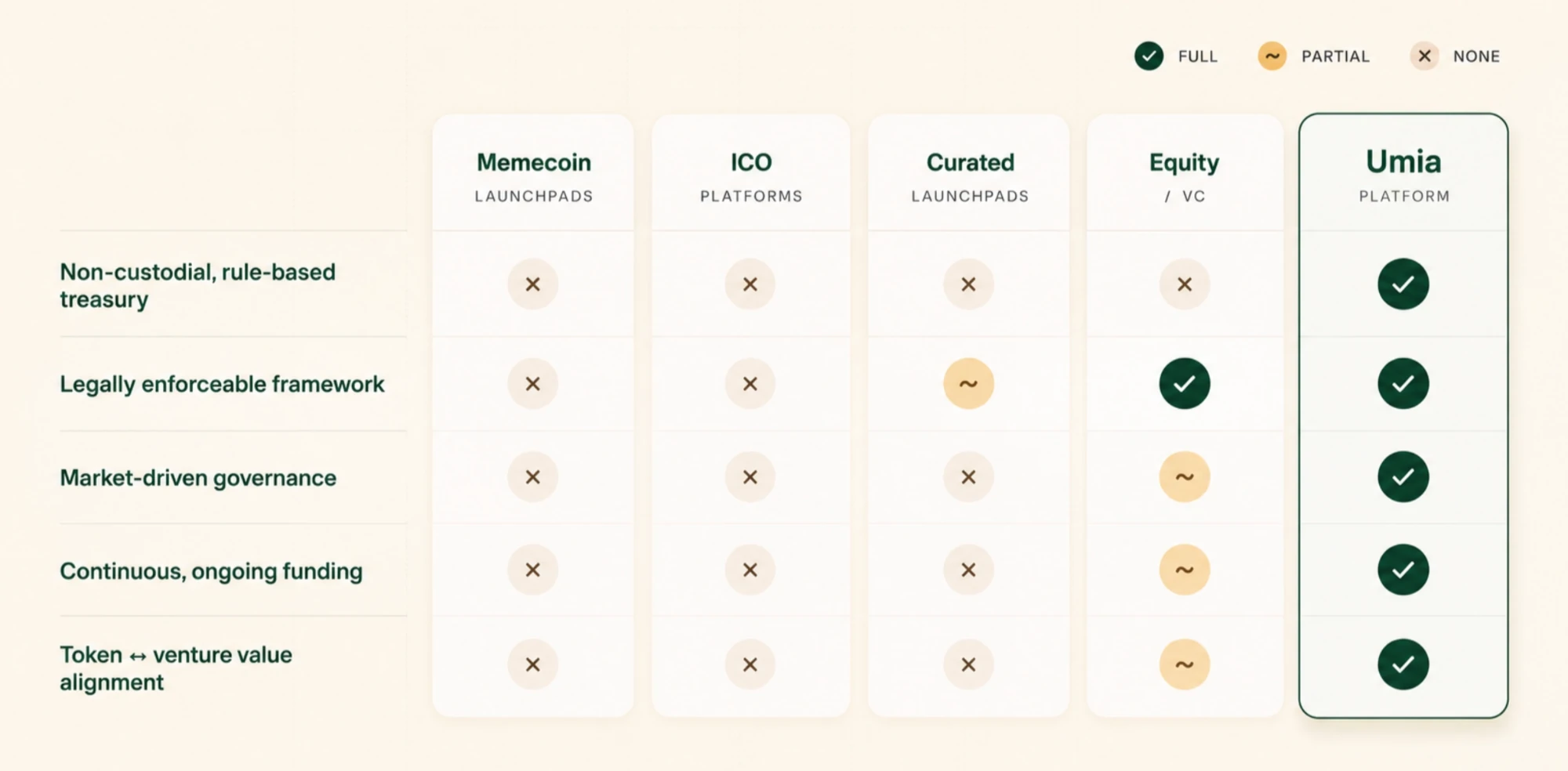
Tailored Auctions are Umia's own configuration of Uniswap's Continuous Clearing Auction. A launch can configure buckets or steps, optional gated stages, zkTLS or allowlist eligibility, wallet caps, supply by stage, price bounds, bidding currency and a minimum-proceeds graduation threshold. At graduation, cleared funds are designed to enter the project treasury and seed a treasury-held Uniswap v4 position. Formation and IP assignment can occur around that settlement. If the threshold is missed, commitments become refundable and, under Umia's documentation, formation and IP assignment do not proceed. Eligibility applies only to the configured bucket; final restrictions depend on each launch's terms.
The new venture playbook
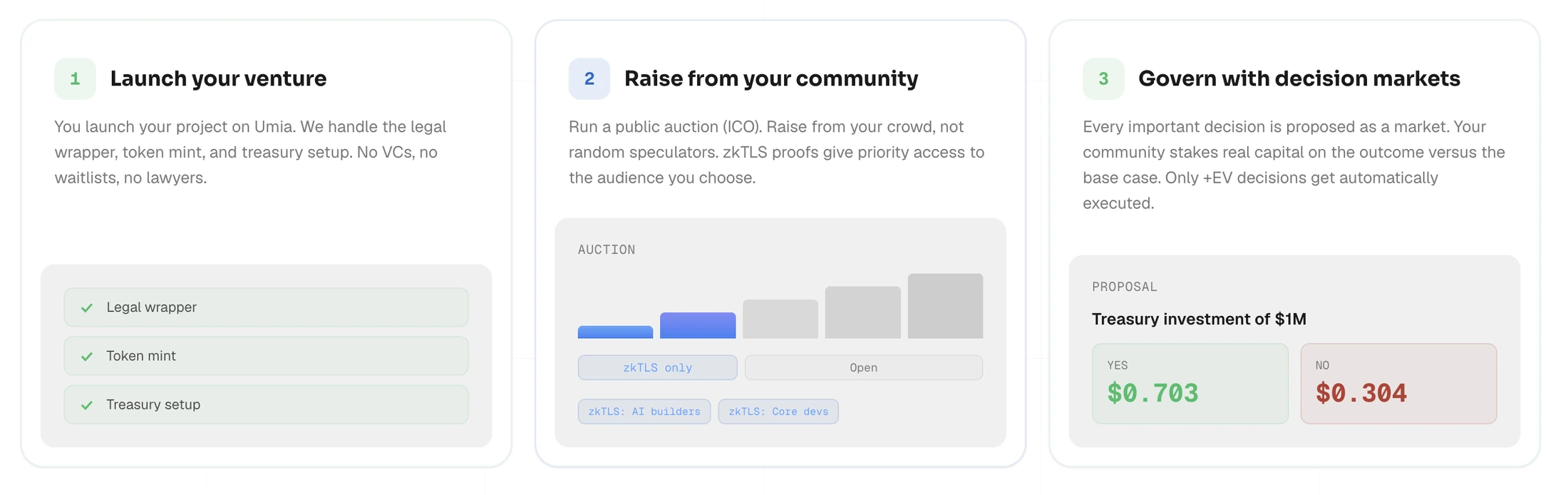
Auction proceeds are intended to enter a treasury contract, not a team wallet. The operating team receives a predefined monthly operating allowance. Preconfigured transfers, vesting and other schedules can execute under established rules, but new discretionary spending beyond the allowance must go through a decision market. Changes to the allowance, major spending, issuance, strategic actions and liquidation must use the same decision-market process. These are defined treasury paths, not optional alternatives for incremental spending.
Umia also extends futarchic governance beyond MetaDAO's standard binary structure. Suppose a project must choose Strategy A, Strategy B, Strategy C or No-Op. Each outcome receives its own conditional market. Participants receive or trade conditional versions associated with all possible outcomes, and each market generates a TWAP. At resolution, the highest-TWAP actionable strategy must exceed No-Op by the project's configured threshold. If none does, the status quo remains. Resolved outcomes are designed to trigger onchain execution where possible and direct offchain action through the governing arrangements. This is a move from pass-versus-fail evaluation toward multi-option strategy, not proof that one form produces better decisions. The mechanism and early safeguards are documented here.
Each venture is intended as a segregated portfolio within Umia Launcher SPC, using a MetaLeX BORG-based structure. Umia Launcher SPC remains the single legal entity; a portfolio is not a separate legal person. Portfolio assets and liabilities must be separately identifiable and segregated from other portfolios, subject to the articles and applicable law. Sections 216 and 219 to 221 of the Cayman Companies Act 2026 govern this treatment. Umia states that its documents are designed to connect the portfolio, treasury, IP and operating arrangements, and bind the operating team to resolved outcomes. Without operative documents or a legal opinion, enforceability and participant standing remain Umia's stated design, not an independent conclusion.
Umia's testnet concluded on August 11, 2026 with substantial activity across both its auction and governance components. According to Umia, more than 66,344 visitors generated 159,366 auction bids, 96,119 decision-market trades and 9,533 position-settlement claims during the testnet.
https://x.com/umia_finance/status/2087219946040218010
On the Saturday preceding its conclusion, Umia activity accounted for 28.5% of all transactions on Base Sepolia. The figures do not establish production-scale adoption, but they provide an early load test across the auction, conditional-market and settlement flows that the protocol intends to carry into mainnet.
The system is not intervention-free. Public security documentation discloses temporary proposal approval or relay and an emergency veto intended for exploits during the early phase. As of August 10, 2026, testnet is live; based on current team guidance, mainnet is expected shortly before the first live auction. The UMIA Tailored Auction is currently scheduled for the end of August 2026, with exact timing still to be confirmed.
8. Conclusion
The programmable public venture is now specific enough to test. The relevant questions are measurable.
Price discovery. Do broad auctions generate more informative initial prices than negotiated rounds, or different momentum? Investors should measure bidder concentration, execution by wallet cohort, post-migration depth and price stability. A transparent auction with concentrated demand may be less representative than its participant count suggests.
Distribution and liquidity. Does wider participation improve adoption, developer activity or network growth, or merely distribute speculative supply? Earlier liquidity can improve risk transfer and let liquid funds participate nearer formation. It can also shorten management horizons and turn operating decisions into price events.
Treasury discipline. Can teams operate under a predefined monthly allowance? Track incremental requests, decision time, approvals and subsequent operating progress. Rejection rates matter only alongside proposal quality. A market that rejects everything may be illiquid or poorly informed, not disciplined.
Governance-market quality. Conditional markets need informed, independent capital. Track depth, concentration, arbitrage, TWAP sensitivity and the cost of crossing a threshold. Multi-outcome governance enriches the choice set but divides liquidity. Compare it with binary evaluation through decision quality, speed and operating results.
Legal execution. Can a resolved market reliably direct employees, IP, contracts, bank accounts and regulated counterparties? How will administrators, courts and counterparties interpret the documents? Segregation and automation may clarify authority without eliminating securities, insolvency, employment or cross-border risk.
Scale and dependence. A design that works for a handful of launches may not work for hundreds. Identify dependence on operators, legal administrators, oracles, keepers, multisigs and temporary controls. Audits reduce some risks; they do not remove attacks, exploits or operational concentration.
For professional allocators, the opportunity set is converging. Liquid funds may enter earlier; venture funds may underwrite distribution and treasury architecture alongside company-building risk. Lead investors may have less price-setting power while retaining roles in diligence, signaling, governance and follow-on financing. The financing choice becomes part of strategy.
The historical arc is visible. Equity crowdfunding expanded access but retained private-market illiquidity. ICOs introduced global distribution and early liquidity but often lacked organizational alignment. Structured platforms rebuilt allocation, verification and vesting. Auctions are making price discovery programmable; MetaDAO is testing market-based governance; Umia is attempting to integrate auctions, treasury rules, multi-outcome markets and legal operating arrangements on EVM infrastructure.
None of this establishes that markets make better decisions, that auctions discover fair value or that venture capital will move fully onchain. It establishes something narrower: the infrastructure is sufficiently developed to face live-market testing. What happens if startup formation, public markets and strategic governance begin to converge within the same programmable system?
Sources
- US SEC: Regulation Crowdfunding market data through 2024 and issuer guidance
- UK government: Public Offers and Admissions to Trading impact assessment
- Monzo: 2016 and 2018 crowdfunding metrics and Tech.eu: early participant and valuation context
- Carta: VC secondary-market activity through June 2025
- World Federation of Exchanges: 2017 and first-half 2018 ICO data and OECD: ICOs for SME financing
- CoinList: current platform statistics and historical distribution cases
- Coinbase: Echo acquisition and Token Sales mechanics and Monad data
- Kraken: Launch activity and Legion partnership mechanics
- Uniswap: CCA documentation, Aztec results and Aztec auction terms
- Robin Hanson: Futarchy and MetaDAO: governance overview, TWAP rules and current cumulative fundraising
- Umia documentation: overview, Tailored Auctions, decision markets, treasury, legal framework and security
- Cayman Islands Companies Act, 2026 Revision
- umia.finance
Cover Artwork

The Chess Players
Thomas Eakins, c. 1876
Risk Disclaimer
insights4vc provides independent research based primarily on publicly available information believed to be reliable at the time of publication. Figures may change because of market prices, token supply, reclassification and methodology updates. Legal structures, investor rights and regulatory treatment vary by product and jurisdiction.
This article does not constitute investment, legal, tax, accounting or financial advice, or an offer, solicitation or recommendation regarding any security, token, fund interest or other asset. insights4vc makes no representation regarding the completeness or accuracy of third-party data. Readers should conduct independent due diligence and consult appropriately qualified advisers before making investment or business decisions.
Published by the insights4vc research team. See our research methodology, source standards and corrections policy. Dates and measurement periods are stated in each analysis.