Key Statistics
- RWA.xyz showed $1.888 billion of distributed tokenized-stock value on July 27, 2026, according to the report's asset-level export.
- The October 3, 2026 dashboard reading reached $3.22 billion; the report distinguishes this later snapshot from the July baseline.
Figures and examples retain the report's original period, scope and source definitions. Consult the analysis and references below before making comparisons.
What changed in RWA tokenization in 2026?
RWA.xyz showed $3.22 billion of distributed tokenized-stock value on October 3, 2026. That figure combines exposures with different legal rights and does not measure net investor inflows. The original July analysis below explains the distinction between direct ownership, structured notes and derivative wrappers, and why transferability alone does not establish deep liquidity or independent price discovery.
Tokenized stocks: October 3 market snapshot
| Metric | Displayed value | Interpretation |
|---|---|---|
| Distributed value | $3.22B | Value within the dashboard's distributed tokenized-stock universe, including stock and ETF exposure. |
| Represented value | $25.31M | A separate category; it is not additional exchange trading volume. |
| Monthly transfer volume | $12.08B | Token transfers, not necessarily purchases, sales or new investor capital. |
| Monthly active addresses | 348,867 | Address activity; it is not a verified count of individual investors. |
Source: RWA.xyz Tokenized Stocks, displaying an October 3, 2026 observation date. Values are rounded as published. Monthly metrics use the provider's displayed window. These are stock-category figures, not the total RWA or stablecoin market. We do not present the difference from July as net issuance: coverage, classification and asset prices may also change.
The distinction between token ownership and shareholder rights still matters. Ondo's current documentation describes its stock tokens as structured notes issued by a BVI company, with secured claims but no shareholder voting or information rights. The SEC staff's January 2026 taxonomy likewise distinguishes issuer-sponsored securities from third-party custodial and synthetic structures. That staff statement is not a new rule or Commission approval of individual products.
The stock market has not moved onchain. What is emerging instead is a more credible infrastructure layer for distributing securities, recording ownership claims and settling transactions through blockchain-based systems.
RWA.xyz data shows that the value of distributed tokenized stocks nearly doubled, from $951 million in March 2026 to $1.89 billion in July. Most of that growth, however, came from a relatively small group of products and platforms.
The headline figure also brings together instruments with very different legal and economic structures. Some tokens represent issuer-sponsored common stock. Others are structured notes, tracker certificates, custodial entitlements or synthetic exposures. Even one-for-one backing and self-custody do not necessarily give the holder direct shareholder rights.
The most significant progress has come from regulated market infrastructure, particularly Nasdaq’s same-CUSIP settlement model and DTC’s planned commercial rollout. Liquidity, investor distribution and independent onchain price discovery remain limited. Tokenized Treasuries continue to show stronger product-market fit, while equity ETFs may prove easier to scale than individual stocks.
The market is therefore best understood as a divided Tier 2.5 system. Products with the strongest legal foundations tend to have limited liquidity and distribution. More actively traded wrappers generally offer weaker ownership rights.
This report updates insights4vc’s March 2026 analysis, The State of Onchain Real-World Assets, and examines what has materially changed since its publication.
Partner Highlight

At insights4vc, we pay attention to teams building the infrastructure behind emerging market categories.
Umia is developing a new operating model for token-native ventures. The platform brings fundraising, legal formation, treasury management and governance into one integrated system, enabling projects to launch with clearer structures and more accountable decision-making from day one.
To learn more about Umia, contact office@insights4.vc.
What materially changed after March
The March report drew a distinction between assets that are recorded on a blockchain and those that can be transferred to external wallets. That distinction remains important. Under RWA.xyz’s framework, a represented asset stays within the issuer’s or platform’s own environment. A distributed asset can be moved outside it, although transfers may still be restricted to approved or whitelisted wallets.
Transferability alone, however, is no longer enough to judge how mature a product is.
Since March, offshore products have become easier to move across chains and use within decentralized markets. Ondo expanded to Ethereum, BNB Chain and Solana, introduced decentralized routing, and added continuous minting and redemption for a limited number of products. xStocks also broadened its distribution and collateral integrations.
At the same time, regulated U.S. infrastructure moved in a different direction. Its focus has been less on unrestricted portability and more on legal certainty, controlled wallets, regulated custody, transfer-agent records and integration with DTC.
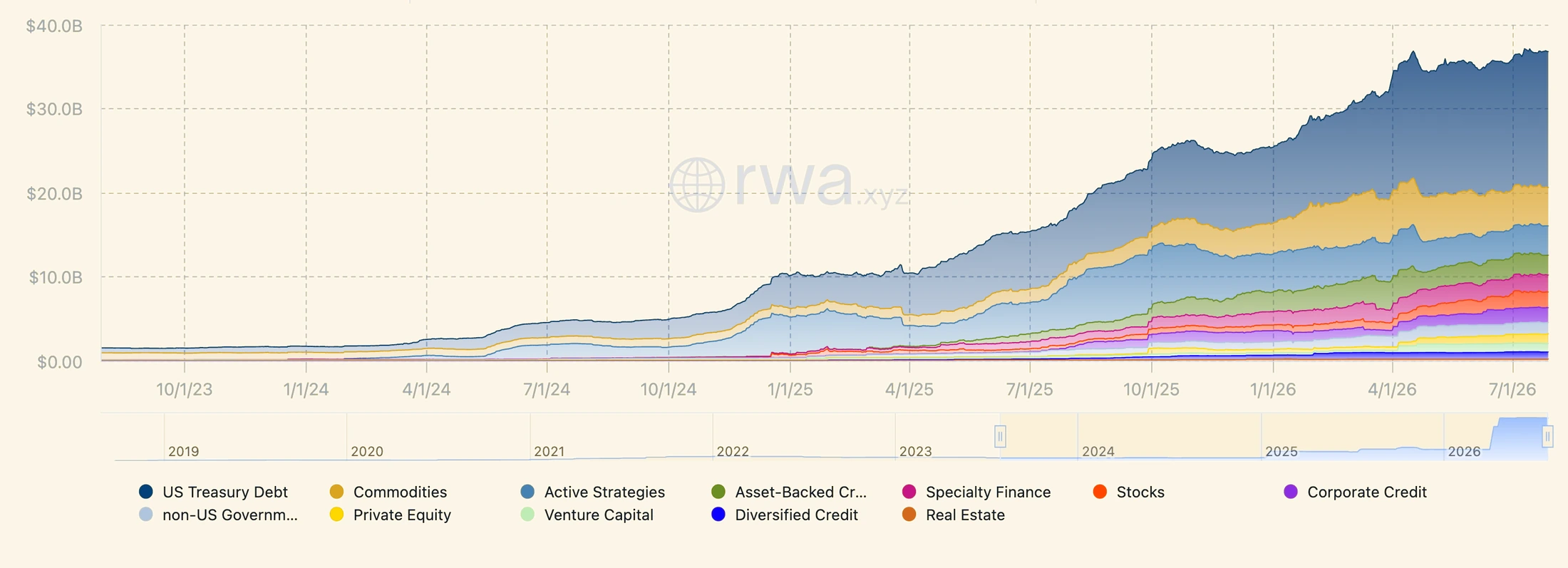
Total RWA Value (Source: RWA.xyz)
The two approaches solve different problems. Offshore wrappers improve access and composability. Regulated infrastructure strengthens the connection between the token and the legal ownership claim.
A canonical share is an issuer-authorized form of the underlying security whose transfer is recognized by the official ownership system. It is different from a third-party instrument created only to track the price or performance of a share.
No product has yet combined all four elements at scale: canonical ownership rights, broad wallet distribution, institutional liquidity and independent onchain price discovery.
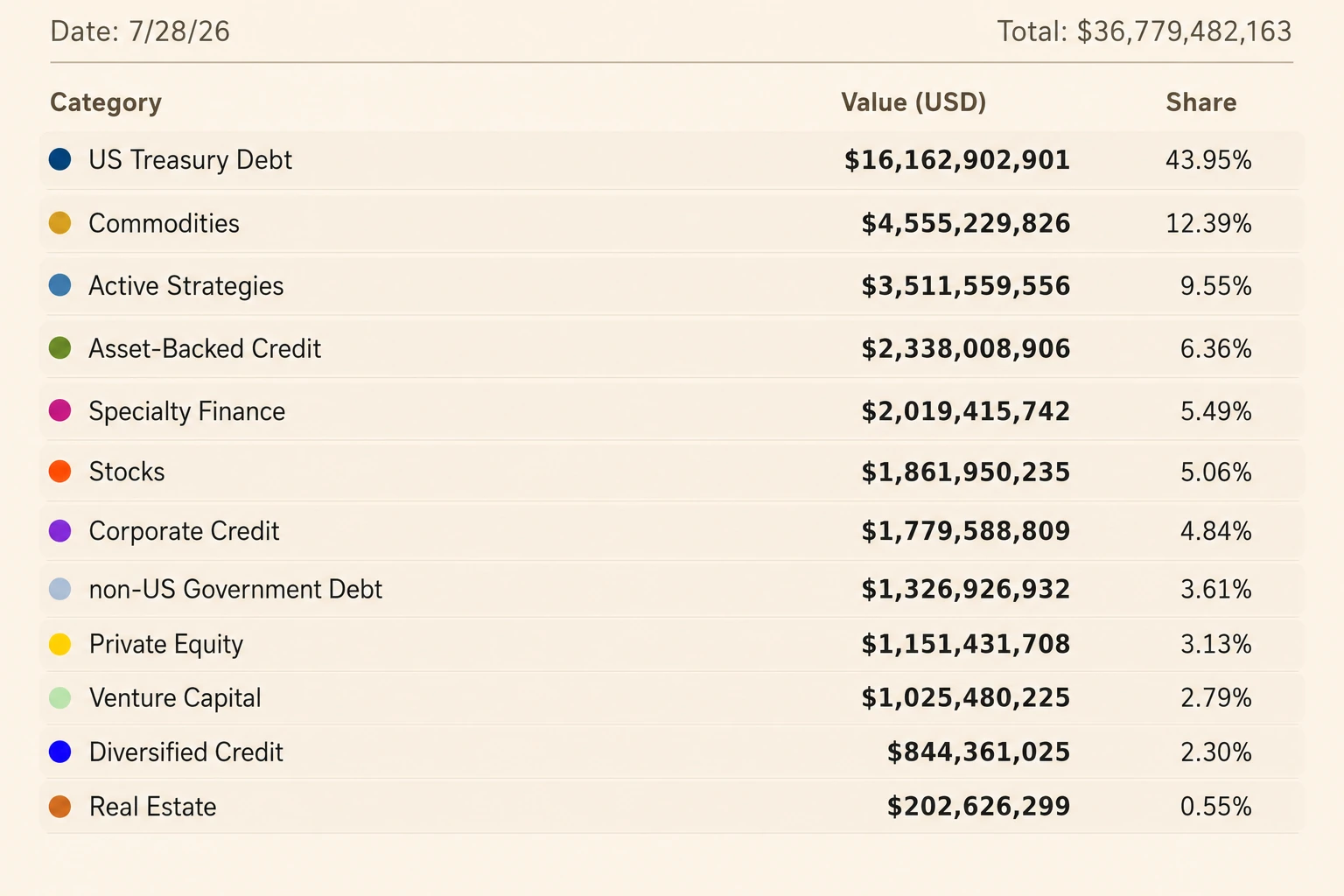
The broader RWA totals should also be interpreted carefully. RWA.xyz reported $36.81 billion of distributed value and $218.27 billion of represented value on 29 July. The apparent $124.33 billion decline in represented value should not be read as an economic outflow or a wave of redemptions. Large datasets were added, removed, reclassified or revalued between the two observation dates.
These figures describe the value of claims covered by the platform’s methodology at a given point in time. They are not a measure of investor flows.
The tokenized-stock series is more useful because the same Bridged Token Value methodology can be applied to both periods. Even here, the reported 98.5% increase cannot be separated cleanly into new issuance, price appreciation and classification changes.
FGRS provides a useful example. Figure completed an offering of 4.375 million blockchain shares at $32 per share, but the reported value later changed with the market price. Without daily data on minting, burning and net asset value for every product, it is not possible to reconstruct market-wide net issuance reliably.
Why the $1.888 billion headline is misleading
RWA.xyz measures tokenized stocks using Bridged Token Value, calculated as bridged circulating supply multiplied by net asset value.
Circulating supply excludes balances identified as treasury holdings or pre-minted inventory. The bridged figure also removes tokens locked in recognized bridge contracts, helping to avoid double counting when an asset is locked on one network and issued on another.
This is a useful measure of distributed value, but it is not the same as free float. Free float refers to the portion of a security that is genuinely available for public trading after restricted, strategic and closely held positions are excluded.
The timing of the data also matters. The supplied asset-level export shows total distributed value of $1,887,902,416 on 27 July, matching the dashboard’s rounded figure of $1.888 billion. Platform and network snapshots taken on 29 July total approximately $1.872 billion.
The $15.8 million difference, equal to 0.84%, is consistent with changes in prices and token supply between the two observation dates. For that reason, instrument-level growth calculations in this report use data from 27 July, while platform and network market shares use the 29 July snapshots. The datasets are not combined within the same calculation.
Leading named instruments by distributed value, 27 July 2026
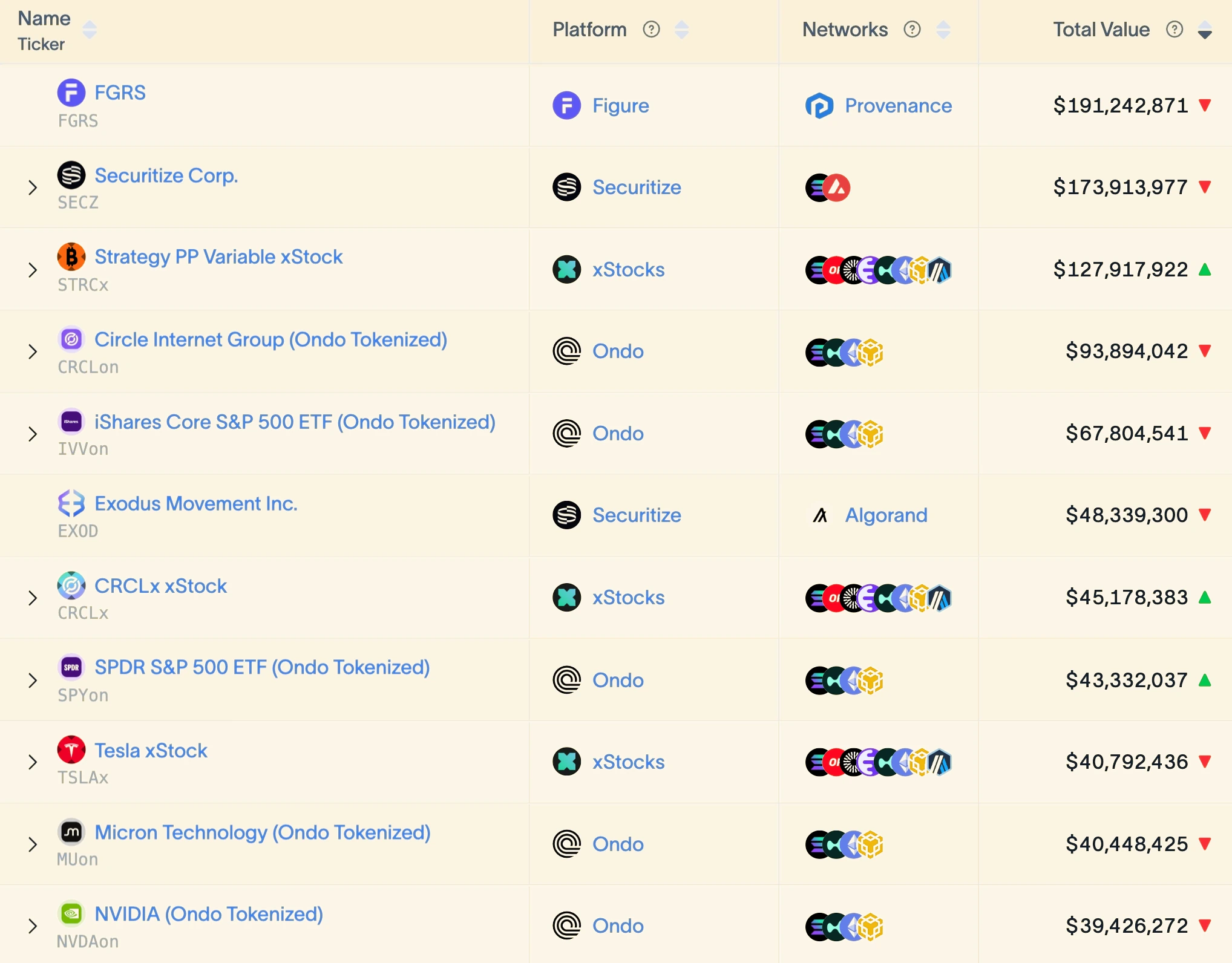
Three named instruments accounted for approximately half of the increase. SECZ added $169.0 million following its listing, FGRS increased by $162.9 million and STRCx added $126.6 million. Together, they contributed $458.6 million, or 49.0%, of the total $936.8 million increase. The aggregated long tail added a further $150.5 million, representing 16.1% of the expansion.
These figures show changes in distributed value, not investor subscriptions.
SECZ is affected by both the number of represented shares and Securitize’s NYSE share price. FGRS reflects a combination of issuance, conversion activity and changes in the market price. STRCx depends on the outstanding supply and value of a certificate linked to Strategy’s variable-rate preferred stock.
Describing all three increases as tokenized-stock inflows would combine several economically different events into a single and potentially misleading figure.
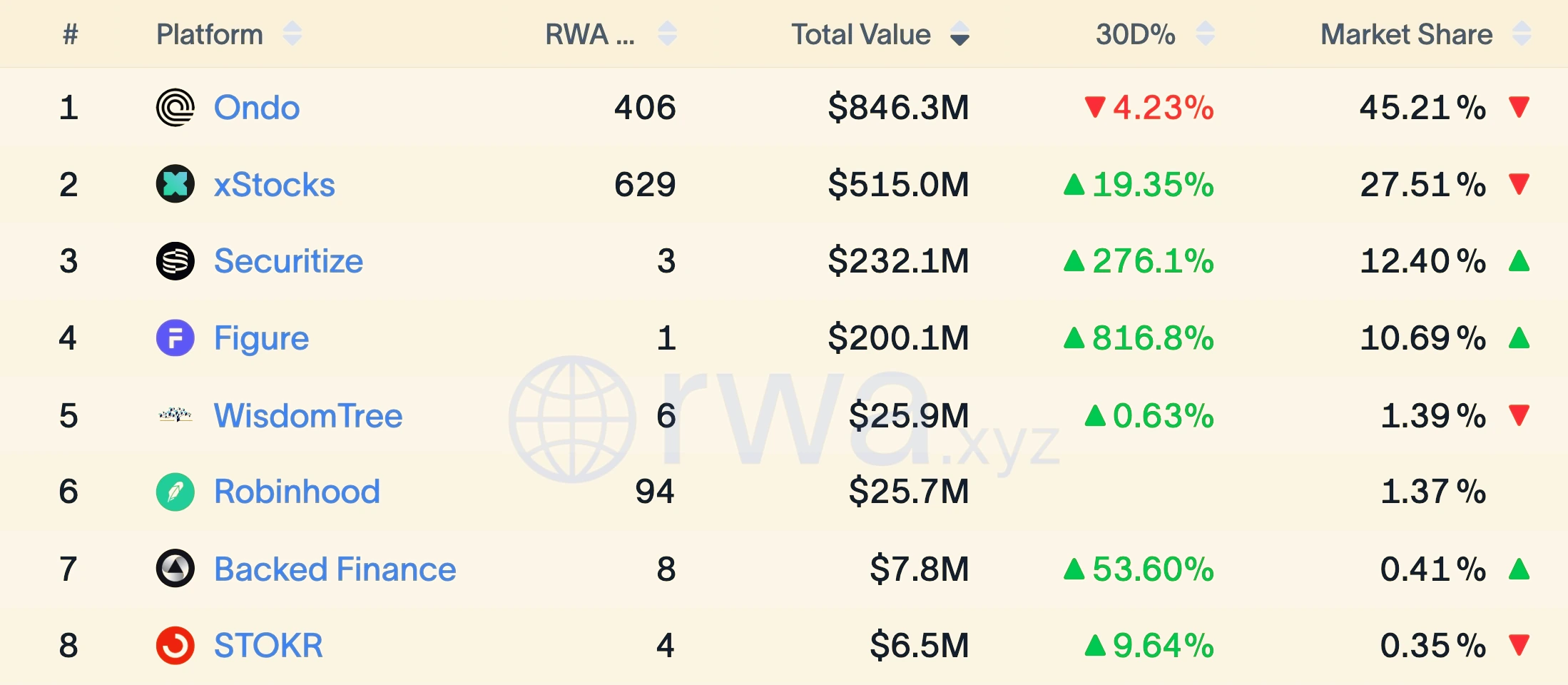
Concentration is even more visible at the platform level. Ondo and xStocks accounted for 72.7% of distributed value in the 29 July snapshot. Including Securitize increased the share held by the three largest platforms to 85.1%.
Platform concentration, 29 July 2026
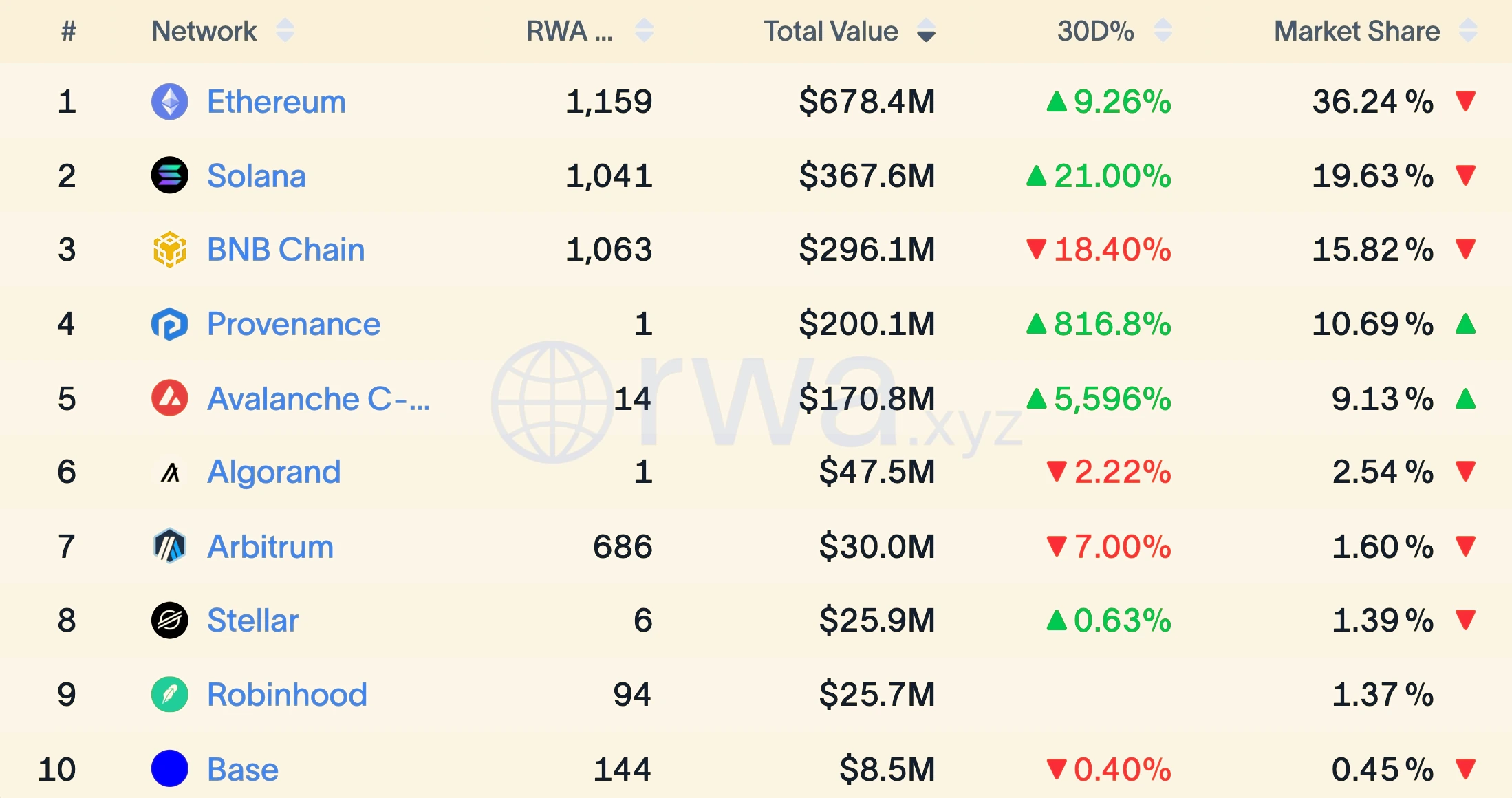
Distribution across blockchain networks is broader, but this does not eliminate common underlying dependencies. Ethereum led with 36.2% of value, followed by Solana at 19.6% and BNB Chain at 15.8%. Provenance and Avalanche were driven largely by Figure and Securitize respectively.
Products issued across different networks may still depend on the same wrapper issuer, broker, custodian, security agent or reference-price provider.
Network concentration, 29 July 2026
The market has become broader without becoming legally uniform. Several tokens can reference Apple shares or an S&P 500 ETF while remaining separate legal liabilities governed by different jurisdictions and dependent on different intermediaries.
Bridge adjustments can prevent the same token from being counted twice across networks. They cannot, and should not, combine products that reference similar assets but provide materially different legal claims.
What investors actually own
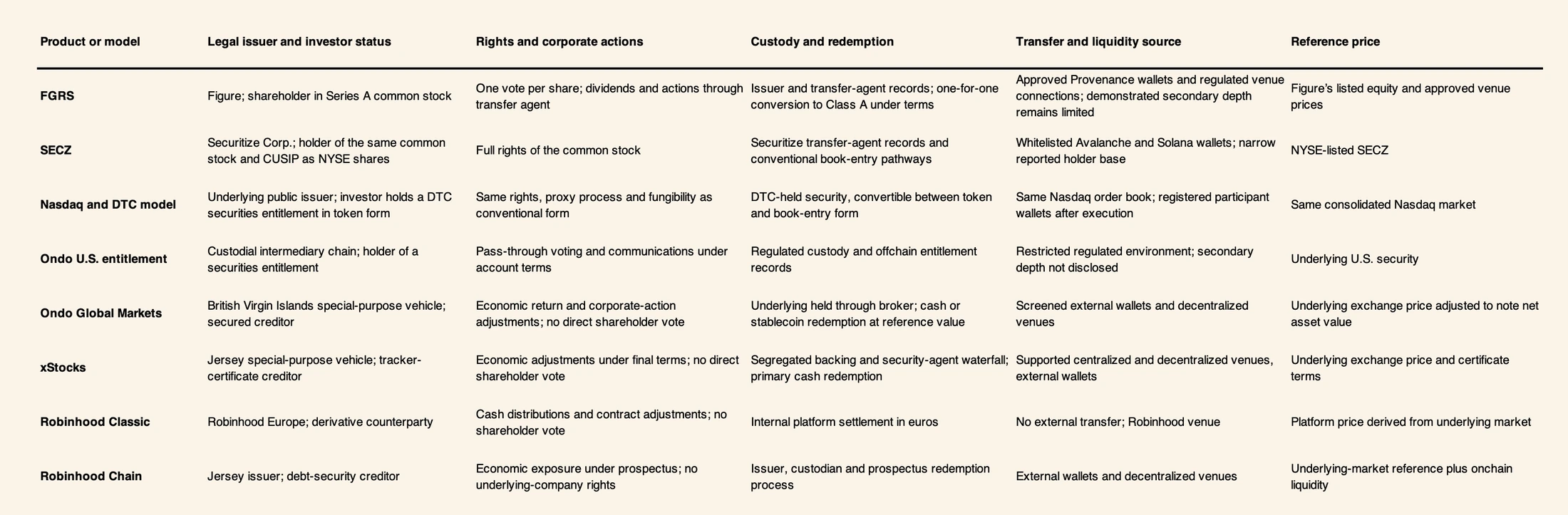
The same underlying stock can support several tokenized products without giving investors the same rights.
The key question is simple: what claim remains if the platform, issuer or intermediary fails?
Issuer-sponsored shares sit closest to conventional equity ownership. Investors remain shareholders, subject to the rights of the relevant share class and the official ownership register. FGRS and SECZ fall broadly into this category, although they use different structures. FGRS is a blockchain-native share class that can convert into Figure’s listed Class A stock under specified conditions. SECZ represents the same Securitize common stock and CUSIP traded on the NYSE.
A securities entitlement is one step removed. The investor holds rights through a broker or custodian rather than appearing directly on the issuer’s register. This is already how most U.S. public equities are held. Tokenization changes the record and transfer process, but not necessarily the investor’s legal position.
Structured notes and tracker certificates are different again. They are debt instruments linked to the performance of another asset. The issuer may hold matching collateral and provide redemption rights, but the tokenholder remains a creditor rather than a shareholder of the referenced company.
Ondo’s offshore products use this structure. The underlying securities are held through a regulated broker, with collateral pledged for tokenholders. Investors receive economic exposure and redemption rights, but not direct voting or information rights in the referenced company.
xStocks follow a similar model. Each token is a tracker certificate issued by a Jersey special-purpose vehicle and backed by asset-specific collateral. The structure provides meaningful protection, but recovery in a default would still depend on the security agent and liquidation process.
Robinhood also uses more than one model. Its Classic Stock Tokens are derivative contracts held within Robinhood Europe. Its transferable Robinhood Chain products are debt securities issued by a separate Jersey entity. Self-custody does not turn either product into direct ownership of the underlying company.
This is the central distinction across the market. A token can be fully backed, transferable and held in a private wallet while still representing an indirect claim.
Investors should therefore look beyond the token itself and ask:
- What legal right does it represent?
- Which ownership record is authoritative?
- Who holds the underlying asset?
- How are dividends, votes and other corporate actions processed?
- What happens if a key intermediary fails?
Self-custody changes control of the wallet. It does not remove the issuer, custodian, broker, transfer agent or special-purpose vehicle from the ownership chain.
Where liquidity and price discovery live
Tokenized stocks recorded $6.12 billion of monthly transfer volume in July, alongside 758,950 holders and 248,774 active addresses. These figures suggest growing use, but they do not show how much genuine trading took place.
Onchain transfer volume includes movements between wallets, exchange deposits, collateral transfers, bridge activity and market-maker inventory. Trading volume measures completed purchases and sales on an exchange. A token can move frequently without changing hands between independent investors.
Holder counts have similar limitations. One investor may control several wallets, while a single omnibus wallet may represent thousands of customers. Addresses are therefore not the same as individual investors.
The clearest available view of secondary trading comes from CoinMarketCap Research. Its June study identified $1.05 billion of onchain value across Ondo and xStocks and $1.30 billion of decentralized-exchange volume over 30 days.
Ondo generated $884 million of trading volume on $638 million of value. xStocks generated $416 million on $408 million. xStocks recorded more holders and almost six times as many trades, but at much smaller sizes. Its average trade was $230, compared with $2,820 for Ondo. Ondo’s median trade was only around $92, suggesting that a relatively small number of large transactions drove much of its volume.
Products with stronger shareholder rights have shown far less activity. FGRS and SECZ had approximately $360.5 million of combined distributed value but only 232 reported holders on 29 July. Their transfer figures do not provide evidence of deep or recurring secondary markets.
Most price discovery still takes place on conventional exchanges. During U.S. trading hours, market makers can hedge tokenized products against the underlying shares and arbitrage price differences. The token generally follows the price established in the listed market.
Outside market hours, that link becomes weaker. Market makers cannot immediately hedge their exposure, so they may widen spreads or stop quoting altogether. CoinMarketCap Research found that weekend decentralized-exchange activity fell by roughly 70% to 90%. Earlier thin-market episodes included an Apple-linked token trading 12% above the underlying share and an Amazon-linked product briefly reaching several times its reference price.
Continuous minting and redemption can reduce these gaps, but it cannot remove the underlying problem: the token may trade around the clock, while the stock used to hedge it does not.
Tokenized wrappers still offer practical benefits. They can be funded with stablecoins, transferred between platforms, held in private wallets and used as collateral. Conventional brokerage accounts, however, continue to offer deeper liquidity, stronger execution and more established corporate-action processes.
For now, the main advantage of tokenized stocks is portability and programmable settlement, not better price discovery.
The institutional infrastructure breakthrough
The most important development since March has come from inside the existing U.S. market structure.
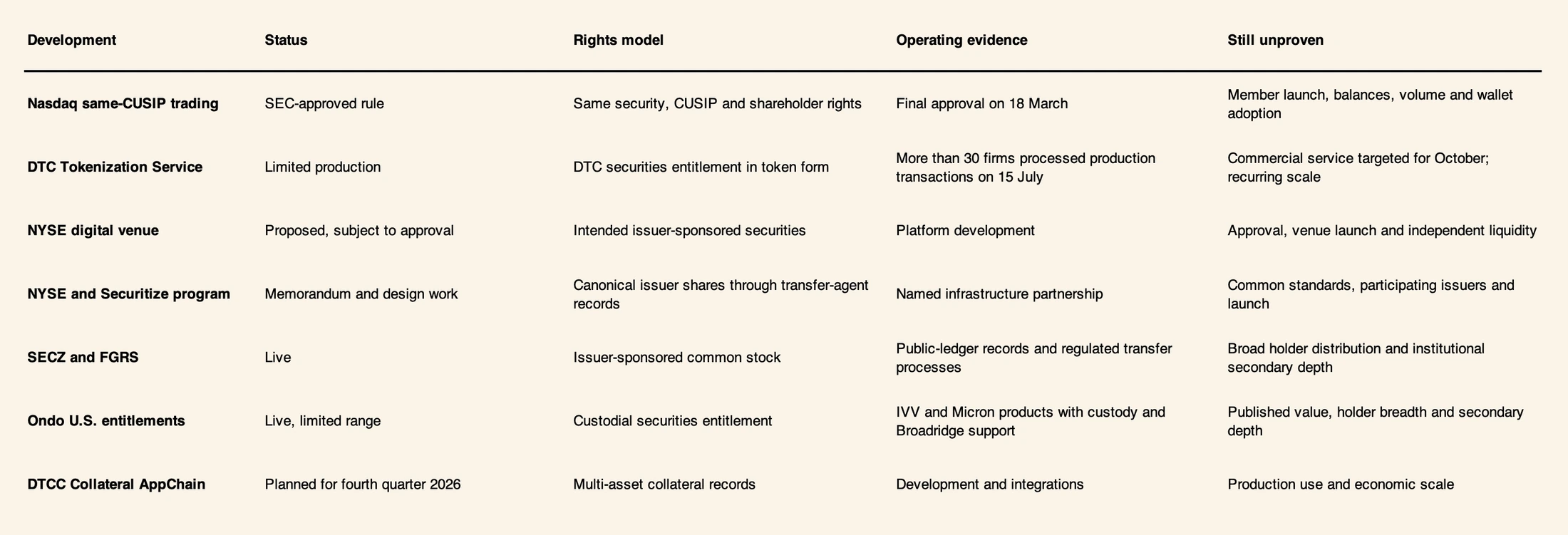
In March, the SEC approved Nasdaq’s framework for trading eligible securities in tokenized form. These assets would keep the same ticker, CUSIP and shareholder rights as the conventional share. Orders would still trade in Nasdaq’s existing order book, with tokenization affecting settlement rather than price discovery.
This is significant because it avoids splitting liquidity. The tokenized share is not a separate product designed to track the listed stock. It is another settlement form of the same security.
DTC is building the infrastructure behind that model. In July, more than 30 firms completed production transactions using DTC-tokenized assets, including securities transfers, collateral pledges, lending and delivery-versus-payment. A commercial launch is planned for October 2026.
The system remains controlled. Assets move through registered participant wallets, DTC continues to manage custody and servicing, and some corporate actions may require conversion back into conventional book-entry form. The blockchain adds portability and programmability without replacing the core market infrastructure.
NYSE is developing a similar model, including a proposed digital venue and issuer-sponsored infrastructure with Securitize. These projects are still early, but the direction is clear.
Institutional tokenization is not moving towards permissionless bearer shares. It is bringing blockchain settlement into regulated systems that already manage identity, custody, ownership records and corporate actions.
This may strengthen incumbents rather than displace them. Exchanges retain liquidity and market data, DTC remains central to custody and settlement, and transfer agents continue to control the official ownership record. Public blockchains may carry the transactions, but they do not automatically capture the most valuable parts of the system.
Regulated tokenized-equity infrastructure
Why ETFs may scale before individual stocks
ETFs may prove easier to bring onchain than individual stocks.
One token can provide exposure to an entire index, sector or income strategy. That reduces the impact of company-specific events such as earnings, takeovers, trading halts and shareholder votes. It also allows the provider to manage one legal structure and one creation and redemption process rather than building separate systems for every company.
The case becomes stronger when the token represents an official fund share rather than a third-party wrapper. F/m Investments, for example, has applied to create a tokenized share class for a Treasury ETF using the same CUSIP as the conventional fund. The proposal had not been approved by the report’s cutoff date, but it shows how tokenization could preserve investor rights while improving settlement and distribution.
Recent launches in Asia follow a similar pattern. SBI Global Asset Management and DigiFT introduced a tokenized Japanese dividend strategy, while Hong Kong expanded its framework for tokenized investment products. These products do not move the underlying stock market onchain. Instead, they use a regulated fund structure to distribute conventional assets through tokenized rails.
For that reason, broad index, sector, income and Treasury ETFs may reach meaningful scale before single-name stocks. They spread legal and operational costs across a larger pool of assets and offer investors a simpler product.
Stablecoin settlement may matter more than share representation
The larger opportunity may sit around the asset rather than in the share record itself.
Stablecoins already fund subscriptions, redemptions, exchange balances and collateral transfers. They allow cash to move outside banking hours, even when the underlying stock cannot trade. A broker can receive funds over the weekend, move collateral between venues or prepare for settlement before markets reopen.
Tokenized equities can also be used in lending markets. xStocks reported $6.3 million supplied and $5.75 million borrowed through a Kamino market in April. The utilization rate was high, but the market represented only a small share of total xStocks value and was supported by incentives. It remains unclear whether demand will persist without them.
The harder questions appear when markets are closed or volatile. Can lenders liquidate collateral while the underlying stock is halted? Which price should the oracle use? Can the wrapper still be redeemed? Who absorbs the loss if the token and the reference share move apart?
Smart contracts may operate continuously, but the brokers, custodians and exchanges behind them do not.
The likely outcome is not one universal settlement asset. Stablecoins may serve global distribution and after-hours funding. Tokenized bank deposits may be better suited to regulated institutions, while central-bank money remains important for wholesale settlement.
In practice, continuous cash movement may deliver more immediate value than putting every share register onchain. The stock can remain inside conventional market infrastructure while stablecoins make funding, margin and collateral more flexible.
Where economic value is likely to accrue
Creating a token is becoming relatively easy. The harder and more valuable work sits around it: regulated distribution, custody, official ownership records, corporate actions, liquidity, financing and settlement.
Wrapper issuers can earn fees from issuance, redemption, spreads and distribution. Brokers and exchanges can monetize trading, foreign exchange, margin and market data. Custodians and clearing firms may benefit regardless of which consumer platform wins, because several competing products can depend on the same underlying infrastructure.
Transfer agents could become especially important. They connect the blockchain record to the legal security and ensure that ownership, dividends, votes and other corporate actions remain synchronized.
Stablecoin issuers may also benefit as tokenized assets generate demand for subscription cash, collateral and settlement balances. Market makers earn for taking inventory and after-hours price risk, while asset managers can collect recurring fees from tokenized funds and ETFs.
Blockchain networks will gain transactions and assets, but the value of securities recorded on a chain should not be confused with revenue earned by the network.
The likely model looks less like a decentralized stock exchange and more like a global distribution network. Custodians hold the assets, transfer agents maintain the official records, brokers bring customers and liquidity, and stablecoins or tokenized deposits support settlement.
The strongest companies will connect these parts of the market. Token issuance alone is unlikely to provide a durable advantage.
What would have to happen for the market to reach Tier 3
Tokenized equities remain a Tier 2.5 market because legal rights and market activity have developed separately.
FGRS and SECZ have relatively strong ownership structures but limited distribution and trading. Ondo and xStocks have broader reach and more visible onchain activity, but their offshore products give investors creditor claims rather than direct shareholder rights. Nasdaq and DTC offer the clearest path to combining existing liquidity with rights-preserving settlement, although commercial adoption had not begun by the report’s cutoff.
Reaching Tier 3 will require more than another increase in distributed value.
- Issuer participation: Major public companies must authorize tokenized forms of their securities with clear shareholder rights and an official ownership record.
- Real secondary liquidity: Data must separate trading from wallet transfers, issuance, redemptions and internal movements. Market depth and spreads matter more than headline volume.
- Reliable extended-hours markets: Products must remain tradable through weekends and volatile periods without large or persistent gaps from the underlying share price.
- Broader ownership: Canonical shares need a meaningful base of independent, funded investors rather than a small number of issuer, custodian and market-maker wallets.
- Routine corporate actions: Dividends, votes, splits, tenders and mergers must be processed accurately and without lengthy suspensions or manual reconciliation.
- Sustainable collateral demand: Lending activity must continue after incentives end, supported by credible pricing and liquidation rules when the underlying market is closed.
- Clear interoperability: Assets should be able to move between approved venues and networks without creating uncertainty over which token represents the legal security.
Recent problems show why these conditions matter. Incorrect supply calculations overstated some token balances. Thin weekend markets produced sharp price gaps. Failed access to private shares showed that a token cannot create ownership that does not exist in the first place.
In every case, the same principle applies: the token, the legal claim, the backing asset and the market process must remain aligned.
Scenario framework for tokenized public equities through 2030
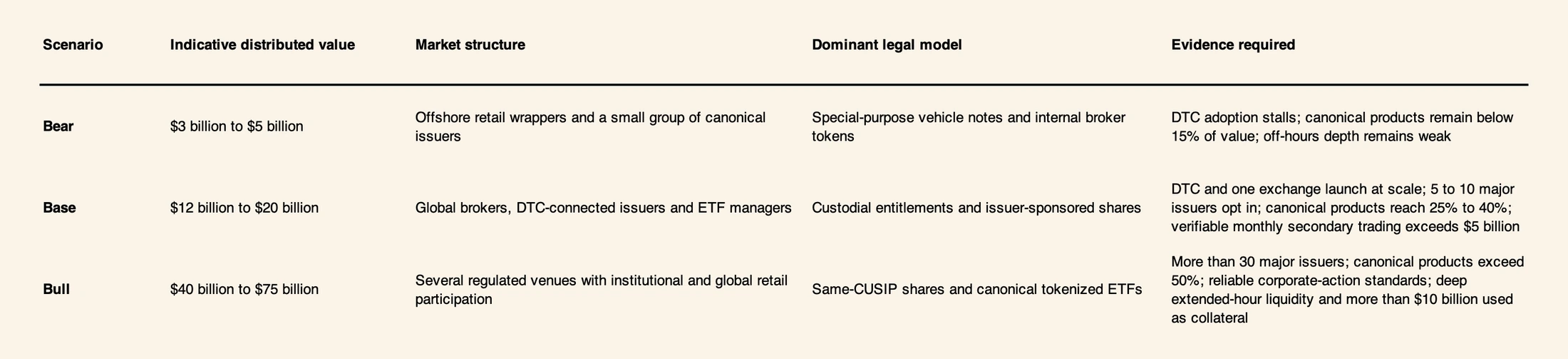
The next 12 to 24 months should provide better evidence. The most useful indicators will be issuer adoption, DTC wallet balances, net issuance and redemption, genuine secondary trading, weekend liquidity, holder concentration, corporate-action failures and collateral that is actually borrowed rather than simply deposited.
Conclusion
The answer depends on which part of the market is being examined.
Ownership has moved onchain in a narrow but genuine set of issuer-sponsored products. FGRS and SECZ demonstrate that a public-company share can be issued or represented through blockchain-based records while preserving shareholder rights. DTC’s tokenized entitlement model can extend the same economic and legal protections available through conventional book-entry ownership into a new settlement form.
Distribution has moved much further. Ondo, xStocks, Robinhood and other platforms have made hundreds of exposures portable across wallets, exchanges and decentralized applications. They solve real access and settlement problems, especially for investors outside the United States. Their legal claims still depend on special-purpose vehicles, brokers, custodians or derivative counterparties, and their prices remain anchored to conventional markets.
Liquidity has moved the least. Decentralized trading is no longer negligible, but it is concentrated and materially weaker outside the underlying exchange session. Canonical products have not yet shown broad holder distribution or institutional secondary depth. Nasdaq’s approved model deliberately keeps price discovery in the existing order book.
That may be the economically rational path. The near-term winners are likely to be exchanges, brokers, custodians, transfer agents, market makers, asset managers and settlement-money providers that make the new layer usable without breaking the old one. The centre of value capture may sit in the connections between systems rather than in a new onchain exchange.
Since March, the stock market has gained a credible onchain distribution and settlement layer. Its centre of ownership, liquidity and price discovery has not moved with it.
Sources
The original report sources were accessed on July 29, 2026 unless another date is stated. The October snapshot and legal-structure check use the separately linked sources accessed October 3, 2026.
Market data and prior framework
- insights4vc, The State of Onchain Real-World Assets, published 12 March 2026.
- RWA.xyz market overview, data as of 29 July 2026.
- RWA.xyz data catalog, live methodology.
- CoinMarketCap Research, Tokenized Stocks: The Venue Landscape, published 23 June 2026.
U.S. regulation and market infrastructure
- SEC, Staff Statement on Tokenized Securities, 28 January 2026.
- SEC, Order Approving Nasdaq Trading of Securities in Tokenized Form, 18 March 2026.
- DTC no-action letter and operating conditions, 11 December 2025.
- DTCC, Development of the Tokenization Service, 4 May 2026.
- DTCC, Production Transactions Using DTC-Tokenized Assets, 15 July 2026.
- DTCC, Stellar Integration, 27 May 2026.
- DTCC, Collateral AppChain, 12 May 2026.
- ICE, NYSE and Securitize Memorandum, 24 March 2026.
Product structures and issuer materials
- Ondo Global Markets legal structure, live terms.
- xStocks legal overview, updated March 2026.
- Kraken xStocks risk disclosure, live terms.
- Kraken, SpaceX IPO Access Through xStocks, updated 12 June 2026.
- The Wall Street Journal, SpaceX Token Allocation Shortfall, published 12 June 2026.
- xStocks Kamino lending case study, 13 May 2026.
- Robinhood Classic Stock Tokens FAQ, live terms.
- Gemini Form 10-K, filed 30 March 2026.
- Securitize, Tokenizing SECZ, 2 July 2026.
- Figure blockchain-stock offering prospectus, 18 February 2026.
- F/m Investments tokenized ETF share-class application, 21 January 2026.
International frameworks and settlement
- ESMA, DLT Pilot Regime, live register.
- Bank of England, Digital Securities Sandbox, updated 30 June 2026.
- FINMA, First Swiss DLT Trading Facility, 18 March 2025.
- Hong Kong SFC, Secondary Trading Framework, 20 April 2026.
- DigiFT, SBI Japan High Dividend Equity Strategy Token, 15 July 2026.
- BIS, Project Agorá, updated 27 May 2026.
Cover Artwork

The Tivoli Waterfalls
Hubert Robert, c. 1776
Risk disclaimer
insights4vc provides independent research based primarily on publicly available information believed to be reliable at the time of publication. Figures may change because of market prices, token supply, reclassification and methodology updates. Legal structures, investor rights and regulatory treatment vary by product and jurisdiction.
This article does not constitute investment, legal, tax, accounting or financial advice, or an offer, solicitation or recommendation regarding any security, token, fund interest or other asset. insights4vc makes no representation regarding the completeness or accuracy of third-party data. Readers should conduct independent due diligence and consult appropriately qualified advisers before making investment or business decisions.
Published by the insights4vc research team. See our research methodology, source standards and corrections policy. Dates and measurement periods are stated in each analysis.