Key Statistics
- In the 30 days through 3 September, DefiLlama attributed $16.94 billion of $19.75 billion in DEX volume to it, or 85.8%; its 24-hour share was 76.8%.
- Q2 revenue grew 32% to $1.308 billion even as crypto transaction revenue fell 38%, giving management room to fund the network patiently.
- For the quarter ended 30 June, revenue was $1.308 billion, up 32%; transaction revenue was $776 million, net interest $389 million and other revenue $143 million.
Figures and examples retain the report's original period, scope and source definitions. Consult the analysis and references below before making comparisons.
From the 1 July launch through Sep 2026, Robinhood Chain reported $34.6 billion of DEX volume, 576 million transactions, 12.3 million addresses, more than 190 Stock Tokens and over $3 billion of Stock Token DEX volume. Lighter reportedly routed another $7.29 billion of perpetual volume. These address- and contract-level totals cannot be treated as people, fresh capital or revenue booked by Robinhood. [2][13]
On 3 September, DefiLlama showed $791 million of chain TVL, $2.78 billion of bridged TVL and $868 million of stablecoins. Robinhood called a separate $1.27 billion figure “protocol TVL.” Without a methodology note linking the two, they cannot be reconciled. Uniswap handled roughly 86% of tracked 30-day DEX volume, including much of the liquidity created through Pons v2. [12][14]
Pons became the main consumer venue. By 1 September it claimed $4.54 billion of platform volume and more than $25 million of creator earnings; PONS briefly reached about $0.52 on 3 September. The model rewarded issuance and rapid trading, yet disclosed no retention or token-survival cohorts. Pons accounted for 63.9% of tracked launchpad fees on 31 August. That percentage applies to one peak day. [15][17][18]
Stock Tokens are already usable in liquidity pools and, according to secondary reporting, as collateral in a limited set of markets. Evidence for broad settlement use or recurring collateral demand is thin. During the BONER/HIMS episode, a small tokenized float traded far above HIMS shares while the primary market was closed, then converged after new wrappers appeared. The dislocation occurred in the wrapper; there was no comparable squeeze in the underlying equity. [19]
Q2 revenue grew 32% to $1.308 billion even as crypto transaction revenue fell 38%, giving management room to fund the network patiently. Options and event contracts still do much of the work, and investment gains supplied 22.5% of Q2 net income. At the cutoff, Chain was too small and too opaque to matter to group earnings. Most observable activity came from speculative turnover; two months cannot establish whether useful infrastructure will follow.
Partner Highlight

Umia is live on Base after successfully launching $UMIA through the same infrastructure it now offers to other projects. The auction reached its $18M maximum FDV only seven minutes after public bidding opened and closed with $6M+.
Founders interested in launching through Umia can contact us at office@insights4.vc.
1. Robinhood in 2026: From retail broker to financial super-app
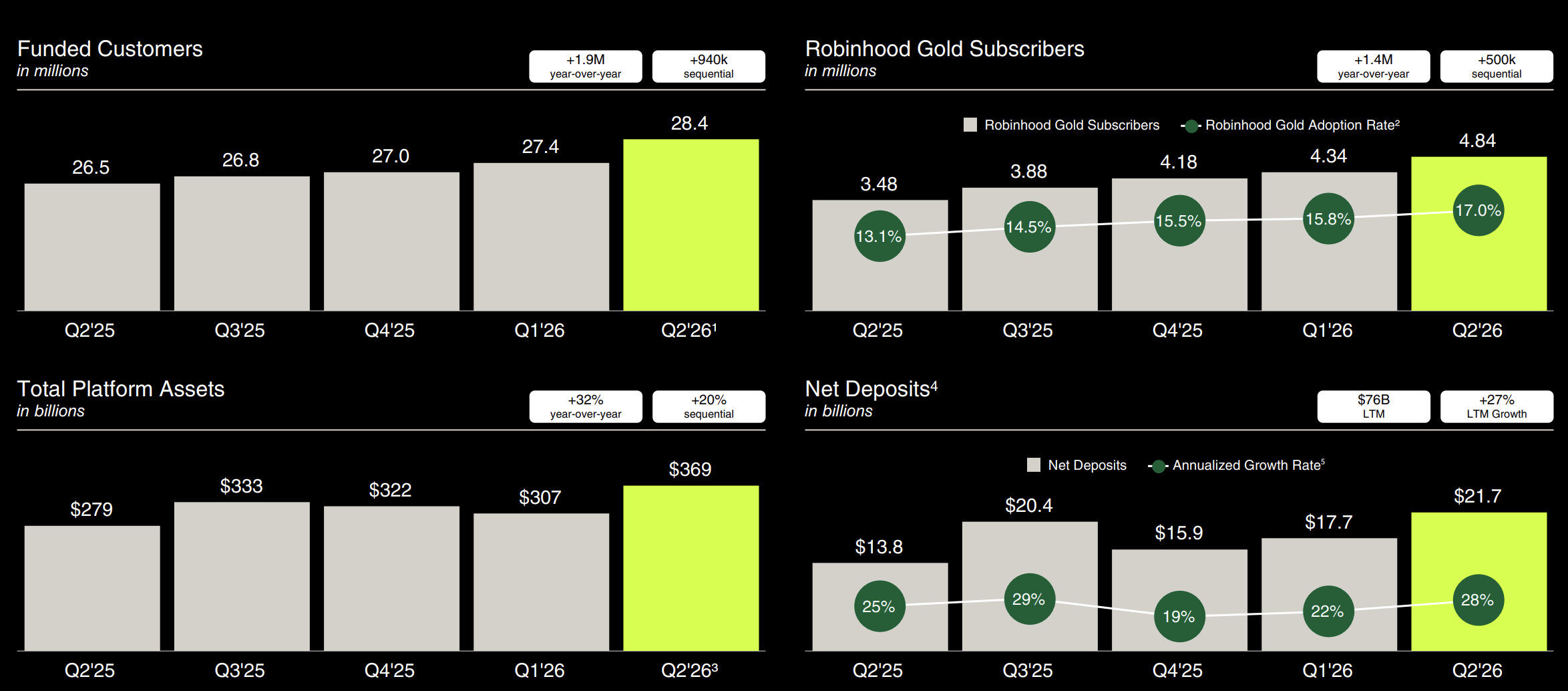
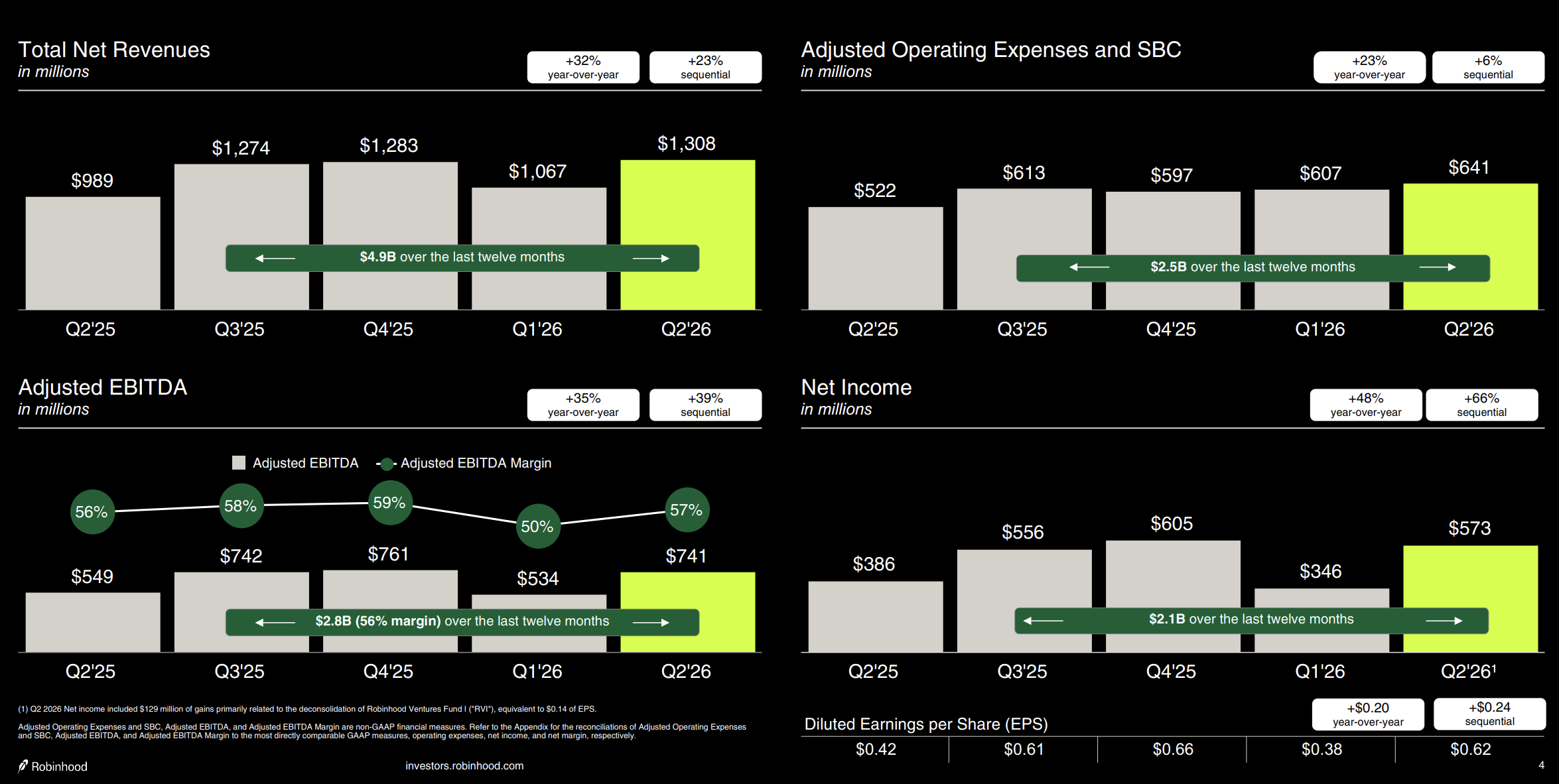
Customer assets and trading intensity explain Robinhood’s Q2 2026 performance better than account growth. For the quarter ended 30 June, revenue was $1.308 billion, up 32%; transaction revenue was $776 million, net interest $389 million and other revenue $143 million. Net income reached $573 million, adjusted EBITDA $741 million and diluted EPS $0.62. A $129 million investment gain represented 22.5% of net income. [3][4]
Robinhood: Q2 2026 Business Results Highlights
Q2 2026 Financial Results Highlights
Robinhood Markets Q2 2026 scorecard
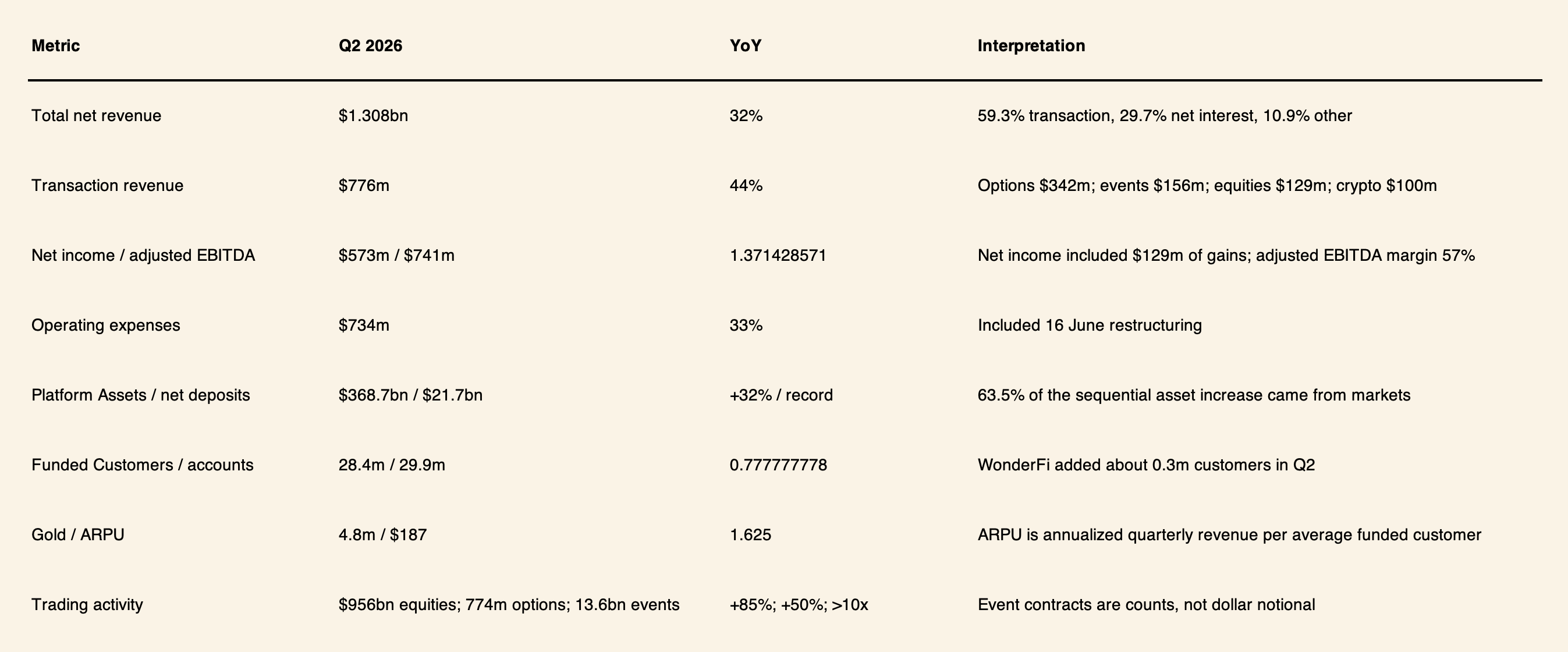
Crypto was no longer necessary for growth, though Robinhood remains sensitive to retail risk appetite. Options produced $342 million; events $156 million, more than ten times the prior year; equities $129 million; and crypto $100 million, down 38%. Morgan Stanley argued on 1 September that retirement, cards, advisory and asset-based revenue could drive the next phase. That is an analyst’s opinion. Options and events together supplied 64% of transaction revenue, leaving the mix exposed to participation and regulation. [3][29]
Interest income shifted toward margin lending. Margin interest reached $215 million, up 89%, and supplied 55% of net interest revenue. Card net interest was $40 million, while cash and sweep revenue fell with rates. Securities lending produced $112 million gross and $10 million net after expense; only $6.00 billion of the $96.25 billion enrolled was borrowed at 30 June. Credit expansion also brought a $51 million provision for card losses. [4]
Existing accounts and acquired customers both contributed, but rising markets supplied most of the asset growth. Funded customers rose from 27.4 million at 31 March to 28.4 million at 30 June, including about 300,000 from WonderFi. Of the $61.4 billion sequential Platform Asset increase, $39.0 billion came from markets, $21.7 billion from deposits and $0.7 billion from acquisitions. Average assets per funded customer reached about $13,000, up roughly 17% year over year. [4]
The 13 businesses above $100 million in “quarterly annualized revenue” were options, equities, crypto, margin interest, two securities-lending lines, cash sweep, Gold, instant withdrawals, Bitstamp, prediction markets, Legend and card. The threshold is one quarter times four, not contracted revenue. Several lines monetize the same customer. [5]
Robinhood is selling more products through the same customer relationship. At 30 June it reported $34.5 billion of retirement assets, a $21.6 billion margin book and more than one million funded customers outside the United States. Banking, Strategies, TradePMR and Bitstamp broaden the offering; WonderFi added Canada, while Rothera adds a separately governed, CFTC-regulated event venue. Stock Tokens offer overseas distribution without rebuilding the full US brokerage stack. Robinhood has not published cohort data showing whether this cross-sell improves retention. [4][5][6]
The 16 June reduction of roughly 10% of employees accompanied a lower full-year adjusted expense range of $2.675 billion to $2.775 billion. Q2 GAAP expense still rose 33%, and the filing warns that cuts can damage knowledge, compliance and service. [4]
HOOD price performance and valuation
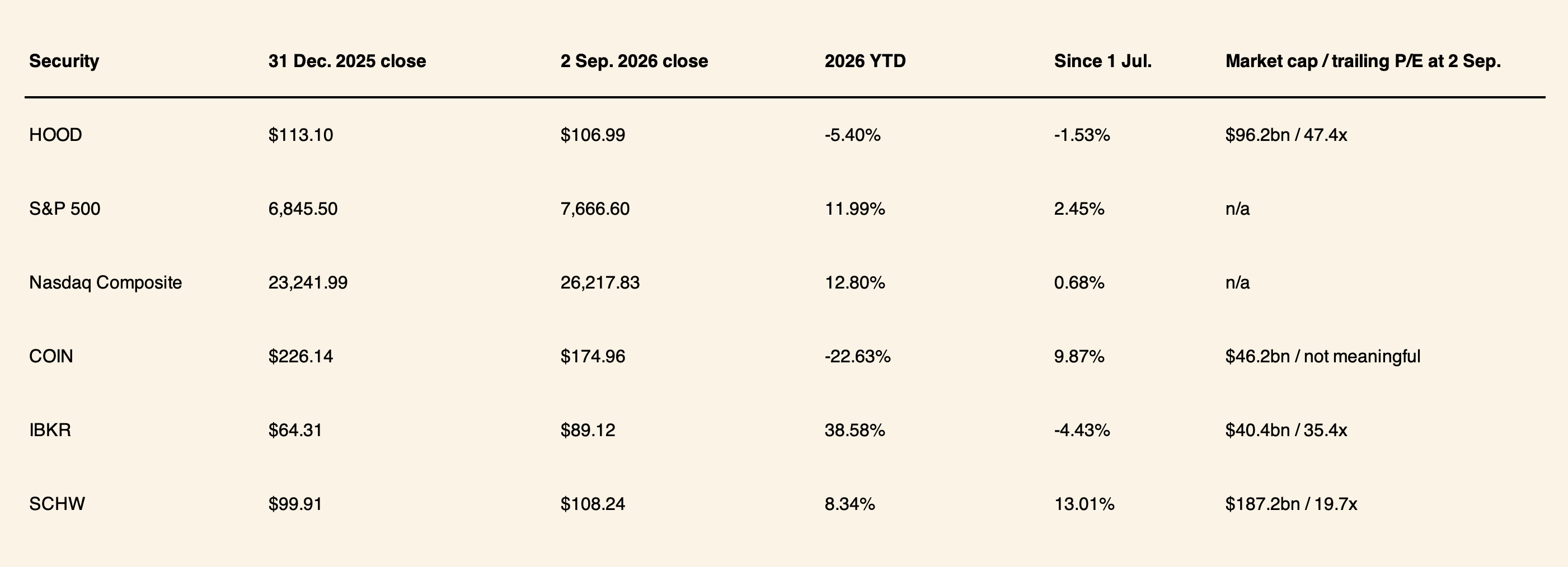
HOOD’s one-year return to 2 September was 6.10%. Its 2026 intraday range ran from $63.52 on 30 March to $120.05 on 2 July: a 43.8% fall to the trough followed by a 68.4% recovery. The 1 July launch-day close rose 8.35%, but several products were announced together, preventing clean attribution to Chain. Q1 and Q2 results prompted next-day declines of 11.25% and 3.61%. At 47 times trailing and 45 times consensus forward earnings, Robinhood traded more like a high-growth fintech than a conventional broker. Chain was not disclosed as a material contributor. [28]
2. Robinhood Chain: Two months in numbers
The network launched 1 July as an Arbitrum Dedicated Blockchain using ETH for gas. By early 3 September, Johann Kerbrat reported $34.6 billion in DEX volume, $1.27 billion in “protocol TVL,” more than 190 Stock Tokens, over $3 billion in Stock Token volume, 576 million transactions, 12.3 million addresses and $7.29 billion routed through Lighter. Several definitions remain unpublished, and every figure is a company-associated, unaudited claim. [2][13]
Robinhood Chain launch-to-cutoff scorecard
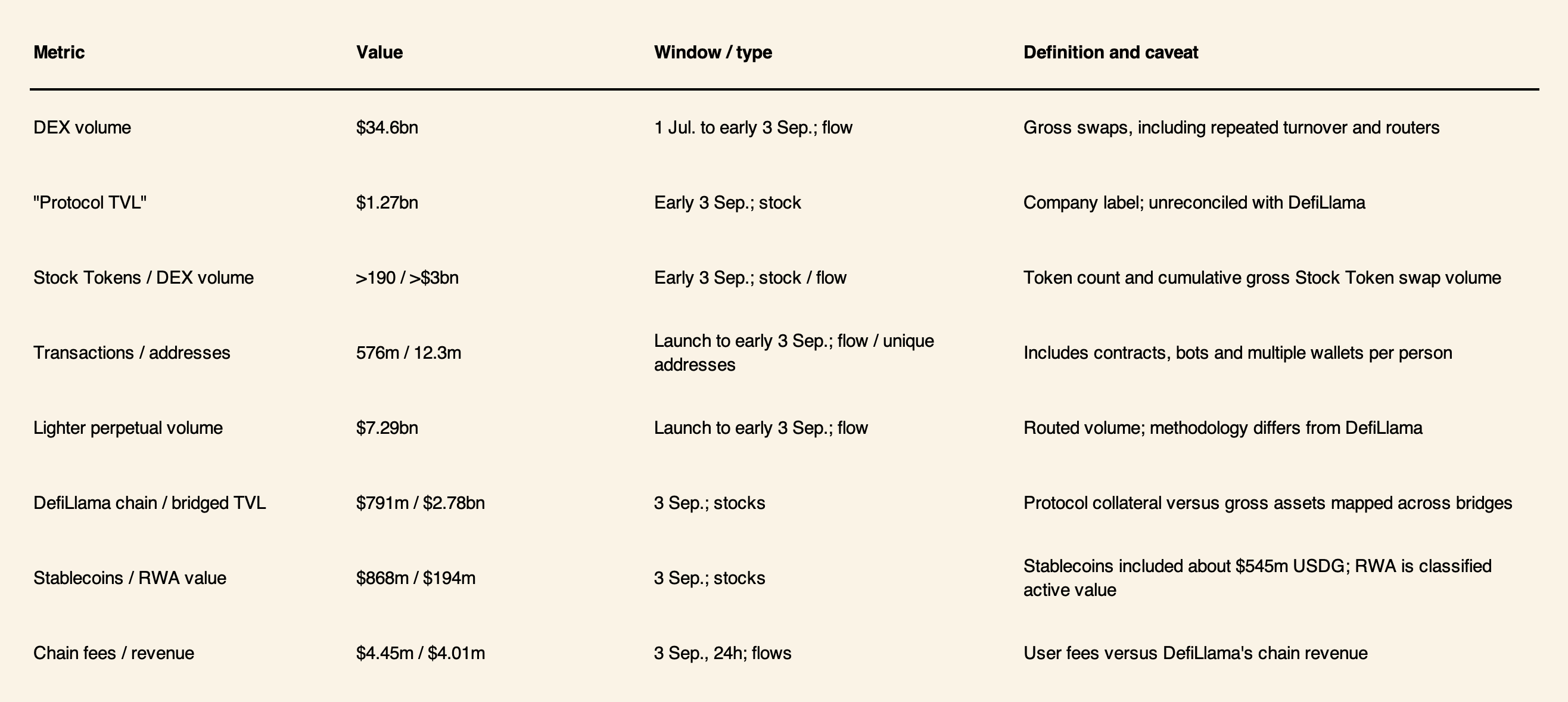
Across 64 launch days, the totals average 46.8 transactions per address and $549 million of DEX volume a day. Cumulative volume was 12.5 times the 3 September bridged TVL. Addresses may be bots or contracts, and capital can trade repeatedly through routers. These averages measure turnover more readily than net inflows or retained people.
3. What is actually driving the chain?
Uniswap processed most spot trading. In the 30 days through 3 September, DefiLlama attributed $16.94 billion of $19.75 billion in DEX volume to it, or 85.8%; its 24-hour share was 76.8%. Pons v2 originates assets and fee logic, then settles trading into Uniswap v4. [14][16]
Estimated composition of DEX activity
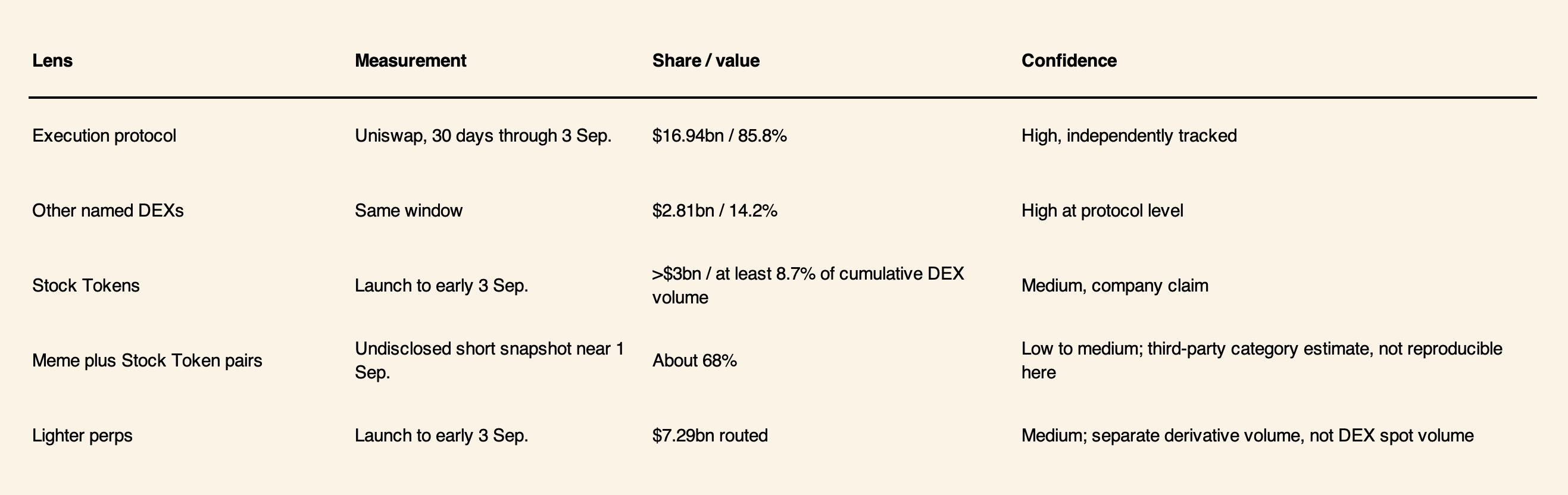
The asset breakdown is incomplete. More than $3 billion of Stock Token volume equals at least 8.7% of cumulative DEX volume, although meme/Stock pools overlap categories. A third-party estimate near 1 September put these pairs at 68% without publishing a reproducible window or taxonomy. It is only a dated snapshot.
Protocol figures count capital differently. On 3 September, Morpho Blue showed $488 million TVL, Steakhouse $476 million, Uniswap $188 million and Lighter $56 million. Their sum exceeds chain TVL because one deposit can appear in a vault, lending market and collateral position. [12]
No public dashboard isolates human cohorts from contracts, account-abstraction wallets, routers, snipers and market makers. Comparable series for trade size, wallet concentration and token survival are also missing. The data establish heavy throughput, but leave retention, net inflows and fee diversification unresolved.
The activity metrics diverged. Artemis counted 323,969 active addresses on 21 July versus 314,843 on 11 July. Transactions reached 13.3 million on 5 August versus 10.4 million on 11 July, while daily DEX volume fell 72.5% from $878 million on 11 July to $241 million on 1 August. Addresses and transactions include automation, and sponsored gas plus zero-fee perpetuals lowered its cost. The divergence is not evidence of stronger retention. [2] (The Defiant, 6 August)
4. Stock Tokens, memecoin liquidity and the 24/7 market experiment
Robinhood Assets (Jersey) Limited, or RHJ, issues each Stock Token as an ERC-20 debt security. It provides economic exposure to a referenced security without ownership of the share or voting rights. A multiplier accounts for dividends and corporate actions. Only KYB-approved participants can mint or redeem: launch documentation identified BBVI, while current service-provider documentation names Bitstamp Global Limited. US investors and other restricted jurisdictions are excluded. [7][8]
Robinhood describes 1:1 exposure supported by assets at a US custodian. The prospectus permits series-level securities lending and temporary broker claims during settlement, so the backing need not be an untouched share in a vault. Token holders also face issuer, custodian, broker, authorized-participant and insolvency risk. The SEC’s January 2026 framework similarly separates issuer-sponsored tokens from third-party linked instruments. [8][9]
Trading is the first visible use case. Stock Tokens can sit in AMMs, pass through aggregators and serve as collateral where accepted. Artificial Inu/NVDA, Gently Used Tesla/TSLA, Stonks/SPY and BONER/HIMS attach a familiar equity reference to a speculative token and trade around the clock.
Calling AMM inventory “locked” is misleading. Buying a meme with a Stock Token adds wrappers to the pool; selling reverses the flow. Assets remain available along the pricing curve and through other venues. Net wrapper issuance is more relevant to the underlying stock than volume that recycles existing inventory.
The path from a memecoin trade to the stock market has several steps. Buying changes the meme-to-wrapper ratio; routers may then source more wrappers, and a thin float increases price impact. An authorized participant will mint into a premium only when it covers execution, custody, timing and operational costs. The participant must then acquire or hedge the exposure. Wrapper demand reaches the equity only through that hedge, and the sequence can stop while the primary market is closed.
The spike was confined to the wrapper. Weekend constraints on issuance and hedging let the pool detach from HIMS. An oracle publishes a reference price without forcing the AMM to trade there. New wrappers appeared, the premium collapsed and the share showed no comparable short covering.
A smaller company with thin free float, weak liquidity and high short interest would be more exposed. Even there, wrapper demand reaches the stock only if authorized participants hedge in meaningful size. Evidence would require net wrappers hedged relative to share volume and float; gross pool turnover is insufficient.
5. Pons and the launchpad economy
Pons drove more consumer activity than any other application, leaving Robinhood Chain dependent on it. The launchpad joins open issuance, Stock Token or crypto quote assets and Uniswap liquidity. Creators collect fees, while PONS buybacks and burns keep attention on the platform.
Pons growth timeline
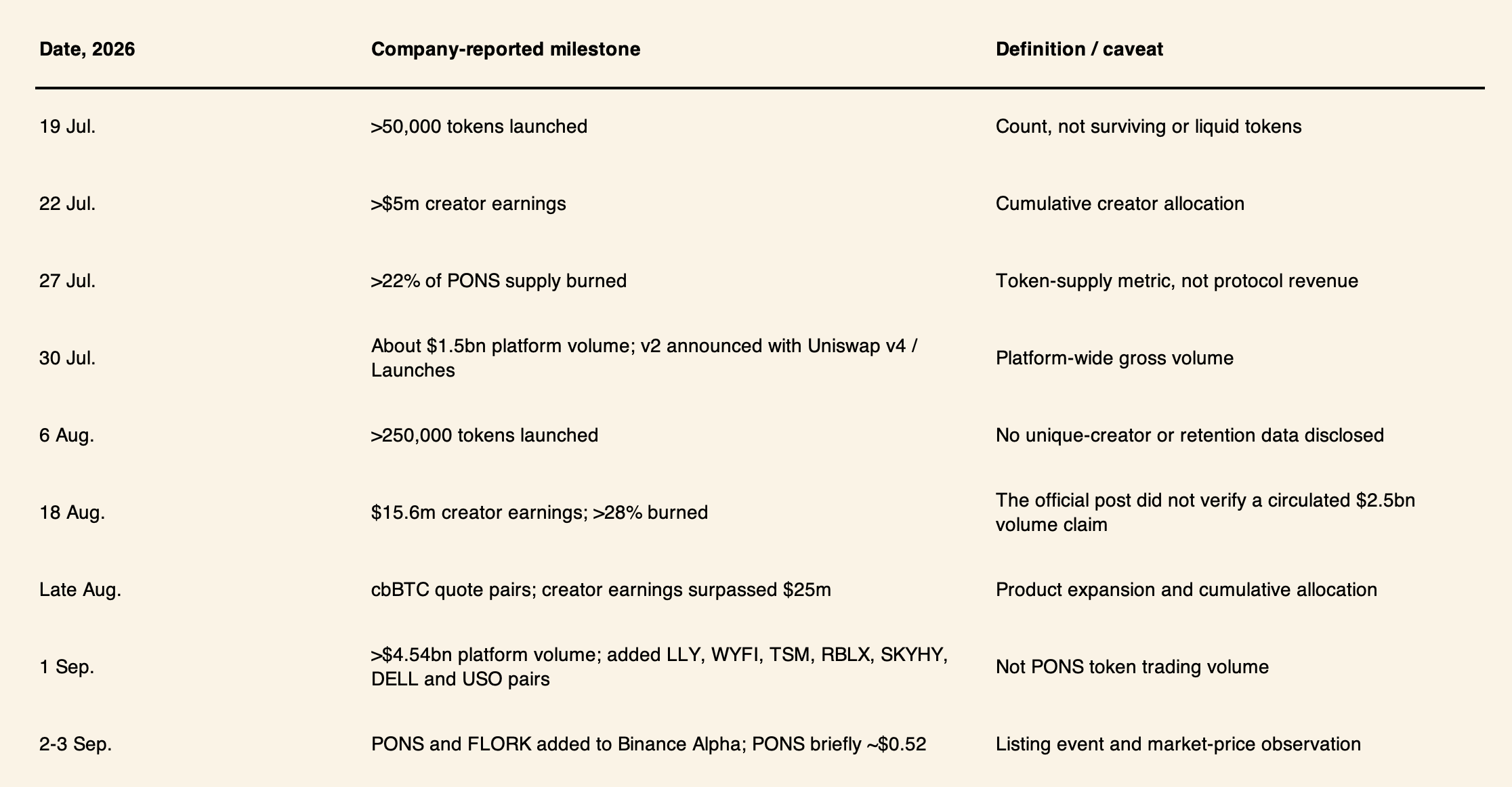
On 3 September, CoinGecko showed PONS at $0.4796, a $341.8 million circulating market cap, $339.1 million FDV and $132.0 million of 24-hour volume. Its supply classification put market cap slightly above FDV. These are PONS-market figures, separate from platform volume, Stock-pair volume, creator earnings and protocol revenue. [15]
Pons v2 moves supply through a constant-product curve into a full-range Uniswap v4 position. Hooks collect quote-asset fees and creator tax; Stock Tokens, ETH, USDG and cbBTC can be quotes. The repository caps parameters and describes a five-year buyback vault, with no universal 80% revenue rule. V2 buybacks vest launched tokens; burns reduce PONS supply. [16]
V1 charged 0.0005 ETH to create a token and 1% on Uniswap v3 swaps, with mutable fee splits. V2 uses launch-specific onchain parameters and a five-second decaying anti-sniper tax. [16]
On 31 August, Pons generated $4.89 million of fees, or 63.9% of tracked launchpad fees; Robinhood Chain launchpads approached 70% in aggregate. This was a peak day. DefiLlama’s 30-day Pons totals through 3 September were $40.8 million of fees and $7.9 million of protocol revenue. Creator and LP fees accrue separately. [17][18]
The public record does not show whether this can last. Automated launches, snipers and recycled capital can inflate activity. No reliable dataset disclosed repeat creators, returning traders, median token life or wallet concentration. Fees and token appreciation attract more launches; if issuance slows, that feedback loop loses fuel.
Pons attracted creators, wallets and liquidity quickly. So far, that supports demand for the launchpad. A wider ecosystem requires those balances to remain after launches cool and move into lending or other Stock Token markets.
6. Lighter and the perpetual futures layer
Through Lighter, Robinhood Wallet offers hourly funded perpetual futures without operating the trading venue. Users deposit USDG into Lighter’s relayer or smart-contract system, place market or limit orders and trade under Lighter’s liquidation and funding rules. Robinhood describes its role as the provider of non-custodial wallet technology and says it does not collect or monetize peer-to-peer funding payments. Geographic restrictions apply. [20]
This separation of customer access from venue operation is also useful when assessing Derive’s institutional options strategy. The product and collateral requirements differ, so wallet distribution alone is not a sufficient comparison of derivatives businesses.
Robinhood attributed $7.29 billion of cumulative perpetual volume to the integration. On 3 September, DefiLlama’s dedicated instance showed $5.31 billion cumulative volume, $55.5 million TVL and $0.57 million cumulative protocol revenue. Timing, routing or classification may explain the gap, but no reconciliation exists. Broader Lighter users cannot be assigned to Wallet; origin, retention, liquidations and asset mix were undisclosed. [13][21]
The same snapshot showed $240 million of 24-hour volume, $1.74 billion over seven days, $5.21 billion over 30 days and $235 million of open interest. The Defiant reported on 20 July that NVDA, GOOG and AAPL Stock Tokens were accepted as collateral. No primary configuration notice was located, so the asset list remains unverified. [21]
The integration offered 11 million LIT tokens and double points through Wallet. The figure refers to token units, not $11 million. Incentives are therefore a plausible contributor to the reported volume. Lighter previously raised $68 million with Robinhood participation. No primary source supports a 50/50 Robinhood-Lighter revenue split. [20][21]
Robinhood gets a derivatives product without taking on Lighter’s venue, risk-engine and liquidity operations. If the partnership endures, the same distribution model could be used for other onchain products. At the cutoff, incentives were still running and Wallet-origin activity was undisclosed, leaving too little evidence to call Lighter a mature Robinhood franchise.
7. Chain economics, control and strategic importance
Access and application deployment are public, subject to product-level restrictions. Sequencing and validation are controlled. Robinhood runs a centralized sequencer with sanctions screening, first-come ordering and subsecond soft confirmations. Ethereum finality follows about 13 minutes after posting; canonical withdrawals take roughly seven days. Offchain Labs and Alchemy are the documented, permissioned BoLD validators. [10][11]
The eight-member Security Council comprises BitGo, Chainlink, Fireblocks, Offchain Labs, Paxos, Talos and two Robinhood seats. Routine actions require six approvals and a seven-day timelock; emergencies require seven approvals with no timelock. Stock Token issuance and redemption remain limited to KYB-approved participants.
User-paid gas does not flow entirely to Robinhood. Data availability, Ethereum settlement, validators and services consume part of it; applications, LPs and creators collect separate fees. Arbitrum describes 10% of net protocol revenue, while Robinhood’s CFO referred to “a few basis points” per transaction and an approximately 50/50 split. The disclosures have not been reconciled, and Robinhood’s accrual is unknown.
After the 10% license share, the base scenario’s $164 million annual pool equals 1.6 times Q2 crypto revenue, 1.1 times event revenue, 21% of transaction revenue and about 22% of adjusted EBITDA. This is a scale check, not current accrual. Arbitrum reported $360,000 of AEP license fees in July and said Robinhood Chain contributed, without disclosing how much. [3][30]
8. From consumer app to infrastructure owner: fomo acquires Mobula Technology
On 31 August 2026, fomo announced that it had acquired Mobula’s technology, IP and parts of its technical team. The announcement did not disclose consideration. Axios reported approximately $17 million, citing fomo chief executive Paul Erlanger. That reported purchase price is separate from fomo’s claim of approaching $17 million in August monthly revenue. [22][23]
Mobula founder Sacha Marcus, CTO Sacha Delhoux and infrastructure lead Cyril Conan joined fomo. Delhoux wrote that he was 19 at sale; reliable age evidence did not cover the whole team. It supports describing an unusually young French technical group, but not every member as a teenager. fomo also claimed about 1.9 million users, 1.2 million active users in August, 30,000 new users a day, and volume rising from $500 million in June to $1.5 billion in July, with August pacing above $2.8 billion. These are unaudited claims. fomo supports Robinhood Chain. [22]
fomo’s reason for buying Mobula is more informative than the reported price. A consumer trading application depends on indexing speed, prices, token metadata, security scoring and routing. These inputs determine which assets a user sees and whether an order can execute safely. Relying on an outside data provider therefore creates product and operational risk. Owning Mobula could cut latency, reduce vendor dependence and let fomo build its data around the execution product.
One acquisition cannot establish a market-wide M&A pattern. It does show that a fast-growing consumer application considered data infrastructure important enough to own. Robinhood is making a larger version of the same calculation across custody, execution and settlement. For both companies, infrastructure affects the margin they keep and the quality of the product their customers experience.
9. What Robinhood Chain says about the future of financial markets
Robinhood now owns or connects functions that retail brokers once bought from third parties, from custody and exchange access to token issuance and settlement. Coinbase approached infrastructure from exchange and custody; Robinhood comes from consumer distribution and regulated brokerage. Robinhood can grow in the near term without Chain. Network ownership could retain economics now shared with venues, custodians and protocols.
Retail attention feeds several of Robinhood’s fastest-moving products. Options and event contracts produced $498 million of Q2 revenue; on Chain, short-duration risk appeared in launchpads, memecoins, wrappers and perpetuals. Such activity can recruit wallets and seed liquidity cheaply, then disappear much faster than retirement assets or recurring deposits.
BONER/HIMS put a price on the mismatch between a continuous wrapper and limited-hours equity. Its premium opened when issuance and hedging were constrained. The SEC approved Nasdaq tokenized securities that keep the same CUSIP, symbol and rights; LSEG and Payward announced rights-preserving UK structures. Robinhood reached international users sooner. Its tokens carry no shareholder rights and depend on an authorized participant. [25][26]
Tokenized-equity context
On 3 September, RWA.xyz reported $2.55 billion of distributed tokenized-stock value, $22.5 million represented, $23.5 billion of monthly transfers, 2.54 million holders and 152,006 active addresses. Robinhood ranked about sixth at roughly $91 million across 189 assets. Holders rose 155% over 30 days while active addresses fell almost 90%, making adoption difficult to read. [24]
Robinhood brings its brand, customer base, brokerage, custody, Wallet, Bitstamp and regulatory relationships. Against those advantages sit geographic exclusions, issuer risk, no shareholder vote, authorized-participant dependence and weekend pricing gaps. Memecoin-heavy activity adds reputational exposure. The SEC innovation exemption remained under discussion at the cutoff. Comparable products from regulated exchanges could expand tokenization while eroding Robinhood’s early lead. [9][27]
A Robinhood Chain trade can combine a regulated reference asset, permissioned issuance and socially coordinated speculation in an open AMM, then add borrowing or perpetual leverage. Issuance and network operation remain controlled while public pools set prices. Capital-market rules are being divided between the legal instrument, the application and the chain.
10. Fast distribution, little proof of durability
Robinhood’s 2026 performance no longer looks like a crypto-volume recovery. Q2 revenue grew 32% while crypto transaction revenue fell 38%, and customers added a record $21.7 billion. Market appreciation still supplied most of the asset increase, options and events led transaction revenue, and investment gains lifted profit. A wider product set often monetizes the same active customer.
Chain’s clearest achievement is speed. In 64 days, company-associated figures reached 576 million transactions, $34.6 billion of DEX volume and more than 190 Stock Tokens. Developers deployed around legally controlled assets. Clean retention cohorts, stable net inflows, recurring collateral demand and Robinhood’s revenue share remain missing.
Pons drew large numbers of traders and creators during its first two months. Durability depends on repeat activity, surviving assets and fees after incentives. Lighter distributes leverage without Robinhood running the venue, but its $7.29 billion headline cannot be judged until Wallet-origin volume and incentive effects are separated.
Stock Tokens work as composable trading instruments. Broader financial utility remains thin: trading pairs dominate visible use, activity concentrates around three applications, and Robinhood’s economics are undisclosed.
Selected sources
- insights4vc, original Robinhood Chain report, 9 July 2026
- Robinhood, Chain public launch announcement, 1 July 2026
- Robinhood, Q2 2026 results, 29 July 2026
- Robinhood, Q2 2026 Form 10-Q
- Robinhood, Q2 2026 earnings presentation
- Robinhood, Q2 2026 earnings-call transcript
- Robinhood Chain, Stock Token documentation
- Robinhood Assets Jersey, Base Prospectus and product, FAQ and service-provider disclosures
- US SEC, statement on tokenized securities, 28 January 2026
- Robinhood Chain, governance documentation
- Robinhood Chain, differences from Ethereum and finality
- DefiLlama, Robinhood Chain dashboard and definitions, snapshot 3 September 2026
- Johann Kerbrat, Robinhood Chain two-month scorecard
- DefiLlama, Robinhood Chain DEX breakdown, snapshot 3 September 2026
- Pons, $4.54 billion platform-volume post and official milestone feed
- Pons, public repository and v2 mechanics
- DefiLlama, Pons fees and revenue, snapshot 3 September 2026
- The Defiant, Pons launchpad-fee snapshot and chain activity analysis, through 1 September 2026
- The Defiant, BONER/HIMS case study
- Robinhood, Wallet perpetual-futures support and risk disclosures
- DefiLlama Lighter-Robinhood metrics, CoinDesk financing report and The Defiant collateral report
- fomo, Mobula acquisition announcement and Sacha Delhoux’s age claim, through 1 September 2026
- Axios, reported Mobula transaction value, 31 August 2026
- RWA.xyz, tokenized-stock dashboard, snapshot 3 September 2026
- US SEC, Nasdaq tokenized-securities rulemaking
- LSEG, tokenized UK equity structures and Payward partnership, 1 September 2026
- Reuters, US tokenized-stock policy discussion, 17 June 2026
- Stock Analysis, HOOD historical closes and valuation statistics, through 3 September 2026
- MarketWatch, Morgan Stanley upgrade, 1 September 2026
- Arbitrum Foundation, AEP license update and ArbitrumDAO Robinhood Chain factsheet, through 2 September 2026
Cover Artwork

View of Warsaw from Praga
Bernardo Bellotto, c. 1770
Risk Disclaimer
insights4vc provides independent research based primarily on publicly available information believed to be reliable at the time of publication. Figures may change because of market prices, token supply, reclassification and methodology updates. Legal structures, investor rights and regulatory treatment vary by product and jurisdiction.
This article does not constitute investment, legal, tax, accounting or financial advice, or an offer, solicitation or recommendation regarding any security, token, fund interest or other asset. insights4vc makes no representation regarding the completeness or accuracy of third-party data. Readers should conduct independent due diligence and consult appropriately qualified advisers before making investment or business decisions.
Published by the insights4vc research team. See our research methodology, source standards and corrections policy. Dates and measurement periods are stated in each analysis.