Key Statistics
- Derive options notional volume reached $1.92 billion in August 2026, according to the cited DeFiLlama data.
- FalconX reported Derive's open interest exceeding $1 billion on March 10, 2026, with options representing 61%.
Figures and examples retain the report's original period, scope and source definitions. Consult the analysis and references below before making comparisons.
Accessibility update: . 5 exhibits are now available as selectable, accessible tables, with the original images retained below each table. Research cutoff: September 24, 2026; activity series through September 17, 2026. Figures and assessments retain their original reporting periods.
In September 2025, Derive proposed a 50% increase in DRV supply to fund institutional expansion and retain contributors, acknowledging that earlier spending on AMM liquidity had been inefficient. A year later, another architectural overhaul is taking shape. Derive has survived by adapting. The question is whether those changes are building a business that lasts. [19, 45]
Today’s platform looks very different from the options liquidity pools launched as Lyra in 2021. Professional market makers supply liquidity, orders are matched offchain, and risk management and settlement happen onchain. The ambition remains, but much of the original machinery has changed. [2, 5, 12]
There are concrete signs of progress. Options notional volume reached $1.92 billion in August 2026, according to the retrieved DeFiLlama data, and BitGo independently confirms its custody integration. These support the case for a useful product, although neither establishes lasting customer demand or profitability. [47, 52]
The harder questions remain open: do customers return, how concentrated is liquidity, and what does Derive retain after rebates, incentives, and operating costs? The time available to answer them may be narrowing. Hyperliquid has brought bounded outcome contracts to mainnet, an independent project has launched a limited options market on its network, and Lighter’s founder has identified options as a development priority. None of these developments establishes comparable depth in Derive’s BTC and ETH options markets. Recent revenue after trading rebates looks more meaningful against historically disclosed expenses, but current profitability and runway remain unclear. For DRV holders, buybacks must also be weighed against dilution. Derive’s next test is turning activity into recurring revenue without ever larger subsidies, then showing how that value reaches tokenholders. [19, 47, 70–73]
Partner Highlight

Umia is building an operating stack for token-native ventures that combines fundraising, legal formation, treasury management and market-based governance.
1. From an options pool to a professional trading venue
Derive identifies Nick Forster, Michael Spain, Jake Fitzgerald, and Dominic Romanowski as its founders in 2021. Forster brought options trading experience from Susquehanna. The public record supports a combination of trading, software, and product expertise, but does not establish a complete contemporaneous division of responsibilities or an exact date when the founding team assembled. Nor should the project's founding year be treated as the incorporation date of every entity that subsequently operated it. [1]
The June 2021 introduction described a recognizable market failure. Blockchain options were expensive to transact, difficult to price, and unattractive for liquidity providers who absorbed poorly managed volatility risk. Lyra combined a model-based options price with an implied-volatility surface adjusted by trading activity. Implied volatility is the volatility assumption embedded in an option's price. The system sought to make that assumption responsive to supply and demand while managing the pool's directional exposure. [2]
The Synthetix relationship supplied infrastructure and aligned incentives. Synthetic assets and Synthetix exchange liquidity supported collateral conversion and planned hedging; activity could generate Synthetix fees. Investors and advisers overlapped with that ecosystem. The synthetixDAO announced a $1 million contribution in August 2021, following Lyra DAO's $3.3 million financing announcement led by Framework and ParaFi in July. These relationships do not establish that Lyra was a Synthetix subsidiary. The announcements do not adequately identify equity versus token instruments, so this report does not label both financings conventional venture rounds. [3, 4]
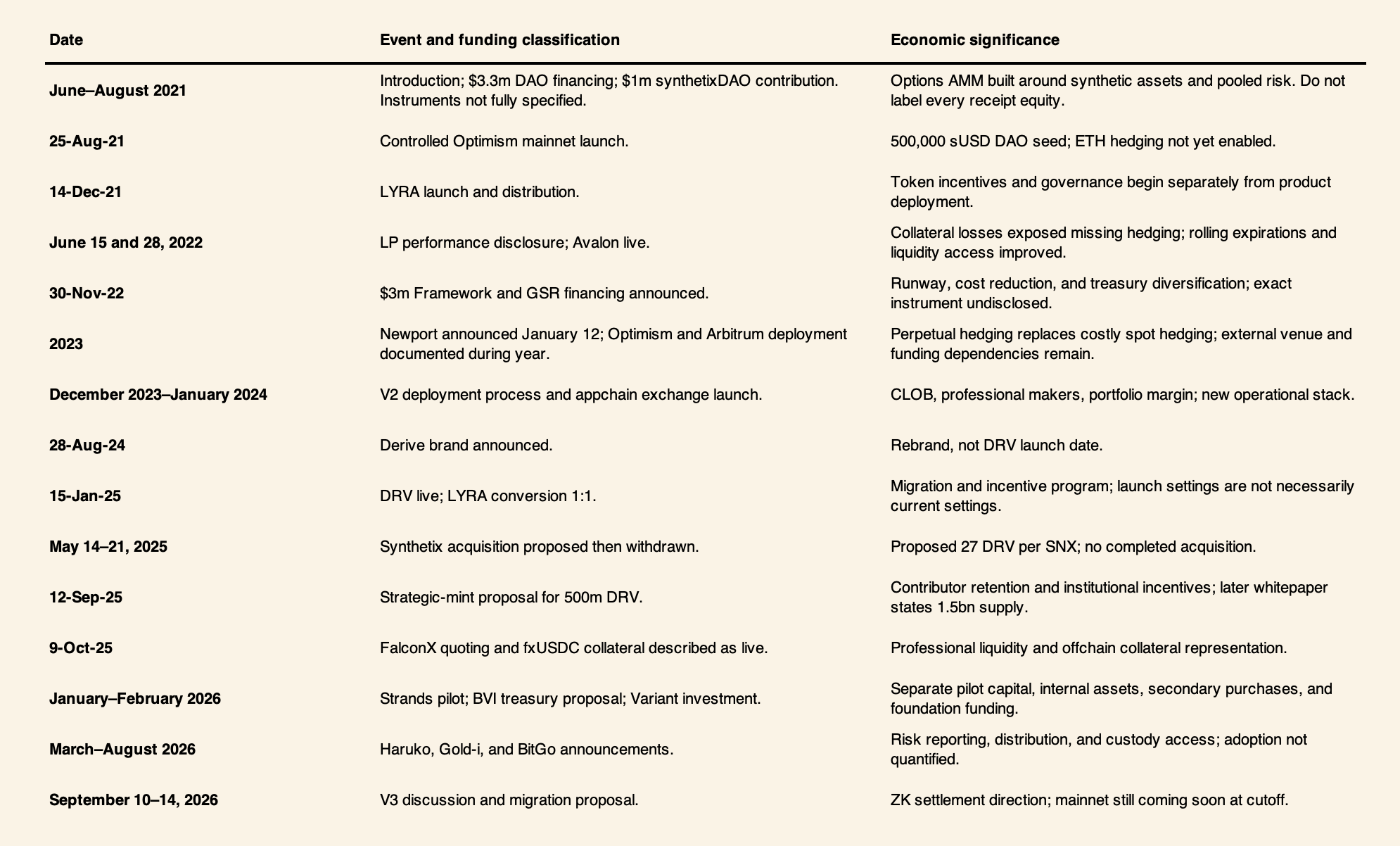
The archived August 25, 2021 mainnet announcement describes a much narrower product than today's Derive: an ETH options experiment on Optimism, seeded with 500,000 sUSD, with fixed liquidity rounds and restricted entry and exit. ETH hedging was explicitly not yet available. This contemporaneous record also contradicts a 2026 governance retrospective that places the team's Optimism mainnet deployment in 2020. The dated original announcement is the stronger evidence. LYRA's distribution followed on December 14, 2021, separately from the product launch. [5, 6, 45]
Avalon, announced live on June 28, 2022, loosened operational constraints. Rolling expirations and delayed liquidity withdrawals replaced the inflexibility of discrete rounds; partially collateralized shorts improved capital efficiency. Those changes expanded usability while placing greater importance on margin, liquidation, and liquidity management. Allowing capital to leave a pool before every liability expires creates a different problem from simply locking deposits until settlement. [8]
Newport addressed another weakness: hedging could consume much of the pool's expected return. The January 12, 2023 upgrade announcement estimated approximately $800,000 of Synthetix exchange fees paid by the ETH pool over the previous six months. It proposed perpetual futures hedges instead of repeated spot conversions and a more modular design. Subsequent governance records confirm Newport deployments on Optimism and Arbitrum during 2023. These changes reduced some transaction costs but introduced funding, basis, margin, and external hedging-venue dependencies. Announcement and deployment dates must not be conflated. [9, 65]
The larger break was V2. A December 2023 governance proposal prepared deployment and Newport deprecation; the foundation subsequently dated the exchange's operating history from January 2024. Order books and requests for quotes (RFQs) replaced the AMM as the principal mechanism for sourcing prices. Portfolio margin recognized offsets within a portfolio, while perpetuals supplied a hedge on the same venue. Market makers could manage inventory rather than force each trade through a pooled pricing curve. Professional firms inherited more pricing and hedging responsibility; the protocol retained responsibility for collateral and default management. [11, 12, 15, 65]
The rebrand arrived on August 28, 2024. DRV launched January 15, 2025, with a one-for-one LYRA migration, following earlier migration and staking processes. These are separate events. Historical V2 articles were republished or edited under Derive branding in 2024, making their current titles unreliable evidence of when the original architecture launched. Even the January DRV guide contains inconsistent headline and detailed circulation percentages. It is safer to use explicit launch and conversion terms than manufacture a perfectly smooth chronology. [13, 14]
Financing likewise requires disaggregation. The November 30, 2022 announcement reported $3 million from Framework and GSR, alongside cost reduction and treasury diversification, but did not specify the investment instrument. Later foundation grants were internal resource allocations, not necessarily fresh external capital. Ethena received tokens for a strategic investment with undisclosed commercial terms. Variant's February 2026 investment combined secondary-market DRV purchases with a foundation transaction; only the latter could directly fund the organization. Neither amount was disclosed. [10, 15, 20, 21]
The resulting history is an evolution of the market-access thesis through substantial abandonment of the original liquidity model. Better technology mattered, but so did accepting that options prices, distribution, and balance sheets require specialized intermediaries.
| Date | Event and funding classification | Economic significance |
|---|---|---|
| June-August 2021 | Introduction; $3.3m DAO financing; $1m synthetixDAO contribution. Instruments not fully specified. | Options AMM built around synthetic assets and pooled risk. Do not label every receipt equity. |
| 25-Aug-21 | Controlled Optimism mainnet launch. | 500,000 sUSD DAO seed; ETH hedging not yet enabled. |
| 14-Dec-21 | LYRA launch and distribution. | Token incentives and governance begin separately from product deployment. |
| June 15 and 28, 2022 | LP performance disclosure; Avalon live. | Collateral losses exposed missing hedging; rolling expirations and liquidity access improved. |
| 30-Nov-22 | $3m Framework and GSR financing announced. | Runway, cost reduction, and treasury diversification; exact instrument undisclosed. |
| 2023 | Newport announced January 12; Optimism and Arbitrum deployment documented during year. | Perpetual hedging replaces costly spot hedging; external venue and funding dependencies remain. |
| December 2023-January 2024 | V2 deployment process and appchain exchange launch. | CLOB, professional makers, portfolio margin; new operational stack. |
| 28-Aug-24 | Derive brand announced. | Rebrand, not DRV launch date. |
| 15-Jan-25 | DRV live; LYRA conversion 1:1. | Migration and incentive program; launch settings are not necessarily current settings. |
| May 14-21, 2025 | Synthetix acquisition proposed then withdrawn. | Proposed 27 DRV per SNX; no completed acquisition. |
| 12-Sep-25 | Strategic-mint proposal for 500m DRV. | Contributor retention and institutional incentives; later whitepaper states 1.5bn supply. |
| 9-Oct-25 | FalconX quoting and fxUSDC collateral described as live. | Professional liquidity and offchain collateral representation. |
| January-February 2026 | Strands pilot; BVI treasury proposal; Variant investment. | Separate pilot capital, internal assets, secondary purchases, and foundation funding. |
| March-August 2026 | Haruko, Gold-i, and BitGo announcements. | Risk reporting, distribution, and custody access; adoption not quantified. |
| September 10-14, 2026 | V3 discussion and migration proposal. | ZK settlement direction; mainnet still coming soon at cutoff. |
Source: the original report exhibit, based on the dated project announcements and governance records in the bibliography, including [2], [3], [4], [5], [6], [8], [9], [10], [13], [14], [16], [18], [19], [20], [43], [45], [51], [52], [53], [54], [57], [59], [65], [66]. Timeline status is retained at the report cutoff; an announcement is not treated as verified deployment. Link to this table.
Original exhibit
2. What survived and who absorbed the cost
Lyra's June 15, 2022 performance update provides unusually useful evidence because it separates trading performance from collateral exposure. During the pool's eighth ETH round, the reported return was negative 7.74%, or approximately $1.58 million. Collateral losses were about $1.8 million. Delta hedging, which offsets sensitivity to movements in the underlying asset, had not been enabled for ETH or BTC. A pool marketed around options therefore also carried substantial directional collateral exposure. [7]
The team's reconstructed hedged result for that round ranged from a small gain to a much smaller loss, depending on assumptions. It was a counterfactual, not money earned by depositors. Its usefulness is diagnostic: much of the damage could arise outside the option premium itself. Passive LPs paid for an implementation limitation while the team continued building. Token rewards, if received, would require separate valuation and would not erase the underlying trading loss. [7]
Avalon and Newport changed that exposure management, but hedging is not free insurance. A falling market can require selling into weakness, while repeated adjustments incur fees and slippage. Perpetual hedges add funding costs and can be liquidated. The later professional market maker model distributes these decisions among firms able to price them. It reduces the protocol's dependence on a single pooled strategy without abolishing the economic costs. The spread paid by customers and the incentives paid to makers are alternative ways of financing them. [8, 9, 12]
The failures of Terra, Three Arrows Capital, and FTX form the environment in which these decisions occurred. The reviewed evidence does not establish a direct Lyra loss on those counterparties. The November 2022 financing announcement is evidence of fresh financing and an explicit runway response during a hostile market; it is not evidence of an FTX rescue. Comparable disclosures of layoffs, monthly cash burn, or a complete crisis-period treasury reconciliation were not located. [10]
There is more visibility later. A February 2025 funding proposal disclosed roughly $1.65 million of 2024 USDC spending on contributors and service providers, with a projected 20% to 25% increase in 2025. It also listed token grants, loans to liquidity providers, strategic sales, and long-dated compensation. Those are distinct economic commitments. A loaned token inventory is not unrestricted cash, and a vested compensation promise is not the same thing as a current dollar expense. [15]
The January 2026 treasury proposal listed approximately 2.465 million USDC, 62.5 ETH, and 142.07 million DRV for transfer to a BVI subsidiary. Crucially, the USDC was described as originating from the security module and protocol fees, with proposed uses including rewards, buybacks, and operations. One cannot count that entire balance simultaneously as loss protection and operating runway. The report therefore makes no current runway estimate. An accounting separation between customer protection reserves and freely deployable corporate resources remains necessary. [57]
Synthetix's May 2025 acquisition attempt exposes another pressure point: a functioning product can coexist with dissatisfaction about its token. SIP-415 proposed exchanging 27 DRV for one SNX, implying approximately $27 million at the announced valuation, and transferring treasury, intellectual property, code, domains, and operations. Synthetix emphasized technology and personnel for its own mainnet exchange ambitions. Derive's forum discussion emphasized stronger distribution and token liquidity. [16, 17]
The documents were not identical. The Derive proposal contemplated different vesting treatment for smaller holders, while the Synthetix text described a three-month lock followed by nine-month vesting. Community objections concerned valuation, dilution, strategic control, and whose interests consolidation served. On May 21, Synthetix withdrew the proposal; SIP-415 is marked rejected. This establishes a failed transaction, not a completed merger or proven insolvency rescue. The subsequent strategic-mint proposal said some supporters and team members had been offboarded, showing that organizational continuity did not mean an unchanged coalition. [16, 17, 18, 19]
Security evidence also needs careful language. Sigma Prime's second review identified a critical auction-bid blocking issue closed with an operational workaround, rather than a code fix, and a high-severity withdrawal issue marked resolved. An audit's existence does not mean every finding was eliminated. No comprehensive public incident register or independently reconciled history of liquidation losses was available. [41]
Survival is most convincingly explained by adaptable product development, continued access to capital, and an ability to recruit liquidity. Public evidence is insufficient to assign it primarily to profitability or flawless risk management. The protocol continued; some LPs lost money; governance and contributors changed. Each outcome requires its own ledger.
3. The earlier generations were different businesses
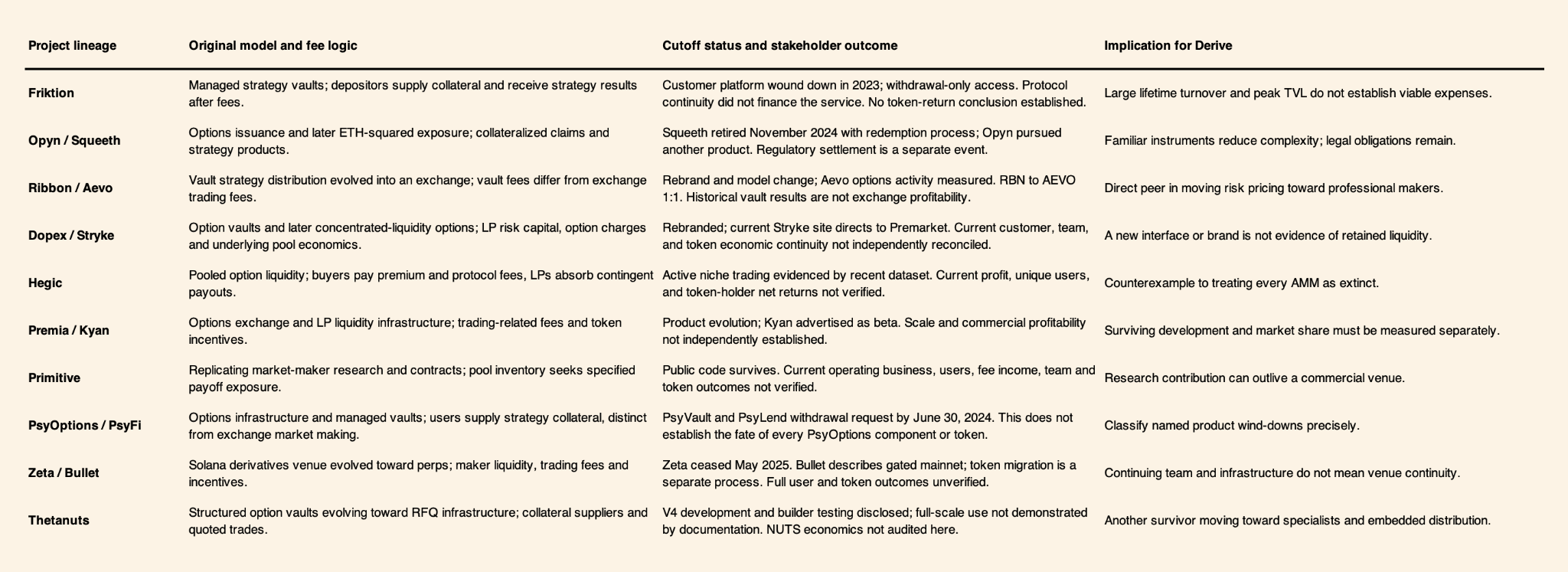
Calling every discontinued crypto-options product a failed exchange obscures the problem Derive is trying to solve. A vault sells a predefined strategy to depositors. An issuance protocol creates transferable claims. An AMM prices trades against pooled inventory. An exchange coordinates competing counterparties. Each can collect fees, but each requires a different combination of risk capital, customers, and distribution. Exhibit 2 follows product lineages rather than counting each new brand as another failure.
Friktion is the clearest commercial warning. Its January 2023 sunset announcement said costs exceeded revenue, despite a claimed history of nearly 20,000 wallets, $3 billion traded, and $150 million peak TVL. The interface became withdrawal-only and platform fees were removed; the underlying protocol remained accessible. This was a managed wind-down of the customer product, not proof that its smart contracts had ceased to exist or that every user lost principal. [22]
Its Volts packaged option and portfolio strategies for depositors. Such packaging can solve a real usability problem while failing to finance a company. Assets under management can fall with both withdrawals and asset prices, while engineering, security, and distribution costs remain. Selling options generates premium, but premium is compensation for contingent losses and foregone upside. A covered-call strategy can underperform holding the asset during a rally; a put-selling strategy can concentrate losses in a crash. Annualizing a quiet week's premium does not establish a sustainable investment return.
Derive has reduced Friktion's dependence on selling one packaged yield proposition by serving both sides of trading and allowing third parties to construct products. It has not removed the need for revenue to cover fixed costs. If vaults dominate its demand, the same cyclicality returns through an intermediary. A venue can process recurring option sales without the depositors or vault manager earning an attractive risk-adjusted return.
Opyn illustrates a different separation. Squeeth offered exposure linked to ETH squared, a power perpetual rather than an ordinary expiring option. In September 2023, the CFTC imposed a $250,000 penalty on Opyn and found registration and customer-identification failures; attempted exclusion of US users was inadequate. That is a specific regulatory finding, not a complete explanation of every later business decision. [24]
Squeeth was retired in November 2024 as Opyn redirected effort toward Opyn Markets. Its retirement material described settlement and redemption rather than an abandonment of outstanding claims. The organization and subsequent product work must therefore be distinguished from the terminated instrument. An elegant exposure can still be difficult to explain, hedge, distribute, and legally offer. Continuous financing economics can also make the cost of holding a power perpetual unintuitive. [23]
Derive reduces that product-comprehension burden by offering familiar options and perpetuals. It cannot solve Opyn's legal problem merely by settling onchain. Access controls, the operating entity, customer classification, and local derivatives law remain relevant. Its institutional intermediaries may improve compliance workflows, but their authorizations do not automatically authorize the venue.
Ribbon and Aevo provide a direct comparison with Lyra's transition. Ribbon built structured vault strategies; Aevo developed a professional options and perpetuals exchange. Aevo's documentation identifies AEVO as the rebranded RBN token and specifies a one-for-one conversion. The exchange combines an offchain order book with onchain settlement and portfolio margin. This is a change in the center of the business, not evidence that the original vault model naturally became a profitable exchange. [25, 26]
The lineage also survives commercially in a measurable, if smaller, form: the retrieved DeFiLlama dataset recorded about $41.3 million of Aevo options notional over the latest 30 complete daily observations. That observation establishes trading activity, not profitability, broad customer retention, or the success of every historical Ribbon product. Derive is therefore not the sole survivor of the category. [47]
Both venues have addressed the limitations of forcing complex options demand through passive pools. Both still need makers with inventory, reliable hedges, and enough customer flow to justify quoting many strikes and expirations. Moving to an order book does not magically concentrate liquidity across those instruments. It makes professional inventory management possible, while RFQ can aggregate a multi-leg request without requiring every leg to display deep standing liquidity.
Zeta is the fourth instructive case. Its documentation now states that Zeta Markets ceased operating in May 2025 after an evolution toward perpetual futures. Bullet continues related development as a new trading network, with gated mainnet access described in its current documentation. Token migration is discussed separately and conditionally. The old venue stopping, the team continuing, and a successor token acquiring value are three different propositions. [27]
The implication for Derive's V3 is uncomfortable but useful. Infrastructure specialization can be a rational response to performance limits, yet another migration also consumes integration budgets and exposes users to operational transitions. A team may preserve its technical capabilities by changing products faster than customers can form durable habits. Derive must show that its next architecture retains counterparties and balances, rather than merely preserving development momentum.
Other cases prevent a one-winner narrative. Hegic still registers measured options activity. Premia presents Kyan as a newer trading product. Thetanuts describes an RFQ-based V4 with builders testing integrations. Stryke's site now directs users toward Premarket. These are varying degrees of survival and model change, not interchangeable endorsements. For Primitive, public code alone does not establish an operating business at cutoff. [28, 29, 30, 31, 32, 33]
Across these histories, Derive has substantially improved capital use and trade coordination. It has transferred much of volatility pricing and hedging to specialists. It has not demonstrated an unlimited supply of natural options buyers, immunity from adverse selection, or distribution that remains economical after incentives. Those are market problems that faster settlement can help manage but cannot independently solve.
| Project lineage | Original model and fee logic | Cutoff status and stakeholder outcome | Implication for Derive |
|---|---|---|---|
| Friktion | Managed strategy vaults; depositors supply collateral and receive strategy results after fees. | Customer platform wound down in 2023; withdrawal-only access. Protocol continuity did not finance the service. No token-return conclusion established. | Large lifetime turnover and peak TVL do not establish viable expenses. |
| Opyn / Squeeth | Options issuance and later ETH-squared exposure; collateralized claims and strategy products. | Squeeth retired November 2024 with redemption process; Opyn pursued another product. Regulatory settlement is a separate event. | Familiar instruments reduce complexity; legal obligations remain. |
| Ribbon / Aevo | Vault strategy distribution evolved into an exchange; vault fees differ from exchange trading fees. | Rebrand and model change; Aevo options activity measured. RBN to AEVO 1:1. Historical vault results are not exchange profitability. | Direct peer in moving risk pricing toward professional makers. |
| Dopex / Stryke | Option vaults and later concentrated-liquidity options; LP risk capital, option charges and underlying pool economics. | Rebranded; current Stryke site directs to Premarket. Current customer, team, and token economic continuity not independently reconciled. | A new interface or brand is not evidence of retained liquidity. |
| Hegic | Pooled option liquidity; buyers pay premium and protocol fees, LPs absorb contingent payouts. | Active niche trading evidenced by recent dataset. Current profit, unique users, and token-holder net returns not verified. | Counterexample to treating every AMM as extinct. |
| Premia / Kyan | Options exchange and LP liquidity infrastructure; trading-related fees and token incentives. | Product evolution; Kyan advertised as beta. Scale and commercial profitability not independently established. | Surviving development and market share must be measured separately. |
| Primitive | Replicating market-maker research and contracts; pool inventory seeks specified payoff exposure. | Public code survives. Current operating business, users, fee income, team and token outcomes not verified. | Research contribution can outlive a commercial venue. |
| PsyOptions / PsyFi | Options infrastructure and managed vaults; users supply strategy collateral, distinct from exchange market making. | PsyVault and PsyLend withdrawal request by June 30, 2024. This does not establish the fate of every PsyOptions component or token. | Classify named product wind-downs precisely. |
| Zeta / Bullet | Solana derivatives venue evolved toward perps; maker liquidity, trading fees and incentives. | Zeta ceased May 2025. Bullet describes gated mainnet; token migration is a separate process. Full user and token outcomes unverified. | A continuing team and infrastructure do not mean venue continuity. |
| Thetanuts | Structured option vaults evolving toward RFQ infrastructure; collateral suppliers and quoted trades. | V4 deployment and builder testing disclosed; full-scale use not demonstrated by documentation. NUTS economics not audited here. | Another survivor moving toward specialists and embedded distribution. |
Source: report synthesis of [22], [23], [24], [25], [26], [27], [28], [29], [30], [31], [32], [33]. Qualitative classifications reproduce the original exhibit, including its verification limits; they are not current token recommendations. Link to this table.
Original exhibit
4. Deribit and the value of an established market
Deribit, launched in 2016 and co-founded by John Jansen, is the relevant commercial benchmark. Its development around professional crypto derivatives traders produced something harder to reproduce than a matching engine: a venue where counterparties expect other counterparties to be present. Portfolio margin, programmable APIs, block execution, and familiar operational procedures reinforce that expectation. Current FIX documentation shows a detailed institutional interface rather than a simple retail trading screen. [34, 39, 61]
Options amplify these network effects. Liquidity is distributed across strikes and expirations, while makers hedge across spot, futures, and other options. An established venue offers both potential customers and more opportunities to offset inventory. A new entrant may have better custody architecture yet still impose the cost of duplicated collateral, integration, and risk limits. Its price must compensate for those costs before a trading firm shifts recurring activity.
Deribit's record was not incident-free. A November 1, 2022 hot-wallet compromise cost $28 million; the company said reserves would absorb it and client funds were unaffected. Withdrawals were temporarily halted. This demonstrates the importance of financial resources and operational recovery, not invulnerability. It also shows why losses borne by shareholders must be separated from losses imposed on customers. [35]
Coinbase announced the acquisition on May 8, 2025 at approximately $2.9 billion, comprising $700 million cash and 11 million shares. Closing was announced on August 14. The 2025 Form 10-K subsequently recorded $4.294552 billion of purchase consideration: $721.460 million cash and $3.573092 billion of stock valued at closing. These figures reflect different measurement dates and closing adjustments; they are not competing estimates of one fixed cash price. [36, 37, 61]
The accounting allocation is revealing. Coinbase assigned $1.059 billion to customer relationships, $288 million to developed technology, and $43 million to the trade name. Those are valuation estimates rather than independent market prices, but they identify the assets management expected to monetize. Coinbase also disclosed more than $30 million of Deribit transaction revenue in July 2025 and expected immediate adjusted EBITDA accretion. A profitable trading franchise is a different economic object from a governance token. [36, 37]
Integration continued after closing. By the cutoff, production FIX documentation described selected spot instruments routed to Coinbase Exchange through the Deribit session. Coinbase's June 2026 filing included Deribit within the consolidated business. Neither establishes that every customer, margin system, or product had been fully unified. The competitive direction is nevertheless clear: broader distribution and trading services can make the incumbent more useful without requiring customers to adopt another venue. [38, 39]
Two recent announcements sharpen that picture. On August 27, Deribit said it would discontinue daily proof-of-reserves publication from September 1 because Coinbase integration was changing its wallet infrastructure. On September 16, it announced a staged expansion exceeding 90 USDC-settled perpetual contracts across crypto and other referenced markets. The latter was a rollout announcement, not proof that every contract was already live. Integration is broadening the business while changing the form of customer transparency. [67, 68]
Deribit is not the only source of potential competition. Hyperliquid’s HIP-4 has introduced fully collateralized, dated outcome contracts, initially including binary BTC markets. Their payoff differs from a conventional call or put. Separately, Hypercall, an independent project built on Hyperliquid, announced a limited mainnet options launch in June 2026 with SPCX calls and puts. Its September roadmap still described broad listings and portfolio margin as unavailable. Lighter’s founder has identified options as a major project, while the platform’s September update described an options project being built by a third party as upcoming. These products and plans represent different stages of development. [70–73]
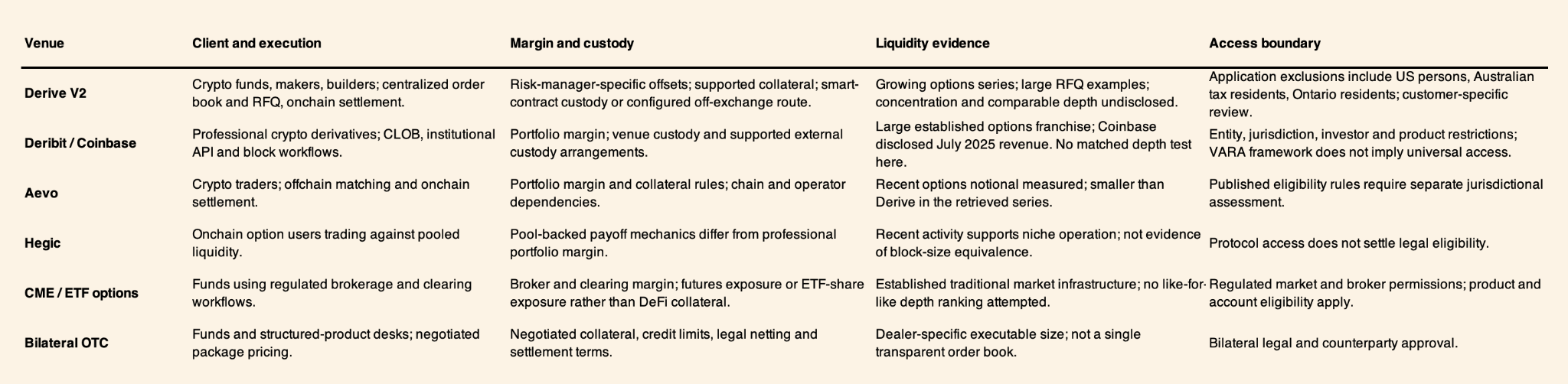
An established perpetuals business could give a future options entrant traders, market makers, distribution, and a market in which to hedge. It would still need competitive quotes across individual strikes and expiries; perpetuals turnover does not create that liquidity automatically. Derive can serve customers through collateral flexibility, programmable distribution, and institutional workflows even if larger platforms expand their product ranges. US institutional mandates may instead favor CME futures options or options on spot crypto ETFs; ETF options reference fund shares, while bilateral OTC structures require negotiated credit and documentation. DRV capitalization cannot be compared mechanically with Deribit’s acquisition price because the rights, liabilities, and profitability differ. [56, 62]
Alternative venues serve different mandates
| Venue | Client and execution | Margin and custody | Liquidity evidence | Access boundary |
|---|---|---|---|---|
| Derive V2 | Crypto funds, makers, builders; centralized order book and RFQ, onchain settlement. | Risk-manager-specific offsets; supported collateral; smart-contract custody or configured off-exchange route. | Growing options series; large RFQ examples; concentration and comparable depth undisclosed. | Application exclusions include US persons, Australian tax residents, Ontario residents; customer-specific review. |
| Deribit / Coinbase | Professional crypto derivatives; CLOB, institutional API and block workflows. | Portfolio margin; venue custody and supported external custody arrangements. | Large established options franchise; Coinbase disclosed July 2025 revenue. No matched depth test here. | Entity, jurisdiction, and investor and product restrictions; VARA framework does not imply universal access. |
| Aevo | Crypto traders; offchain matching and onchain settlement. | Portfolio margin and collateral rules; chain and operator dependencies. | Recent options notional measured; smaller than Derive in the retrieved series. | Published eligibility rules require separate jurisdictional assessment. |
| Hegic | Onchain option users trading against pooled liquidity. | Pool-backed payoff mechanics differ from professional portfolio margin. | Recent activity supports niche operation; not evidence of block-size equivalence. | Protocol access does not settle legal eligibility. |
| CME / ETF options | Funds using regulated brokerage and clearing workflows. | Broker and clearing margin; futures exposure or ETF-share exposure rather than DeFi collateral. | Established traditional market infrastructure; no like-for-like depth ranking attempted. | Regulated market and broker permissions; product and account eligibility apply. |
| Bilateral OTC | Funds and structured-product desks; negotiated package pricing. | Negotiated collateral, credit limits, legal netting and settlement terms. | Dealer-specific executable size; not a single transparent order book. | Bilateral legal and counterparty approval. |
Sources: [12], [26], [30], [34], [36], [37], [38], [39], [47], [51], [52], [56], [60], [62]. Qualitative comparison of operating models, not an execution league table. OTC is analytical market-structure context. V3 is excluded because production launch was not verified at the research cutoff. Link to this table.
Original exhibit
5. The production system and the proposed V3 migration
A production Derive trade begins with collateral and an account structure. Users bring supported assets into the current chain and protocol, then allocate them to subaccounts. These are separate risk portfolios rather than evidence of separate customers. A wallet signs instructions; the centralized application receives orders or RFQs, finds counterparties, and submits resulting actions for protocol processing. The May 2026 terms identify Lyra Technologies Corp as the operator of the application, including its order book, RFQ service, API, and interface. [12, 56]
Execution consequently has several meanings. Price discovery and matching occur offchain. Signature and risk checks constrain what can settle through the protocol. Settlement and collateral accounting occur onchain. A fast acknowledgment from an API is not an irrevocable settlement, and a chain confirmation is not the same as an Ethereum withdrawal becoming available. Each stage has a different failure mode and recovery procedure.
The V2 design supports standard and portfolio risk managers. Portfolio margin evaluates a combined book under stressed price and volatility scenarios, recognizing offsets between positions; cross-margin means positions share collateral rather than each having an entirely separate buffer. Neither implies unrestricted offsets between every asset. Collateral valuation includes asset-specific parameters and haircuts. Yield-bearing or wrapped collateral adds redemption, price, and issuer dependencies, so its face value should not be treated as cash. [12]
Options are European-style claims settled using the specified expiry price methodology. Perpetuals maintain exposure through ongoing funding and margin accounting. Oracle inputs and mark prices drive both valuation and risk decisions; they need not equal the last traded price. Institutions should verify the live collateral schedule, expiry rules, and risk parameters for each market. The available static publications do not support reproducing a complete, independently verified cutoff schedule of haircuts and maturities. [12, 56]
Liquidation starts when a subaccount breaches maintenance requirements. The published V2 mechanism auctions a fraction of its portfolio, with discounts intended to attract liquidators. If the portfolio becomes insolvent, the security module can pay another participant to assume it. Partial liquidation can preserve offsets and reduce market impact, but it requires liquidators able to finance and hedge the acquired book. If those firms withdraw during stress, a formally permissionless auction may have very few practical bidders. [40]
A security module should therefore be analyzed as a finite resource, not a blanket guarantee. Liquidation losses, insurance resources, and any residual loss allocation need reconciliation against deployed contracts and operating rules. The audit documents include socialization accounting findings, underscoring that the economic loss waterfall matters beyond ordinary auctions. This report does not assume a shareholder guarantee or unlimited fund behind customer claims. [40, 41]
The product range also exceeds the original ETH pool. BTC and ETH options and perpetuals are established markets; Derive has announced SOL and tokenized-gold XAUT options, alongside HYPE. Those listing announcements establish product availability as represented by the operator, not sustained liquidity at every strike. V3's broader proposed asset schedule must be treated separately from those existing markets. [45, 69]
An illustrative call spread shows both the benefit and the limits of margin offsets. A trader sells ten BTC calls struck at $100,000 and buys ten with the same expiry struck at $110,000. Assuming one BTC per contract and a net $20,000 premium received, maximum expiry loss is $80,000: ten times the $10,000 strike difference, less premium. Recognizing the long calls can reduce collateral relative to an uncovered short. This is not a Derive quote or margin requirement. Interim marks, collateral depreciation, liquidation costs, and an unmatched leg can still create funding needs before expiry.
The current chain adds operator dependencies. L2Beat's cutoff assessment identifies permissioned sequencing/proposal arrangements, Celestia data availability without an Ethereum data-availability bridge, and immediately upgradeable chain contracts. It also reports a mismatch affecting the functioning of the deployed proof system. Forced inclusion is not equivalent to guaranteed prompt withdrawal if the proposer fails. These observations concern the deployed chain and must not be replaced with claims about V3's intended protections. [42]
V3 is not established as production mainnet at cutoff. The September 10 discussion presents the architectural direction; the current onboarding documentation labels mainnet coming soon and publishes Sepolia deployments. A September 14 governance proposal describes migration and chain wind-down in future terms. Together these support a proposed migration with testnet infrastructure, not a completed production transition. [43, 44, 45]
The proposal moves custody and proof verification to Ethereum while running computation inside a zkVM and publishing state changes to Celestia. Matching remains centralized. Its proposed owner can change the state root or verifying key; emergency powers and a multisignature bypass remain. The escape process initially uses a two-week timeout. These qualifications matter as much as the cryptographic proof: validity is only as strong as the program, data, and authority governing what is verified. [45]
Economically, V3 could lower the cost of complex portfolios and reduce appchain-specific integration work. It also introduces prover availability, proving cost, data reconstruction, and migration reconciliation as dependencies. The planned conversion of balances, risk portfolios, and withdrawal arrangements deserves an account-level rehearsal. Partners must know whether their collateral mappings and controls survive the change. A benchmark for the matching engine, including the website's millions-of-transactions claim, provides no measured end-to-end settlement capacity. [1, 43, 44, 45]
6. Activity is growing faster than the evidence on profitability
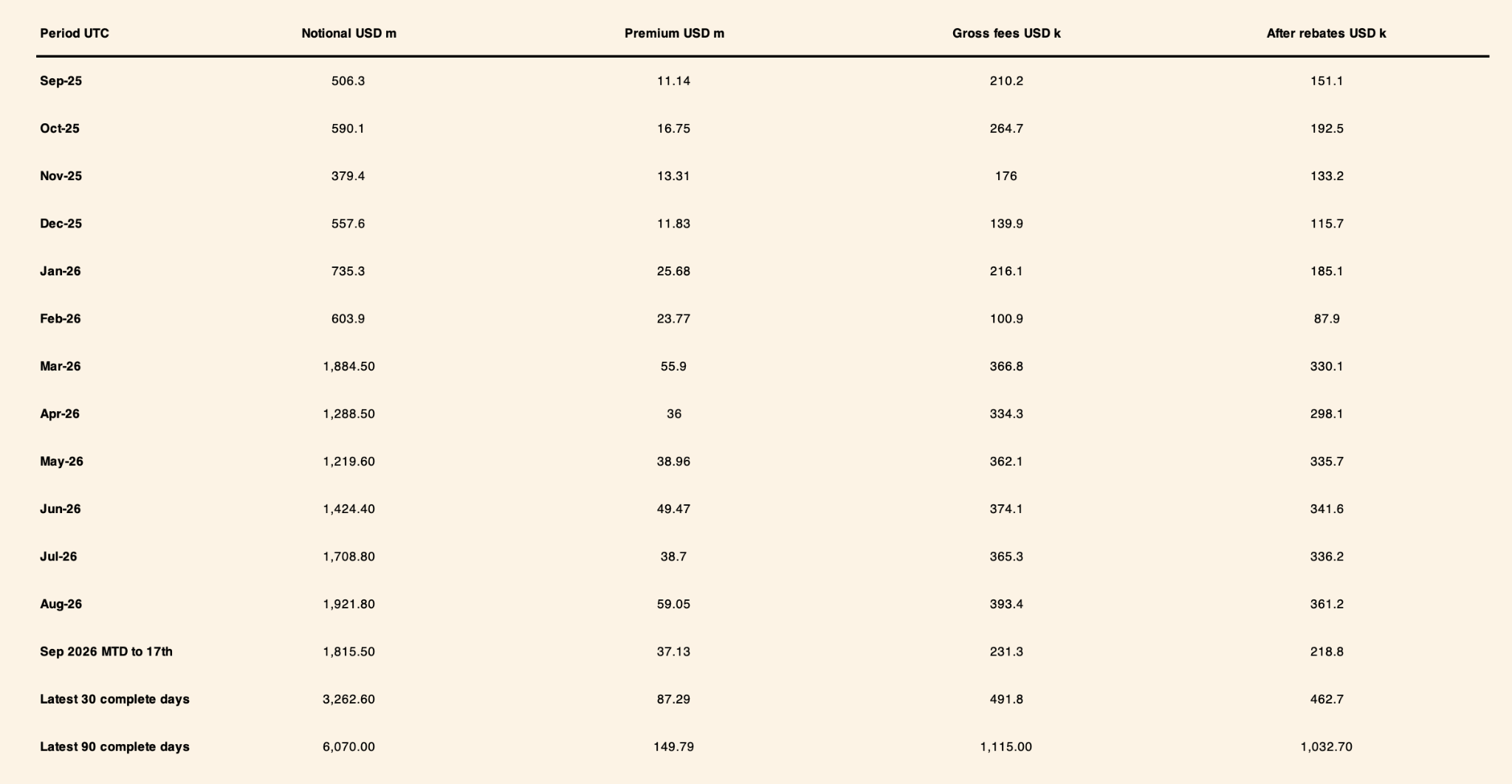
The cleanest recent comparison is within a single data family. Exhibit 4 aggregates DeFiLlama's daily options series and separate options fee series through September 17, 2026, retrieved on September 18. Its adapter obtains activity from Derive's API, so this is an independently maintained pipeline using operator-originated statistics, not an independent reconstruction of every trade. [47, 48, 49]
August options notional was $1.922 billion, against $735.3 million in January. Over the latest 30 complete daily observations, options notional was $3.263 billion and premium volume $87.29 million. Notional measures the underlying exposure traded; premium measures the price exchanged for options. Neither is open interest, collateral, or TVL. Rolling a position creates new volume without necessarily creating a new customer or increasing outstanding risk. [47]
The adapter does not independently prove whether all strategies and historical versions count both sides or each leg identically. Its options endpoint filters the instrument category, making it preferable to combining options and perpetual turnover. The report uses within-series comparisons and does not claim a precise global market share from these data. Comparing option premium with another exchange's notional would produce a meaningless ratio. [47, 49]
Open interest is less well resolved. FalconX's March analysis reported total Derive open interest above $1 billion on March 10, with options representing 61%. It put BTC options open interest at $488 million and approximately 0.8% of the $63 billion monitored BTC market. The September V3 proposal later claimed roughly $2 billion options open interest against an estimated $40 billion global total. Different dates, asset scopes, and denominators prevent treating these as a clean market-share series. The latter remains a team claim without an independently reproduced cutoff reconciliation. [45, 50]
The March report also described a structure above $130 million. Large trades establish that the venue can accommodate some large negotiated risk transfers; they can also make short-period growth lumpy. FalconX is a liquidity participant, not a disinterested evaluator. No public evidence reviewed establishes wash trading, but neither does aggregate volume establish unrelated counterparties, retention, or broad participation. The API's total trade count is not a count of investment firms. [20, 50]
Fee data show why volume is only the start. Over the same 30-day window, options gross fees were approximately $491,800 and revenue after trading rebates $462,700. Across options and perpetuals, the corresponding figures were $668,600 and $545,900. The adapter subtracts maker and taker rebates to reach revenue; subtracting those rebates again would double-count the expense. Token incentives, partner arrangements outside those fields, infrastructure, and personnel still have to be considered. [48, 49]
Dividing options revenue after rebates by notional produces an author-calculated 1.42 basis points for the 30-day window. January's equivalent was 2.52 basis points; August's was 1.88. Product mix, premium caps, customer tiers, and incentives can move this ratio, so it is an observed yield on reported turnover, not a contractual universal fee. The December fee announcement's top maker rebate and advertised taker entry rate should not be substituted for that realized blend. [46, 47, 48, 49]
Contribution sensitivity is straightforward. At an illustrative $1 billion of monthly volume and one basis point retained before other costs, revenue is $100,000. A 30% volume decline combined with 20% compression in that rate leaves $56,000, a 44% decline. Losing a major maker could hurt both dimensions through worse spreads and demands for replacement incentives. Removing subsidies could improve expense immediately while reducing later flow. This is scenario arithmetic, not a forecast or EBITDA estimate.
Current activity is encouraging relative to the historical expense disclosure. But a 2024 contractor budget cannot establish 2026 break-even after institutional sales, custody integration, and another architecture change. A credible profitability judgment requires current cash costs, contractual rebates, partner shares, incentive valuation, reserve policy, and retained revenue by legal entity. Without them, the appropriate conclusion is improving commercial evidence with unresolved operating profitability.
Options activity and fee economics
| Period (UTC) | Notional (USD million) | Premium (USD million) | Gross fees (USD thousand) | After rebates (USD thousand) |
|---|---|---|---|---|
| Sep-25 | 506.3 | 11.14 | 210.2 | 151.1 |
| Oct-25 | 590.1 | 16.75 | 264.7 | 192.5 |
| Nov-25 | 379.4 | 13.31 | 176 | 133.2 |
| Dec-25 | 557.6 | 11.83 | 139.9 | 115.7 |
| Jan-26 | 735.3 | 25.68 | 216.1 | 185.1 |
| Feb-26 | 603.9 | 23.77 | 100.9 | 87.9 |
| Mar-26 | 1,884.50 | 55.9 | 366.8 | 330.1 |
| Apr-26 | 1,288.50 | 36 | 334.3 | 298.1 |
| May-26 | 1,219.60 | 38.96 | 362.1 | 335.7 |
| Jun-26 | 1,424.40 | 49.47 | 374.1 | 341.6 |
| Jul-26 | 1,708.80 | 38.7 | 365.3 | 336.2 |
| Aug-26 | 1,921.80 | 59.05 | 393.4 | 361.2 |
| Sep 2026 MTD to 17th | 1,815.50 | 37.13 | 231.3 | 218.8 |
| Latest 30 complete days | 3,262.60 | 87.29 | 491.8 | 462.7 |
| Latest 90 complete days | 6,070.00 | 149.79 | 1,115.00 | 1,032.70 |
Sources and methodology: DeFiLlama options and fee series retrieved September 18, 2026, [47], [48], [49]. All values reproduce the original exhibit. MTD ends September 17, 2026; rolling periods refer to the same historical snapshot. Notional and premium are different measures; fees after rebates are not audited operating profit. Rolling rows overlap monthly rows and must not be added to them. Link to this table.
Original exhibit
7. How institutional access becomes recurring capital
The strongest institutional use case is not simply wanting blockchain exposure. It is a professional participant finding a combination of collateral utility, executable price, and distribution that improves its existing business. A market maker wants inventory offsets, stable APIs, financing, predictable liquidations, and enough profitable customer flow. A crypto fund wants a new source of risk transfer without rebuilding custody and reporting. A structured-product manager wants repeatable execution at a known size and a venue that can support the product throughout its life.
A traditional asset manager faces a more demanding approval sequence. Legal teams identify the contracting entities and permitted products. Compliance determines jurisdictional eligibility and customer classification. Risk approves collateral, concentration, and default limits. Operations tests reconciliation, settlement, and emergency withdrawals. Investment teams then decide whether the execution benefit justifies those fixed costs. A signed integration agreement does not demonstrate completion of that process by an end client.
Strands addresses one part of the problem. The January 27, 2026 announcement described an initial off-exchange custody pilot allocation of $2 million to $5 million. Custodied assets are represented through a one-for-one onchain proxy, illustrated as strandsBTC, that can support margin and is removed when the allocation unwinds. The much larger historical volume cited for Strands' broader infrastructure must not be attributed to Derive. [51]
The economic promise is fewer asset movements and less direct exposure of custody principal to an exchange environment. The legal mechanism is more consequential than the token label. The client needs to know whether it retains title to segregated assets, grants a security interest, or holds a contractual claim. It also needs to know who can issue and burn proxies, how outstanding issuance is reconciled with encumbered custody balances, and who has authority to release assets. Those details are not fully disclosed in the announcement. [51]
A proxy introduces a bridge between legal and technical records even when no conventional blockchain bridge is used. If the same custody asset can secure two obligations, onchain collateral may be overstated. If a proxy is mistakenly issued, the protocol can appear solvent while its offchain backing is insufficient. If P&L is settled periodically, exposure can accumulate between settlement cycles. An immediate onchain liquidation right is useful only if the offchain assets can be realized in time and under enforceable instructions.
These are failure scenarios, not allegations about the implemented arrangement. They explain why leaving principal with a custodian does not eliminate all smart-contract or counterparty risk. Incorrect margin or settlement logic can create liabilities enforceable against that principal. Custodian insolvency, intermediary insolvency, sanctions intervention, valuation disagreement, or conflicting jurisdictional orders can interrupt recovery. The complete contracts and default waterfall would determine who ultimately bears those losses.
BitGo supplies stronger partner-side confirmation. Its August 4, 2026 announcement says eligible institutional clients can access Derive options and perpetuals while collateral remains with BitGo Bank & Trust. The arrangement is subject to onboarding and regulatory requirements. This independently confirms the integration's commercial availability as described by the custodian. It does not disclose funded customers, utilization, revenue, settlement latency, or a guaranteed loss indemnity. [52]
The Strands pilot and BitGo announcement should not be silently combined into one fully documented architecture. Public materials do not establish that every BitGo flow uses the precise proxy arrangement described for Strands. A diligence team needs a configuration-specific diagram of custody accounts, control agreements, minting permissions, margin calls, and P&L settlement. Broad references to custody partners are insufficient to infer that all named custodians support the same production workflow.
Haruko targets the post-trade problem: consolidating positions, Greeks, and P&L across centralized venues, OTC books, and onchain positions. Greeks measure an option's sensitivity to underlying price, volatility, and time. These reports let a risk manager assess the fund's whole portfolio rather than a disconnected exchange balance. Derive announced the integration on March 18, 2026; a corresponding detailed partner-side Derive announcement and customer adoption figures were not located. Its status is therefore reported integration, with production usage not independently verified. [53]
Gold-i provides a different channel. Both sides describe Derive's integration into MatrixNET, allowing brokers, proprietary firms, and fund managers to reach its liquidity through existing trading platforms. Gold-i's own page confirms the connection and lists routes including MT4, MT5, DXtrade, and CLEO. Its infrastructure performance and network size are not measurements of Derive execution or acquired clients. Gold-i also explicitly describes itself as a technology provider rather than a financial-services provider. [54]
Distribution through builders can widen demand without making Derive the customer’s visible brand. Builder codes let an application add an opted-in fee to exchange fees, while broker rewards compensate distribution separately; the additional customer fee is not automatically a deduction from Derive’s base revenue. The intermediary generally retains the interface and customer relationship, giving it the ability to choose where future orders go. Lighter already reaches eligible Robinhood Wallet users for perpetual futures. That integration establishes a distribution channel for perps, while any options flow through it remains prospective. If Lighter or a venue in the Hyperliquid ecosystem develops competitive options depth, Derive will have to keep winning routes through executable prices, collateral use, and reliable settlement. [55, 74]
Copper's ClearLoop model shows that separating custody from execution is already part of centralized market infrastructure, including connectivity to Deribit. Derive's competitive question is therefore whether its implementation adds useful programmability and collateral access at acceptable cost. It cannot claim custody separation as an exclusive advantage. Intermediated settlement reduces some exchange exposure while introducing contractual, operational, and timing dependencies. [60]
The execution test is equally practical. A fund needs firm RFQ responses for its actual legs and size, the spread after all charges, the probability of completion, and the hedge available afterward. Average API latency is a poor substitute. No matched historical dataset was available to compare Derive and Deribit across identical strikes, expirations, sizes, and stress periods. Public large-trade examples should therefore be treated as capability evidence, not proof of uniformly superior execution.
Legal access remains constrained. Derive's May 9, 2026 terms exclude US persons and specified US connections, Australian tax residents, Ontario residents, and sanctioned or otherwise restricted persons. Eligibility must be assessed for the customer and its represented principals. A MiCA token whitepaper and a regulated custodian do not establish authorization to offer derivatives in every jurisdiction. [56, 59]
The most credible near-term customers are sophisticated crypto-native market makers, funds, and product distributors with existing digital-asset operations. They can use a complementary venue and value onchain collateral or embedded execution. Measured options flow, a confirmed custody integration, and disclosed liquidity-provider relationships demonstrate progress. Public evidence does not yet establish a diversified cohort of recurring large institutional clients. That missing link is the difference between being available to institutions and becoming part of their operating infrastructure.
8. DRV and the allocation of economic value
DRV is a governance and incentive instrument, not automatically an equity interest in the exchange operator. The January 2026 whitepaper states a maximum supply of 1.5 billion and contemplates governance-related changes. The September 2025 strategic-mint proposal explains the move from one billion: 500 million additional tokens, including 230 million for core contributors. Its structure combines time vesting with market-capitalization conditions for contributor transfers. The whitepaper corroborates the expanded stated supply; a complete wallet-by-wallet unlock and beneficial-ownership reconciliation was not independently reconstructed. [19, 59]
The distinction between a 50% supply increase and dilution is important. A holder who owns one unit out of a billion owns one out of 1.5 billion after full issuance, a one-third reduction in proportional ownership, before any new economic value is created. Vesting can defer selling pressure without eliminating the eventual claim on that value. Buyback amounts should therefore be compared with net issuance and distributions over matched periods, not simply celebrated in isolation.
The original DRV launch materials allocated 25% of revenue to buybacks and described a 28-day unstaking period. An April 2026 proposal called for 35% of protocol fees for buybacks, 100,000 weekly staking rewards instead of 250,000, and a seven-day unstaking period. The retrieved proposal specifies effectiveness upon implementation. Without a complete execution reconciliation, those revised settings are identified here as proposed terms, not silently treated as verified current parameters. [14, 58]
Legal ownership is more structured than the DAO label suggests. Governance materials identify a foundation holding protocol IP, a BVI subsidiary for treasury and token-related activities, and a Panama operating subsidiary. The current application terms name Lyra Technologies Corp; earlier governance used a different corporate suffix. The exact corporate chain and intercompany agreements require confirmation rather than editorial harmonization. The strategic proposal says contributors are aligned through tokens rather than value-accruing equity, but that statement does not itself give each token holder a direct claim against every entity. [19, 56, 57]
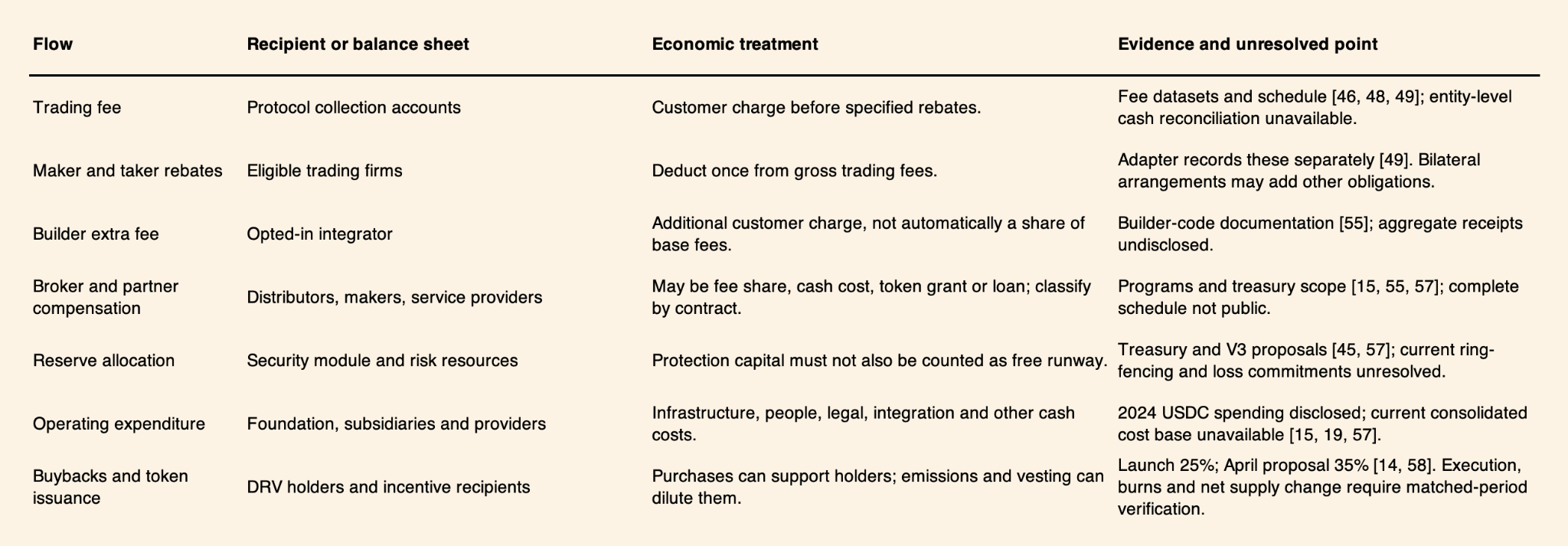
Market makers can earn spreads and incentives, integrators can earn distribution fees, and contributors can receive cash and tokens even when passive holders experience dilution. These arrangements may be necessary to build a valuable market. Their success should be tested against retained fees and lower future subsidy needs. The failed Synthetix proposal showed that control of treasury, software, and governance could become negotiable together; it did not establish a permanent valuation floor for DRV. [16, 17, 18, 19]
Where economic value can go
| Flow | Recipient or balance sheet | Economic treatment | Evidence and unresolved point |
|---|---|---|---|
| Trading fee | Protocol collection accounts | Customer charge before specified rebates. | Fee datasets and schedule [46, 48, 49]; entity-level cash reconciliation unavailable. |
| Maker and taker rebates | Eligible trading firms | Deduct once from gross trading fees. | Adapter records these separately [49]. Bilateral arrangements may add other obligations. |
| Builder extra fee | Opted-in integrator | Additional customer charge, not automatically a share of base fees. | Builder-code documentation [55]; aggregate receipts undisclosed. |
| Broker and partner compensation | Distributors, makers, service providers | May be fee share, cash cost, token grant or loan; classify by contract. | Programs and treasury scope [15, 55, 57]; complete schedule not public. |
| Reserve allocation | Security module and risk resources | Protection capital must not also be counted as free runway. | Treasury and V3 proposals [45, 57]; current ring-fencing and loss commitments unresolved. |
| Operating expenditure | Foundation, subsidiaries and providers | Infrastructure, people, legal, integration and other cash costs. | 2024 USDC spending disclosed; current consolidated cost base unavailable [15, 19, 57]. |
| Buybacks and token issuance | DRV holders and incentive recipients | Purchases can support holders; emissions and vesting can dilute them. | Launch 25%; April proposal 35% [14, 58]. Execution, burns and net supply change require matched-period verification. |
Source: original report exhibit, with supporting references [14], [15], [19], [45], [46], [48], [49], [55], [57], [58]. Percentages describe the cited launch settings or proposals, not a verified current distribution to token holders. Link to this table.
Original exhibit
9. Conclusion
Derive has done something few early onchain options projects managed: it survived the failure of its original liquidity model and built a venue that professional traders use. Growing options volume, market maker participation, and custody integrations support the product case. They do not yet establish a durable liquidity advantage, operating profitability, or a reliable return for DRV holders.
The competitive window may also be shorter than it appears. Hyperliquid has introduced bounded, options-like outcome contracts, and Hypercall has already launched a limited market for calls and puts on its network. Lighter’s founder has identified options as a major project. None has yet demonstrated a broad options market with comparable depth in Derive’s core BTC and ETH instruments. But established trading accounts, market maker relationships, and perpetuals markets for hedging could help a successful entrant scale faster. Each strike and expiry still needs executable liquidity, so an incumbent position in perpetuals offers a starting point rather than an automatic advantage in options. [70–73]
Over the next 24 to 36 months, the most plausible outcome is a valuable specialist venue. Crypto-native firms use Derive alongside larger exchanges, and custody partners and integrators bring recurring flow. That business can work without displacing Deribit or winning every retail trader. It requires V3 to preserve customer balances and workflows, options activity to persist beyond a few large trades, and retained fees to cover incentives, operations, and risk resources.
The upside case is that Derive becomes infrastructure for institutions and product distributors. Several independent makers quote competitive size, customers return across market cycles, and custody integrations produce funded accounts rather than announcements alone. Evidence would appear in customer retention, executable depth, lower flow concentration, and revenue after all acquisition costs. A reliable production V3 would strengthen that case.
The downside case includes competition from established options venues and expanding onchain trading ecosystems. Hypercall’s limited launch shows that this expansion has begun on Hyperliquid, while a broader options product from Lighter remains prospective. If either ecosystem develops deep, repeatable options liquidity as Derive migrates to V3, makers and intermediaries could redirect flow. Maintaining activity through larger rebates or token allocations would further weaken the link between volume growth and value for DRV holders.
Recent fee data leave open the possibility that a sustainable business is closer than public reporting shows. The missing evidence is a current account of costs, subsidies, unrestricted reserves, and recurring customer revenue. Derive has proved it can adapt its market structure. Its next test is whether customers will keep paying for its options liquidity when credible alternatives arrive, and whether enough of that revenue remains with the business and its tokenholders.
Bibliography
[1] Derive, About Derive and current product overview, undated. derive.xyz/about; derive.xyz
[2] Lyra, Introducing Lyra, June 15, 2021. insights.derive.xyz/introducing_lyra
[3] Lyra, Lyra DAO raises $3.3m, July 26, 2021. insights.derive.xyz/lyra-dao-raises-3-3m
[4] Lyra, synthetixDAO contributed $1m to Lyra, August 9, 2021. insights.derive.xyz/sdao-contributed-1m-to-lyra
[5] Lyra, Lyra OΞ Mainnet Launch, August 25, 2021, Internet Archive. web.archive.org/web/20210825073126/blog.lyra.finance/lyra-mainnet-launch
[6] Lyra, LYRA is live, December 14, 2021. insights.derive.xyz/lyra-is-live
[7] Lyra, AMM Performance Update, June 15, 2022. insights.derive.xyz/amm-performance-update
[8] Lyra, Avalon is live, June 28, 2022. insights.derive.xyz/avalon-is-live
[9] Lyra, Newport Upgrade, January 12, 2023. insights.derive.xyz/newport-upgrade
[10] Lyra, Lyra Raises Strategic Round, November 30, 2022. insights.derive.xyz/lyra-raises-strategic-round
[11] Lyra / Derive, Announcing Derive, originally Announcing Lyra V2, March 8, 2024; edited September 17, 2024. insights.derive.xyz/announcing-lyra-v2
[12] Lyra / Derive, A Technical Overview of Derive, originally Lyra V2, March 8, 2024; edited September 17, 2024. insights.derive.xyz/a-technical-overview-of-lyra-v2
[13] Derive, Derive, August 28, 2024. insights.derive.xyz/derive
[14] Derive, DRV launch and token guide, January 21, 2025; launch January 15. insights.derive.xyz/drv
[15] Derive governance, DIP Renew Lyra Foundation Funding, February 26, 2025. forums.derive.xyz/t/271
[16] Synthetix governance, SIP-415 Acquire Derive, May 2025; rejected. sips.synthetix.io/sips/sip-415
[17] Derive governance, DIP Synthetix Acquires Derive, May 14, 2025. forums.derive.xyz/t/277
[18] Synthetix, The Withdrawal of the Derive Acquisition Proposal, May 21, 2025. blog.synthetix.io/the-withdrawal-of-the-derive-acquisition-proposal
[19] Derive governance, DIP Strategic Mint for Institutional Expansion, September 12, 2025; clarifications September 14–15. forums.derive.xyz/t/303
[20] Derive, Variant invests in Derive to build the volatility layer onchain, February 3, 2026. insights.derive.xyz/variant-invests-in-derive-to-build-the-volatility-layer-onchain
[21] Variant, Investing in Derive, February 2, 2026. variant.fund/articles/investing-in-derive
[22] Friktion, Friktion Sunset Part 1, January 2023; withdrawal-only from January 25. friktionlabs.medium.com/friktion-sunset-part-1-8c60691cb657
[23] Opyn, Our beloved Squeeth is retiring and Squeeth has shutdown, September 19 and November 4, 2024. opyn.medium.com/our-beloved-squeeth-is-retiring-its-time-for-opyn-markets-to-take-over-1b66aad68f00; medium.com/opyn/squeeth-has-shutdown-a8a3c2869eaa
[24] CFTC, CFTC Issues Orders Against Operators of Three DeFi Protocols, Release 8774-23, September 7, 2023. cftc.gov/PressRoom/PressReleases/8774-23
[25] Aevo, Token Distribution, live documentation. aevo.xyz/docs/aevo-governance/token-distribution
[26] Aevo, Exchange documentation, live documentation. aevo.xyz/docs
[27] Zeta / Bullet, Zeta cessation notice and Bullet FAQ, cessation May 2025. docs.zeta.markets; docs.bullet.xyz/exchange/help-center/faq
[28] Stryke, Product site and Premarket transition notice, undated. stryke.xyz/en
[29] Premia, Premia Labs and Kyan beta, undated. premia.finance; kyan.blue
[30] DeFiLlama, Hegic options activity dataset, retrieved September 18, 2026. api.llama.fi/summary/options/hegic?dataType=dailyNotionalVolume
[31] Primitive Finance, Replicating Market Maker core contracts, GitHub. github.com/primitivefinance/rmm-core
[32] PsyFi / PsyOptions, PsyVault and PsyLend withdrawal reminder, June 24, 2024. x.com/PsyOptions/status/1805297109291131069
[33] Thetanuts Finance, Thetanuts V4, live documentation. docs.thetanuts.finance/thetanuts-v4
[34] Deribit, TradingScreen MARKTS partnership and VARA conditional approval, June 24, 2020 and April 2, 2024. insights.deribit.com/exchange-updates
[35] Yogita Khatri, Crypto exchange Deribit loses $28 million in hack, halts withdrawals, The Block, November 2, 2022. theblock.co/news/markets/2022-11-02-crypto-exchange-deribit-loses-28-million-in-hack-halts-withdrawals-182048
[36] Greg Tusar, Coinbase, Deribit joins Coinbase: Unlocking the future of global crypto derivatives, August 14, 2025. coinbase.com/blog/deribit-joins-coinbase-unlocking-the-future-of-global-crypto-derivatives
[37] Coinbase Global, 2025 Form 10-K, Note 3 Acquisitions, SEC, filed February 12, 2026. sec.gov/Archives/edgar/data/1679788/000167978826000015/coin-20251231.htm
[38] Coinbase Global, Q2 2026 Form 10-Q, Note 4 Acquisitions, SEC, filed July 30, 2026. sec.gov/Archives/edgar/data/1679788/000167978826000088/coin-20260630.htm
[39] Deribit, FIX API production overview, live documentation. docs.deribit.com/fix-api/production/overview
[40] Lyra / Derive, Derive Liquidation Engine, March 8, 2024; edited September 17, 2024. insights.derive.xyz/v2-liquidation-engine
[41] Sigma Prime, Derive formerly Lyra Round 2 Security Review. raw.githubusercontent.com/sigp/public-audits/master/reports/derive/review-round2.pdf
[42] L2Beat, Derive risk and technology assessment, live assessment. l2beat.com/layer2s/projects/derive
[43] Derive, Nick sat down with The Edge Podcast to talk Derive V3, September 10, 2026. insights.derive.xyz/nick-sat-down-with-the-edge-podcast-to-talk-derive-v3
[44] Derive, V3 Introduction and Contract Addresses, live documentation. docs.derive.xyz/getting-started/introduction; docs.derive.xyz/getting-started/contracts
[45] Derive governance, DIP Launch Derive V3, September 14, 2026. forums.derive.xyz/t/322
[46] Derive, Derive new options fee schedule, December 1, 2025. insights.derive.xyz/derives-new-options-fee-schedule-tighter-spreads-cheaper-trading
[47] DeFiLlama, Options daily premium and notional datasets for Derive and Aevo, retrieved September 18, 2026. api.llama.fi/summary/options/derive; api.llama.fi/summary/options/aevo
[48] DeFiLlama, Options and aggregate fee and revenue datasets, retrieved September 18, 2026. api.llama.fi/summary/fees/derive-options; api.llama.fi/summary/fees/derive
[49] DeFiLlama, Derive options and fees dimension adapters, GitHub. github.com/DefiLlama/dimension-adapters
[50] Martin Gaspar / FalconX, Exploring Derive record options surge, republished by Derive, March 13, 2026. insights.derive.xyz/exploring-derives-record-options-surge
[51] Derive, Derive and Strands launch off-exchange custody, January 27, 2026. insights.derive.xyz/derive-and-strands-launch-off-exchange-custody-for-institutional-derivatives-trading-onchain
[52] BitGo, BitGo and Derive Advance Institutional Onchain Derivatives with Regulated Collateral Infrastructure, August 4, 2026. bitgo.com/resources/blog/bitgo-derive-onchain-derivatives
[53] Derive, Making onchain options work for institutions, March 18, 2026. insights.derive.xyz/making-onchain-options-work-for-institutions
[54] Gold-i / Derive, Gold-i Integrated Derive.xyz to MatrixNET, May 28, 2026. gold-i.com/gold-i-integrated-derive-xyz-to-matrixnet; insights.derive.xyz/gold-i-matrixnet-integrates-derive
[55] Derive, Builder Codes, February 10, 2026. insights.derive.xyz/builder-codes
[56] Lyra Technologies Corp / Derive, Terms of Use and Trading Rules, updated May 9, 2026. derive.xyz/terms-of-use
[57] Derive governance, DIP Transfer Ownership of Protocol Parameters and Treasury Assets to Derive BVI Subsidiary, January 27, 2026. forums.derive.xyz/t/309
[58] Derive governance, DIP Update DRV Buybacks, Staking Emissions and Unstake Period, April 1, 2026. forums.derive.xyz/t/313
[59] Derive Foundation, DRV MiCA crypto-asset whitepaper, January 8, 2026. derive.xyz/files/mica-whitepaper.pdf
[60] Copper, ClearLoop Network, commercial product material. copper.co/en-ch/solutions/clearloop-network
[61] Reuters, Coinbase to buy derivatives exchange Deribit in a $2.9 billion deal, May 8, 2025. reuters.com/markets/deals/coinbase-acquire-deribit-29-billion-deal-wsj-reports-2025-05-08
[62] CME Group / Reuters, Bitcoin futures and options; SEC approves spot bitcoin ETF options. cmegroup.com/markets/cryptocurrencies/bitcoin/bitcoin; Reuters, September 20, 2024
[63] Derive, DRV Launch Program, January 13, 2025. insights.derive.xyz/drv-launch-program
[64] Lyra / Derive, Lyra Chain: Harder Better Faster Stronger, March 8, 2024. insights.derive.xyz/lyra-chain-harder-better-faster-stronger
[65] Lyra governance, Newport Optimism deployment and V2 launch governance records, April 3 and December 9, 2023. forums.derive.xyz/t/30; forums.derive.xyz/t/157
[66] Derive, FalconX Brings Institutional Liquidity Onchain, October 9, 2025. insights.derive.xyz/falconx-brings-institutional-liquidity-onchain
[67] Deribit, Deribit Launches Its Biggest-Ever Product Expansion, September 16, 2026. insights.deribit.com/exchange-updates/deribit-launches-its-biggest-ever-product-expansion
[68] Deribit, Deribit to Discontinue Daily Proof of Reserves Publication, August 27, 2026; effective September 1. insights.deribit.com/exchange-updates/deribit-to-discontinue-daily-proof-of-reserves-publication
[69] Derive, SOL on Derive and XAUT options are live on Derive, March 16 and July 24, 2026. insights.derive.xyz/sol-on-derive; insights.derive.xyz/xaut-options-are-live-on-derive
[70] Hyperliquid, HIP-4: Outcome markets, undated; accessed September 24, 2026.
[71] The Rollup, interview with Vladimir Novakovski, August 4, 2026.
[72] Hypercall, mainnet launch announcement, June 1, 2026; roadmap, updated September 24, 2026.
[73] Lighter, Weekly Update, September 18, 2026.
[74] Robinhood, global expansion and Robinhood Wallet announcement, July 1, 2026.
Cover Artwork

Claude Lorrain, c. 1674
Risk Disclaimer
insights4vc provides independent research based primarily on publicly available information believed to be reliable at the time of publication. Figures may change because of market prices, token supply, reclassification and methodology updates. Legal structures, investor rights and regulatory treatment vary by product and jurisdiction.
This article does not constitute investment, legal, tax, accounting or financial advice, or an offer, solicitation or recommendation regarding any security, token, fund interest or other asset. insights4vc makes no representation regarding the completeness or accuracy of third-party data. Readers should conduct independent due diligence and consult appropriately qualified advisers before making investment or business decisions.
Published by the insights4vc research team. See our research methodology, source standards and corrections policy. Dates and measurement periods are stated in each analysis.
Read next