Key Statistics
- Circle’s EURC remained the clear market leader, with €393.2 million in circulation on August 26, equivalent to 62.3% of screened euro supply.
- The ECB measured approximately €500 million of euro stablecoins on March 31, 2022, equivalent to just 0.2% of global stablecoin capitalization.
- At the August 27, 2026 research cutoff, global stablecoin capitalization was approximately $303.9 billion.
Figures and examples retain the report's original period, scope and source definitions. Consult the analysis and references below before making comparisons.
On August 26, 2026, Revolut began the phased rollout of EURR, its first euro-denominated stablecoin, to eligible customers in Poland, Denmark and Portugal. Although EURR is legally issued by Bridge Building S.A., a Stripe-owned and Luxembourg-regulated electronic-money institution, Revolut controls the customer relationship and distribution. The launch therefore matters less because Europe needed another euro token and more because EURR arrived with something most previous attempts lacked: direct access to tens of millions of existing financial customers.
It entered a market defined by a striking contradiction. The euro accounts for roughly 20% of disclosed global foreign-exchange reserves and appeared on one side of 28.9% of global FX trades in the BIS’s April 2025 survey. It is the domestic currency of 353 million euro-area residents. Onchain, however, it remains almost a rounding error.
At the August 27, 2026 research cutoff, global stablecoin capitalization was approximately $303.9 billion. The BIS estimated that close to 98% of stablecoin value remained dollar-denominated. A token-by-token screen identified approximately €632 million, or roughly $739 million, of redeemable and economically active euro stablecoins. That represented only 0.24% of the global market.
The broad CoinGecko euro-stablecoin category displayed $740.8 million of capitalization and approximately $71.6 million of 24-hour trading volume. That headline figure, however, included legacy, depegged or compromised assets. Trading across the cleaner, active market was concentrated in EURC, EURCV and EURI, and even those reported volumes should not be confused with organic payments or settlement activity.
Circle’s EURC remained the clear market leader, with €393.2 million in circulation on August 26, equivalent to 62.3% of screened euro supply. Société Générale’s EURCV followed with €143.2 million, or 22.7%. EURI, EURe, EURØP and EURQ accounted for a further 5.2%, 4.3%, 2.1% and 1.4%, respectively. EURC and EURCV therefore represented approximately 85% of a market that was itself still tiny.
The wider stablecoin market had grown from roughly $200 billion at the end of 2024 to more than $300 billion by the end of 2025. Euro supply increased as well, but not fast enough to change its global position materially.
Its historical trajectory was also far from linear. The ECB measured approximately €500 million of euro stablecoins on March 31, 2022, equivalent to just 0.2% of global stablecoin capitalization. Much of that supply belonged to a pre-MiCA generation that subsequently contracted, was discontinued or disappeared. The ECB’s tracked euro EMT universe stood at only around €50 million at the beginning of 2024, rising to $338 million by April 2025 and €450 million by January 2026. A separate, consistently defined study of eight MiCA-compliant stablecoins found that their combined capitalization increased from $295.6 million on June 30, 2025 to $673.9 million on June 28, 2026, a gain of 128%, while measured daily trading volume rose from $47.0 million to $67.3 million.
This is the central paradox: the euro is a major currency offline and a minor currency onchain. The problem was never a lack of attempts. It was a lack of distribution, liquidity, crypto-native demand and monetary network effects. Revolut’s EURR is important because it tests whether beginning with the users, rather than beginning with the token, can finally change that equation.
A short history of the onchain euro
Partner Highlight

Umia is building an operating stack for token-native ventures that combines fundraising, legal formation, treasury management and market-based governance.
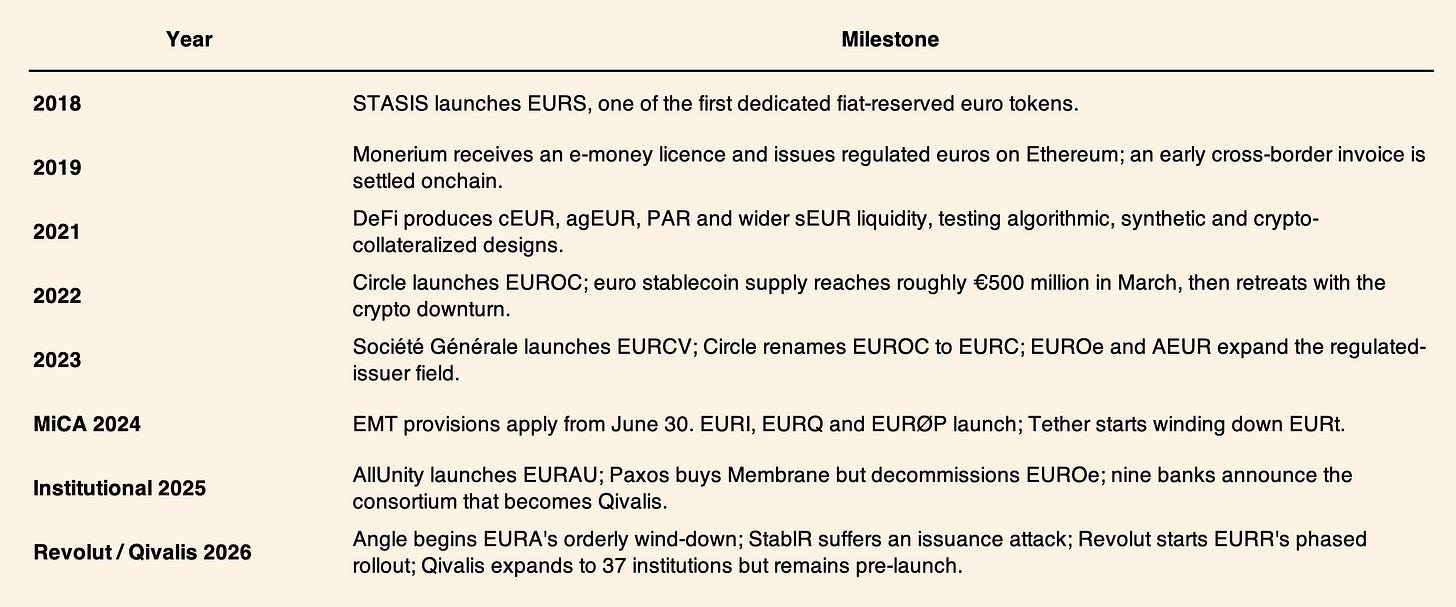
Stablecoins began around 2014 with two enduring models: crypto-collateralized BitUSD and fiat-backed Realcoin, later Tether. Tether introduced euro-denominated EURt in 2016 and moved it to Ethereum in 2017. Yet the company that built the dominant digital dollar never found the same flywheel in euros. EURt peaked near €236 million in February 2022, but Tether received its last acquisition request that year. It announced discontinuation in November 2024 and ended redemption on November 27, 2025. Residual tokens no longer represent a redeemable stablecoin.
Regulation explains the timing of the exit, not the commercial failure. USDT already sat at the center of exchange books, market-maker inventory, offshore settlement and dollar savings demand. EURt offered another currency exposure while adding thinner pairs and FX risk. Tether could mint a euro token; it could not reproduce USDT's accumulated monetary network.
STASIS's EURS, launched in 2018, was the first sustained specialist attempt. It expanded from Ethereum to Algorand, Polygon, XDC and XRP Ledger and exceeded €100 million of issuance in 2022. By the cutoff, only about 5.9 million units remained, with negligible daily trading. New issuance had been suspended since July 2024 and EURS did not appear in ESMA's current EMT register. It still circulated technically, but it was no longer part of the active regulated EU issuance market.
Monerium took a more consequential route. In 2019 it became the first EEA electronic-money institution authorized to issue e-money on public blockchains, then completed an early cross-border euro transaction on Ethereum. Its EURe is not principally exchange inventory. Each verified wallet can receive an IBAN: an incoming SEPA payment automatically mints EURe, while an outgoing wallet instruction burns tokens and sends euros through SEPA. This is regulated e-money with a blockchain interface, a conceptual bridge to the EMT model MiCA later formalized.
DeFi proved that stability is not enough
The 2020 to 2023 DeFi cycle produced euro assets with different promises. Fiat-reserved coins optimized for redemption and legal claims. Regulated e-money added an authorized issuer and safeguarding. Crypto-collateralized coins such as Angle's agEUR or Parallel's PAR sought open, overcollateralized borrowing. Synthetix's sEUR provided synthetic price exposure through a pooled debt system, not a claim on euro reserves. Celo's cEUR used the Celo reserve and protocol mechanisms to target mobile payments. Algorithmic or seigniorage designs attempted to manage supply without full fiat backing. Calling all of these "euro stablecoins" conceals materially different risks.
Angle was the strongest test. Launched in November 2021, agEUR exceeded €180 million of supply during its first growth cycle, integrated across lending markets, DEX pools and multiple chains, and was renamed EURA in 2024. The peg mechanism worked through severe markets. That was not enough. In February 2026, Angle proposed an orderly wind-down of EURA and USDA because declining activity no longer justified the operational and security burden. The protocol said both remained fully collateralized; redemption continues into 2027. This was commercial exhaustion, not an insolvency or peg collapse.
The wider record points the same way. PAR remains an overcollateralized niche of roughly €2.2 million. cEUR, now represented in the Mento system as Mento Euro, is around €1.5 million. sEUR is marginal. Decentralization removed reliance on a bank issuer, but it did not create exchange pairs, deep EUR lending demand or a global reason to save in euros. A stablecoin can work technically and still fail economically because it never becomes money to enough people.
Stopped, stressed and compromised
The discontinued projects failed in different ways. Finnish EMI Membrane Finance launched EUROe in 2023. Paxos acquired the company in February 2025, gaining regulated European infrastructure, then put EUROe into redemption-only mode. The licence, team and platform evidently had more strategic value than preserving a small token and its liquidity.
Anchored Coins' Swiss-issued AEUR, launched in 2023, exposed a different weakness. When reserve bank FlowBank entered Swiss bankruptcy proceedings in June 2024, Anchored restricted onboarding, issuance and redemptions while it assessed exposure. It later rebuilt 1:1 coverage at Swissquote and resumed an orderly redemption path. AEUR did not suffer an algorithmic death spiral, but the episode showed that "fiat-backed" converts smart-contract risk into issuer, safeguarding-bank and access risk.
StablR's EURR then demonstrated that MiCA does not eliminate operational failure. On May 23 and 24, 2026, attackers obtained unauthorized access to issuance infrastructure and minted approximately 6.41 million unbacked EURR, alongside 14.33 million USDR. StablR said lawful pre-incident tokens remained backed and reserve assets were untouched, but minting and redemption were still suspended on August 27. The 6.41 million attack mint is excluded from this paper's market totals.
This also created an unusual ticker collision. StablR EURR and Revolut EURR are unrelated tokens. The latter is issued by Bridge Building S.A. Wallets, exchanges and data vendors that rely on a ticker rather than issuer, chain and contract address risk displaying the wrong price, supply or compliance status.
EURC finds the first flywheel
Circle launched Euro Coin on Ethereum in June 2022 and renamed it EURC in September 2023. It subsequently added Avalanche, Stellar, Solana and Base, while Circle's French entity obtained an ACPR e-money licence and notified EURC under MiCA. EURC crossed €400 million on August 17, 2026, before normal issuance and redemption flows took supply back to €393.2 million on August 26. It ended 2024 near €80 million.
EURC is still microscopic beside USDC's $73.9 billion, but it is the first euro token with credible exchange, custody, payment and DeFi breadth. Coinbase, Kraken, Bitstamp, Bybit and Bitpanda support it; major on-ramps, institutional custodians and card-settlement partners reuse Circle relationships built around USDC. That suggests a qualified answer to why EURC is working: euro demand has improved, but Circle is also exporting an existing distribution machine. In stablecoins, integrations are a form of capital.
MiCA made issuance legible
MiCA did something more constructive than a ban. It made a fiat-referenced euro stablecoin an e-money token, or EMT, and created a common route for private issuance across the EEA. Titles governing stablecoins applied from June 30, 2024; the broader regime applied from December 30.
Under Title IV, an EMT issuer must be an authorized credit institution or electronic-money institution. Tokens are issued at par against funds received. Holders have a direct claim on the issuer and a right to redeem at any time at par, without a redemption fee. Issuers and crypto service providers may not pay interest or an equivalent holding benefit. A notified white paper must disclose the issuer, token, rights, technology and risks, while explicitly stating that the document has not been approved by a regulator.
For non-bank issuers, at least 30% of received funds must be held in separate bank accounts and the balance in secure, low-risk, highly liquid same-currency instruments. The bank-deposit floor rises to 60% for significant EMTs, alongside stricter liquidity, governance and EBA oversight. Bank issuers can use their balance-sheet model, subject to prudential rules.
The economic trade is clear. MiCA improves redemption rights, reserve discipline and institutional confidence, but adds fixed compliance, safeguarding and reporting costs. It therefore favors banks, scaled fintechs and infrastructure firms, while issuerless designs cannot qualify as EMTs. It may also encourage a field of individually compliant but mutually shallow liquidity pools. Regulation can make a token trustworthy; it cannot make it useful.
The regulated field in August 2026
MiCA changed who could credibly enter. EURCV began in 2023 as a whitelisted institutional token. SG-FORGE restructured it as an EMT in July 2024, removed transfer whitelisting and expanded from Ethereum to Solana, XRP Ledger and Stellar. Banking Circle's EURI launched in August 2024 as a bank-issued EMT. Quantoz launched EURQ with backing from Tether, Kraken and Fabric Ventures and a wider multi-currency strategy. AllUnity, the DWS, Flow Traders and Galaxy joint venture, received BaFin authorization and launched EURAU in July 2025, later integrating with Stellar and Deutsche Börse/Clearstream. Schuman Financial's EURØP added another ACPR-supervised issuer.
The credentials are stronger than the balances. EURAU had only about €430,000 outstanding at the cutoff despite its institutional parentage. This is useful negative evidence: a licence, strong shareholders and many chains still do not guarantee demand.
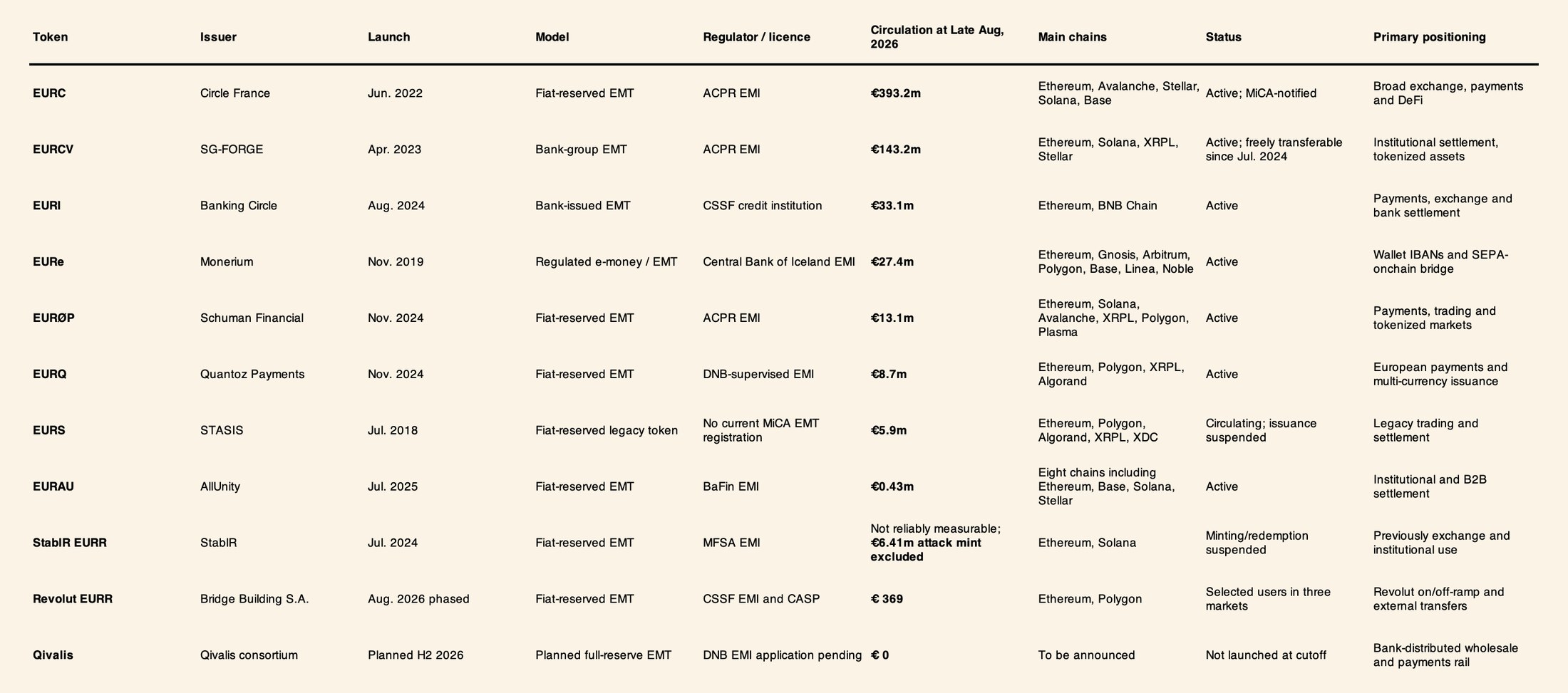
Supply is token units, not unauthorized or non-redeemable lookalikes. Aggregator coverage differs by chain, so figures are an investable-market snapshot rather than an accounting audit.
Revolut EURR: users first, token second
Revolut announced EURR testing on August 8, 2026. Bridge's white paper set August 20 as the public-offer start, and the phased rollout was reported live on August 26 for eligible customers in Poland, Denmark and Portugal. The announcement described an Ethereum-first launch. By August 26, verified contracts were live on both Ethereum and Polygon. Wider EEA availability was expected during 2026, and Revolut said other currency-denominated stablecoins were in development. "Testing," "selected-user availability" and "general availability" are not interchangeable: at the cutoff, reserves and circulating supply were only €369.
Revolut is not the legal issuer. Bridge Building S.A., part of Bridge and owned by Stripe, issues EURR as a Luxembourg EMT. It holds CSSF authorizations as EMI W00000024 and CASP N00000012. Revolut Digital Assets Europe, authorized by CySEC as CASP001/25, is the sole offeror and distributor through the Revolut app and Revolut X.
Bridge's white paper gives holders a direct claim and par redemption, subject to Bridge onboarding, identity checks and an eligible EEA IBAN. The issuer says redemption is completed within two business days without a fee. At August 26, the reserve dashboard showed €369 of cash deposits at credit institutions against €369 of EURR, with no securities allocation. Inside Revolut, users can exchange fiat or crypto for EURR and transfer it to an external wallet; the chain contract, Bridge's issuance ledger and segregated reserve sit beneath Revolut's interface.
That structure divides the stack. Bridge supplies regulated issuance, reserves, minting, redemption and multi-chain contracts. Revolut supplies KYCed customers, balances, FX, payments, crypto execution and the mobile interface. Neither company has publicly explained the make-versus-buy decision in detail, but using Bridge plausibly shortened time to market and separated the token liability from Revolut's banking entity. Stripe completed its acquisition of Bridge in February 2025 to make stablecoin issuance and movement an embedded infrastructure service, not a product every distributor must rebuild.
What Revolut can do differently is sequence. Earlier issuers created tokens, then searched for holders. Revolut started with more than 75 million customers in its August announcement and, according to launch reporting, more than 16 million crypto users. Even a small conversion rate could exceed most prior euro coins.
But distribution is only an option until users move balances outside the app, trade against them, borrow them or pay with them. The proven use case is currently a regulated crypto on/off-ramp. Cross-border payments, programmable treasury, internalized reserve economics and a multi-currency settlement network are credible strategic possibilities, not demonstrated adoption. The decisive metric is not app eligibility; it is sustained external circulation and usage.
The banks are coming, but have not arrived
Qivalis is the other important 2026 experiment. Nine European banks announced the initiative in September 2025. By May 2026 it had expanded to 37 financial institutions across 15 countries, including ING, UniCredit, BNP Paribas, CaixaBank, BBVA, Intesa Sanpaolo, Nordea, ABN AMRO, Bank Pekao, Danske, SEB and Raiffeisen Bank International.
The Amsterdam company was still applying to the Dutch central bank for an EMI licence at the cutoff and targeted a second-half 2026 launch. It therefore had no circulating stablecoin. Its proposed advantage is partner distribution into wholesale payments, corporate treasury, cross-border settlement and tokenized assets. Thirty-seven institutions can seed clients and market infrastructure that a start-up cannot. They can also create slow governance, competing priorities and cautious product design. Qivalis could solve distribution or become a committee before it becomes money.
Why the dollar won
Reserve-currency status is only the first layer. Stablecoins developed as crypto trading infrastructure, and the dollar became crypto's unit of account. USDT and USDC accumulated base pairs, exchange settlement, derivatives margin, lending demand, DEX pools, cross-chain bridges, wallets and market-maker inventory. Roughly 80% of centralized-exchange trades now involve stablecoins. Every new integration made the next one cheaper; liquidity attracted liquidity.
The second layer is international demand. For users living with inflation, currency depreciation, capital controls or weak banking systems, a dollar token is not merely trading cash. It is accessible dollar savings and a cross-border settlement asset. BIS research finds stablecoin flows rise with inflation and exchange-rate volatility, creating digital and sometimes stealth dollarization. A digital euro offers diversification and regional relevance, but it solves a smaller global monetary problem.
First-mover effects then harden into switching costs. An exchange adding a euro pair fragments books. A DeFi protocol accepting a euro coin must price EUR/USD risk and source an oracle. A market maker must finance another inventory. Users already measuring P&L in dollars have little reason to move unless euro rails are substantially better.
Issuer economics reinforce the gap, but did not create it. The ECB deposit rate was negative until July 2022, precisely when dollar stablecoins built their lead, so a simple "Treasury yield" explanation is historically wrong. By August 2026, short US Treasury yields around 3.8% exceeded the ECB's 2.25% deposit rate, making reserve income generally richer for dollar issuers. MiCA also prohibits passing interest to EMT holders, leaving yield with issuers after safeguarding and compliance costs. Rates improve the dollar business model today; network effects explain why it existed first.
Finally, Europe already has effective closed-loop money. SEPA, SEPA Instant, cards and bank apps make domestic euro transfers comparatively cheap. EU rules now require broad instant-transfer availability, and instant payments represented a quarter of euro-area retail-system credit-transfer count in the second half of 2025. A European consumer experiences less pain than someone seeking dollars outside the US. Stablecoins must therefore win on open programmability, 24/7 cross-border reach or tokenized-asset settlement, not merely speed.
Europe's response risks another handicap: fragmentation. A €632 million market split among many licensed liabilities has weaker DEX depth, lending utility and exchange coverage than one coin of the same size. MiCA lowered legal uncertainty while potentially creating several compliant puddles rather than one pool.
Three forms of digital euro
A private stablecoin such as EURC, EURR or EURCV is an issuer liability designed to move on public chains and, subject to controls, into wallets and DeFi. A tokenized commercial-bank deposit remains a claim on one bank and fits regulated wholesale networks, but it is not automatically fungible with another bank's deposit. A digital euro would be central-bank money and a public monetary anchor. The ECB was preparing a pilot for the second half of 2027 and indicated possible issuance around 2029 if EU legislation passed; it was not live in 2026.
These products overlap but are not substitutes. Private EMTs fit open trading, cross-border payments and programmable treasury. Tokenized deposits fit bank clients and institutional settlement. A CBDC can provide retail public money and finality without private-issuer credit risk. The Eurosystem has warned about dollar stablecoin dependence while explicitly leaving room for properly regulated, EU-governed euro stablecoins and tokenized deposits. The likely result is a three-layer architecture, not a single winner.
What would make the euro matter onchain?
The 2026 market is an inflection in issuer quality, not yet in monetary adoption. Four tests through 2027 and 2028 would distinguish the two:
- Scale and share. Euro supply should move from €632 million toward at least €5 billion and above 1% of global stablecoins. Otherwise growth may be real but economically peripheral.
- Liquidity, not listings. Watch non-incentivized DEX depth, EUR/USD spreads, centralized-exchange pairs, lending collateral and derivatives usage. A dozen shallow tokens do not equal one liquid euro.
- Economic transfer. Separate exchange-reported volume from adjusted onchain transfers, merchant payments, cross-border settlement, corporate treasury and delivery-versus-payment for tokenized securities. Active wallets and repeat senders matter more than gross minting.
- Distribution conversion. EURC must keep compounding integrations. Revolut EURR must expand beyond three test markets and turn eligible users into external holders. Qivalis must receive authorization, launch and activate its member banks. EURCV, EURI, EURe, EURQ, EURAU and EURØP must prove distinct use cases or interoperate closely enough to avoid liquidity fragmentation.
Three outcomes remain plausible. In the niche case, euro coins stay below 0.5% of global supply while dollar assets retain crypto and emerging-market demand. In the European settlement-layer case, growth comes from tokenized securities, treasury and regulated cross-border flows rather than retail savings. In the consumer-distribution case, Revolut and similar platforms turn stablecoins into a mainstream product, producing millions of active wallets and meaningful external payment volume.
The evidence does not show that Europe is about to produce a euro USDT. It suggests that copying USDT may be the wrong objective. The dollar winner emerged offshore, exchange-first and globally demand-driven. A successful onchain euro may instead be a network of regulated liabilities distributed through fintechs, banks and financial-market infrastructure.
The economics of that distribution question are explored from the issuer’s side in our Circle and Coinbase analysis. Its examination of reserve income and partner payments offers a framework for asking who retains value when a stablecoin reaches users through another platform.
That architecture can work only if users experience it as a common liquidity layer. Interoperable redemption, deep onchain EUR/USD markets and consolidated wallet and exchange support must make several issuers behave economically like one currency. Without that, 2026 will be remembered as the year Europe regulated the same small market more professionally. With it, the euro may finally move onchain in a form that looks distinctly European.
Sources
- European Central Bank, The international role of the euro, June 2, 2026.
- Bank for International Settlements, Triennial Central Bank Survey of FX and OTC derivatives markets, September 30, 2025.
- BIS Papers No. 170, Stablecoins, capital flows and dollarisation, May 2026.
- DefiLlama, Stablecoins by market capitalization, observed August 27, 2026.
- European Central Bank, The international role of the euro, June 2022.
- European Central Bank, Euro stablecoins and their potential effect on sovereign bond markets, April 2026.
- DECTA, Euro Stablecoin Trends Report 2026, July 5, 2026.
- European Union, Regulation (EU) 2023/1114 on markets in crypto-assets, June 9, 2023.
- ESMA, MiCA and the interim registers, register updated August 21, 2026.
- Tether, Closing update on the EURt wind-down, November 26, 2025.
- Monerium, 2019 year in review, December 31, 2019.
- Angle Protocol, AIP-112: EURA and USDA wind-down, February 2026.
- Paxos, EUROe redemptions, accessed August 27, 2026.
- FINMA, Bankruptcy proceedings opened against FlowBank, June 13, 2024.
- Circle, EURC exceeds €400 million in circulation, August 17, 2026.
- SG-FORGE, EUR CoinVertible elevation to MiCA-compliant EMT, July 1, 2024.
- StablR, Notification update on the May 2026 cyberattack, August 25, 2026.
- Revolut, EURR phased launch announcement, August 8, 2026.
- Bridge, EURR MiCA white paper, notified July 23, 2026.
- Qivalis, 25 new banks join the consortium, May 20, 2026.
Cover Artwork

Matterhorn
Albert Bierstadt, c. 1867
Risk Disclaimer
insights4vc provides independent research based primarily on publicly available information believed to be reliable at the time of publication. Figures may change because of market prices, token supply, reclassification and methodology updates. Legal structures, investor rights and regulatory treatment vary by product and jurisdiction.
This article does not constitute investment, legal, tax, accounting or financial advice, or an offer, solicitation or recommendation regarding any security, token, fund interest or other asset. insights4vc makes no representation regarding the completeness or accuracy of third-party data. Readers should conduct independent due diligence and consult appropriately qualified advisers before making investment or business decisions.
Published by the insights4vc research team. See our research methodology, source standards and corrections policy. Dates and measurement periods are stated in each analysis.