Key Statistics
- Circle reported $701.3 million of revenue and reserve income in Q2 2026, alongside $410.4 million in distribution and transaction costs.
- Circle reported $34.4 million of operating income for Q2 2026.
- Circle reported a 27% share of the specified dollar-backed stablecoin market at June 30, 2026, using its disclosed CoinMarketCap-based definition.
Figures and examples retain the report's original period, scope and source definitions. Consult the analysis and references below before making comparisons.
Accessibility update: . 5 exhibits are now available as selectable, accessible tables, with the original images retained below each table. Research cutoff: September 17, 2026. Figures and assessments retain their original reporting periods.
Circle’s central financial problem is visible before examining a single blockchain transaction. In the second quarter of 2026, it generated $701.3 million of revenue and reserve income, paid $410.4 million in distribution and transaction costs, and reported $34.4 million of operating income. USDC’s average circulation grew substantially from a year earlier, but falling reserve yields absorbed most of the resulting gross-income benefit. Distribution partners continued to collect more than Circle retained before operating expenses.[2][3]
Arc, whose public mainnet launched September 16, gives Circle a possible way to change that relationship. A network organized around its stablecoins, financial applications and developer services could attract balances through channels where Circle keeps more income. It could also produce service revenue that survives lower interest rates. Neither outcome follows automatically from launching a blockchain. Arc introduces another set of participants with claims on the economics, including validators, liquidity providers and prospective token holders.[17][21]
The evidence supports a qualified judgment: Circle owns a valuable distribution and redemption franchise, but shareholders receive a rate-sensitive residual after substantial partner payments and operating costs. Arc improves the range of possible outcomes more clearly than it improves demonstrated earnings. At approximately $17.8 billion of cash-adjusted enterprise value, CRCL already requires substantial commercial progress. The question is whether Arc helps deliver that progress efficiently, rather than merely adding transactions to an impressive network dashboard.
Partner Highlight

Umia is building an operating stack for token-native ventures that combines fundraising, legal formation, treasury management and market-based governance.
The dollar business beneath the platform
Circle Internet Group is the listed parent. Issuing entities include Circle Internet Financial, LLC and Circle Internet Financial Europe SAS, with obligations governed by their respective jurisdictions and terms. USDC is a dollar-denominated payment token; EURC performs a similar function in euros. Neither is an ownership interest in the parent. USYC, a tokenized investment product, has a different economic purpose: it provides exposure to an income-producing fund, subject to eligibility and fund terms. Circle Payments Network, or CPN, connects payment institutions; developer products help applications manage wallets, contracts and cross-chain transfers. Arc is a blockchain operated through a permissioned validator network. Reserve income remains the group’s principal commercial engine.[1][2][6][17]
The distinction matters when evaluating a new partnership. A wallet integration can increase USDC availability without producing a software subscription. A payment can use USDC without generating a material transaction fee for Circle. A tokenized fund subscription can move money out of ordinary USDC holdings into an investment product. These activities may reinforce one another, but they have different revenue mechanisms and cannot be valued as interchangeable platform growth.
Consider a qualifying business buying newly issued USDC through Circle Mint. After onboarding and required checks, it sends dollars through approved banking arrangements. Circle issues the corresponding tokens, while the dollars enter the reserve structure. The customer can transfer those tokens to another wallet without moving the underlying reserve assets. Eventually, an eligible redeemer returns USDC, which is removed from circulation through burning, and receives dollars through the banking system. Outside the European Economic Area, direct redemption under Circle’s published USDC terms generally requires an eligible Circle Mint account in good standing. Other holders normally rely on exchanges, wallets or intermediaries; European issuance and redemption operate under separate terms.[6]
This structure supports arbitrage around the dollar peg. When exchange prices fall below one dollar, an intermediary with reliable redemption access can buy tokens and redeem them. Above one dollar, it can mint and sell. The trade is only attractive after fees, funding costs and execution risks. Banking interruptions, compliance reviews, exchange fragmentation or congested infrastructure can delay the corrective flow. A reserve-backed claim therefore does not guarantee that every holder can obtain fiat dollars instantly, in every market, at exactly par.
Circle describes USDC reserves as cash and short-dated government instruments, including holdings in the BlackRock-managed Circle Reserve Fund, a government money market fund that invests in Treasury securities and overnight Treasury repurchase agreements. BNY serves as the fund’s custodian. Reserve reporting and independent examinations provide evidence about specified assets and liabilities at stated dates. They are distinct from Deloitte’s audit of Circle’s consolidated financial statements, and neither establishes continuous availability of every bank or blockchain connection.[1][7]
USDC also has administrative controls. Circle can block addresses or freeze tokens under its terms and applicable legal requirements. Holders face custody, operational and smart-contract risks alongside issuer and banking risks. Blockchain finality establishes the ledger’s treatment of a transfer; it does not establish that a recipient’s bank has credited spendable cash. USDC is not an insured bank deposit.[6]
Yield requires equally careful language. Ordinary USDC does not entitle its holder to Circle’s reserve interest. A distributor may pay rewards from its own commercial arrangements. Lending USDC introduces borrower, collateral and protocol exposures. Holding a tokenized fund creates investment-product exposure. These returns have different payers and risks, even when a wallet displays them beside the same dollar balance.[6][17]
For a simple illustration, $10 billion of average reserves earning 3.5% annually produces approximately $87.5 million over one quarter. If distribution arrangements absorb 60%, $35 million remains before other costs, compensation and taxes. That assumed split is illustrative, not Circle’s universal contract. A dollar can change hands repeatedly while supporting the same reserve dollar. Faster circulation may improve usefulness without increasing reserve income; durable growth in average balances is what expands the interest base.
Circle reported 27% market share at June 30 under a specific denominator: dollar-backed stablecoins exceeding $100 million of circulation with established periodic attestations, using CoinMarketCap data. That is not a share of all digital assets, all tokenized dollars or global payments. USDC remains behind USDT in outstanding supply. Its positioning emphasizes regulated access and institutional integration, while competing issuers can offer stronger exchange distribution, rewards or bank relationships. Growth in the category does not guarantee growth in Circle’s share.[3][4]
Regulation strengthens access while potentially widening competition. The GENIUS Act was enacted July 18, 2025, but its statutory effective-date mechanism is the earlier of January 18, 2027, or 120 days after final implementing regulations. The OCC’s February 2026 proposal was a rulemaking step, not full implementation. Circle National Trust received final approval July 9 and opened July 24, initially offering fiduciary digital-asset custody to Circle and its affiliates. A separate subsidiary obtained a New York limited-purpose trust charter July 31. These are specific permissions, not general licenses for every group product.[2][8]
In Europe, MiCA’s stablecoin provisions applied from June 30, 2024, ahead of the regulation’s broader December 30 application date. Circle announced MiCA-compliant USDC and EURC issuance through its French electronic-money institution on July 1, 2024, under authorization from the ACPR. This provides a regulated issuance framework without approving every use of those tokens. Circle’s launch disclaimer expressly says Arc itself has not received regulatory approval.[9][17]
Growth that partners and interest rates can absorb
Q2 2026, released August 5, remained Circle’s latest reported quarter at the cutoff. The financial picture is more restrained than the year-over-year net-income comparison suggests. Average USDC circulation increased about 25%, but gross revenue and reserve income increased only 6.6%. The reserve return fell from 4.14% to 3.48%. Other revenue grew from a small base and still represented only 4.8% of the total.[2][3][4]
Circle’s own reserve-income bridge attributes approximately $147.4 million of year-over-year improvement to higher circulation and a $113.9 million reduction to lower yields. Only about $33.5 million survived at the gross reserve-income line. This is a useful correction to a common reading of stablecoin growth: the issuer can process more business and serve a larger dollar base while the return generated by each reserve dollar falls enough to absorb most of the benefit.[2]
Circle financial scorecard
| Metric | Q2 2025 | Q1 2026 | Q2 2026 |
|---|---|---|---|
| Average USDC circulation, $bn | 61 | 75.2 | 76.5 |
| Period-end USDC circulation, $bn | 61.3 | 77 | 73.3 |
| Annualized reserve return | 4.14% | 3.50% | 3.48% |
| Total revenue and reserve income, $m | 658.1 | 694.1 | 701.3 |
| Reserve income, $m | 634.3 | 652.5 | 667.7 |
| Other revenue, $m | 23.8 | 41.6 | 33.6 |
| Distribution and transaction costs, $m | 406.5 | 405.4 | 410.4 |
| Other costs, $m | 0.5 | 1.4 | 2.1 |
| Revenue less distribution costs, $m | 251.1 | 287.4 | 288.8 |
| Operating expenses, $m | 576.7 | 242.4 | 254.5 |
| Operating income or loss, $m | -325.6 | 45 | 34.4 |
| Net income or loss, continuing operations, $m | -482.1 | 55.2 | 48.2 |
| Diluted EPS, $ per share | -4.48 | 0.21 | 0.18 |
| Adjusted EBITDA, $m | 133 | 151.4 | 143.5 |
| Stock-based compensation, $m | 435 | 51.8 | 53.6 |
| USDC onchain transfer volume, $tn | 5.9 | 21.5 | 14.8 |
Sources: Circle quarterly filing, results and presentation [2], [3], [4]. USD unless specified; m = million, bn = billion, tn = trillion. Figures retain the original exhibit's precision. Onchain transfer volume is not equivalent to customer payment volume; adjusted EBITDA is a non-GAAP measure. Link to this table.
Original exhibit
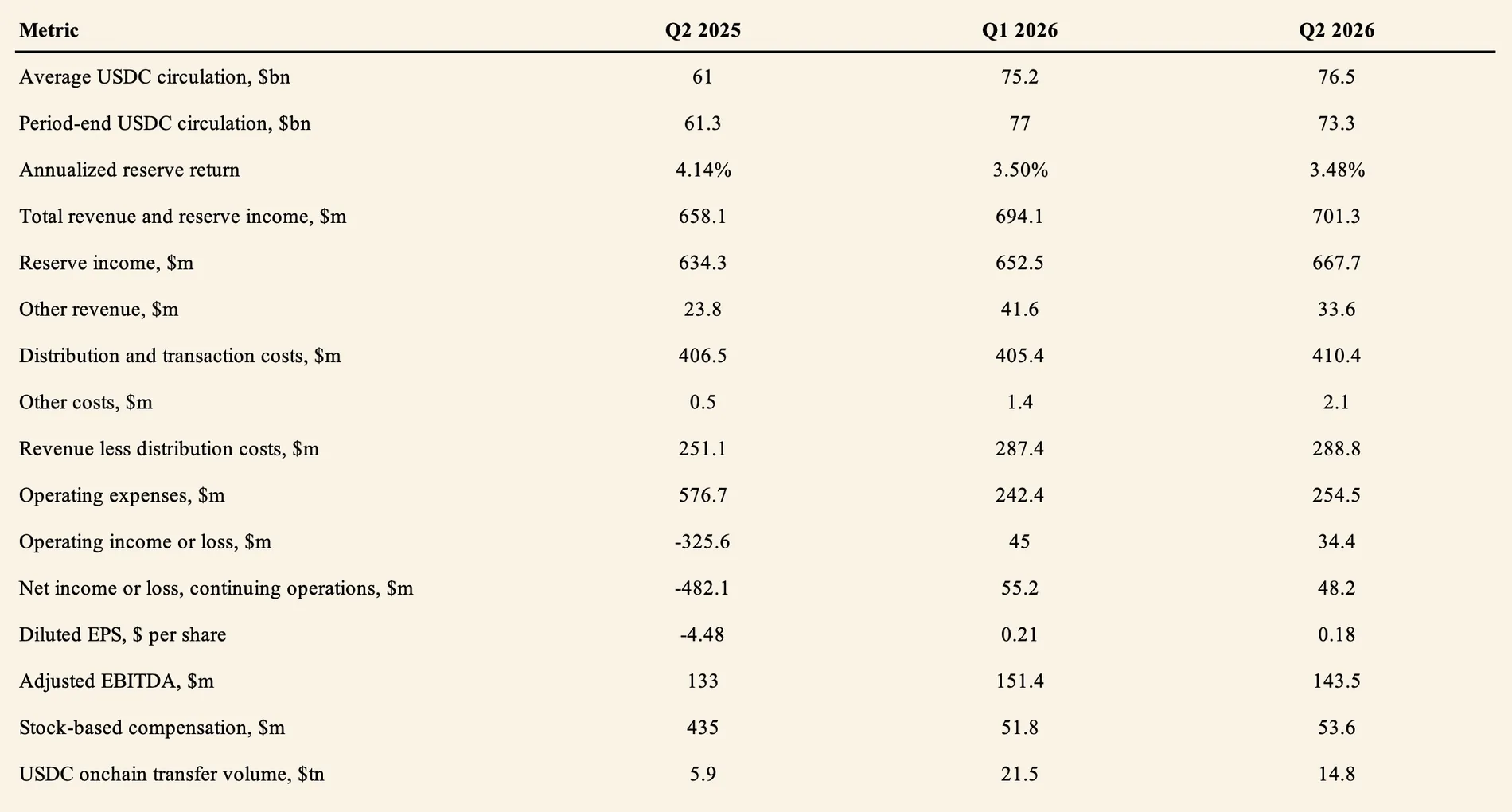
Average balances exceeded quarter-end balances because circulation contracted during the quarter. That helps explain why an attractive year-over-year average can coexist with weaker recent momentum. Nor does the reported $14.8 trillion of quarterly transfers establish an equivalent payments business. Trading, liquidity movements, contract interactions and repeated transfers can inflate turnover relative to the underlying money stock. Circle’s seven million wallets holding more than $10 similarly count addresses meeting a balance threshold, not identified customers.[3][4]
CPN provides a more targeted activity indicator: its trailing-30-day volume, annualized at June 30, reached $14.7 billion, with 175 enrolled institutions. The annualized run rate is not completed annual volume, and enrollment does not establish activity or revenue per institution. These measures suggest a developing distribution channel but do not yet demonstrate material diversification in the income statement.[3][4]
Where the second quarter gross income went
| Q2 2026 bridge | USD million | Interpretation |
|---|---|---|
| Reserve income | 667.7 | Primarily income on stablecoin reserves |
| Other revenue | 33.6 | Integration, subscription, fund and other services |
| Total revenue and reserve income | 701.3 | Gross income denominator |
| Less distribution and transaction costs | -410.4 | Includes $324.6m attributable to Coinbase |
| Less other costs | -2.1 | Included in Circle’s RLDC deduction |
| Revenue less distribution costs | 288.8 | 41.2% of gross income |
| Less operating expenses | -254.5 | Includes $53.6m stock compensation |
| Operating income | 34.4 | 4.9% of gross income |
| Other income, net, less income taxes | 13.9 | Includes corporate investment income |
| Net income, continuing operations | 48.2 | GAAP measure |
| Adjusted EBITDA | 143.5 | 49.7% of RLDC; 20.5% of gross income |
Sources: Circle Q2 2026 filing and financial reconciliations [2], [3], [4]. RLDC means revenue less distribution costs. Reported figures and percentages are rounded, so displayed components may not sum exactly. Adjusted EBITDA is a separate non-GAAP measure, not an additional line to add to net income. Link to this table.
Original exhibit
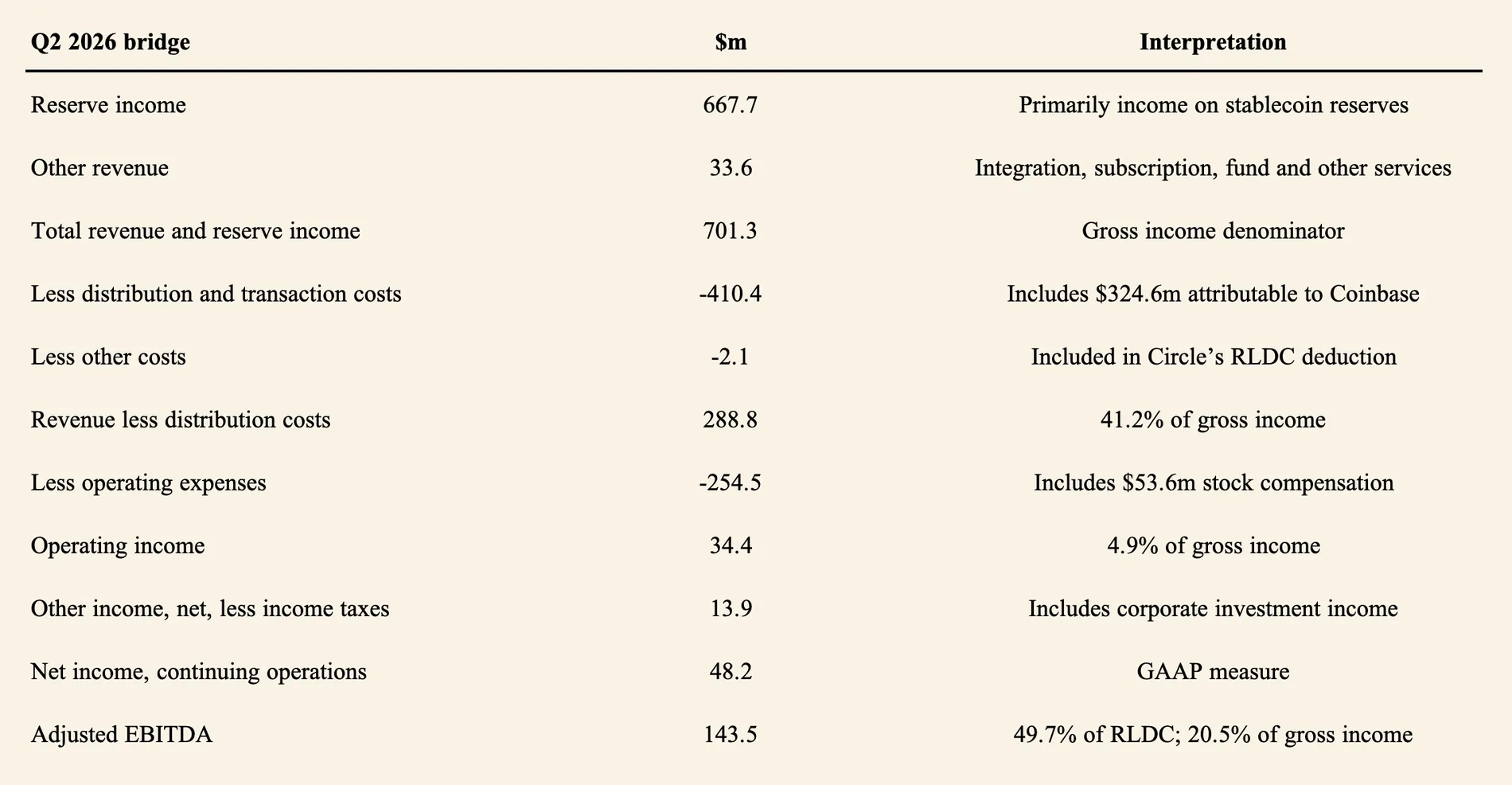
Coinbase is both a powerful distribution asset and a large claimant on the return. The disclosed agreement first allocates an issuer component and platform-related economics, then gives Coinbase half of the remaining ecosystem income after specified adjustments and approved partner payments. Applying a flat 50% haircut to every USDC reserve dollar would misstate the contract. Binance and other channels have separate arrangements, including incentives and commitments that can change the marginal economics of growth.[1]
The relevant question is where the next dollar sits and which agreement governs it. Circle’s own-platform share averaged 19.5% during Q2, versus 7.4% a year earlier. This daily-weighted metric differs from the 17% own-platform share measured at quarter end. Coinbase-related expense fell modestly year over year even as total distribution and transaction costs increased. The outcome reflects channel mix as well as balances and yields.[2][4]
Better direct distribution could improve retained income without any change in market rates. But an on-platform balance is not necessarily costless to acquire or permanently captive. Customers may require incentives, liquidity support, integration spending or preferential pricing. Arc is relevant precisely because an application ecosystem might attract balances more economically. Until that happens, counting an Arc deposit as a high-margin direct customer would assume the result being tested.
Reported earnings also need normalization. The prior-year loss included exceptional IPO-related compensation and valuation effects. FY2025 produced approximately $2.7 billion of gross revenue and reserve income but a roughly $70 million continuing-operations loss, including $424 million of IPO-related stock compensation. Q2 2026’s positive net income therefore represents progress, but the improvement over that comparator exaggerates the change in recurring economics. Sequentially, operating income and adjusted EBITDA declined as expenses rose faster than RLDC.[1][2][3]
Adjusted EBITDA removes recurring stock compensation as well as other specified expenses. Circle changed its definition in 2026 to exclude related payroll taxes, so comparisons should use conformed periods. Investors should not equate the 49.7% EBITDA-to-RLDC ratio with a margin on gross revenue, or treat equity compensation as costless because it is noncash. The difference between GAAP operating income and adjusted EBITDA is economically material.[3][4]
Below operating income, corporate interest contributed $14.5 million and investment gains another $3.7 million in Q2. Those amounts belong to shareholders but do not demonstrate payment-platform profitability. The effective tax rate was only 7.8%, reflecting, among other factors, losses carried forward and stock-compensation deductions that reduced U.S. taxable income. Applying that rate indefinitely would overstate normalized earnings unless the supporting tax position persisted.[2]
Even the other-revenue category needs inspection. Integration fees can be recognized when a particular delivery obligation is accepted, whereas maintenance and access subscriptions accrue over time. Fund performance fees and redemption charges respond to different drivers again. The useful diversification test is recurring contribution after the costs of delivering those services, with contract milestones and token transactions identified separately. A smaller, repeatable revenue stream can deserve more confidence than a larger quarter driven by one delivery event.[2]
What the shares require
Rate exposure remains substantial. Using Q2’s exact average USDC balance of $76.524 billion, a one-percentage-point annual yield change alters gross annual reserve income by approximately $765 million, or $191 million for a simplified quarter. That is not a net-profit sensitivity. Partner costs adjust, reserve instruments reprice over time, and customer behavior can change. Circle’s separately disclosed sensitivity, using period-end balances and its modeled distribution terms, estimates approximately $737 million of annual gross exposure and $360 million of offsetting distribution-cost movement per percentage point.[2]
At unchanged distribution economics, a fall from 3.5% to 2.5% requires 40% balance growth to preserve gross interest income. Twenty percent growth is insufficient. Improved retention can close much of the remaining gap, which makes distribution strategy at least as important as transaction growth. The reverse also applies: higher yields can mask expensive customer acquisition and weak service monetization.
Corporate liquidity offers protection, but reserve assets do not belong in an equity cash adjustment. At June 30, Circle held $1.730 billion of corporate cash and equivalents and another $889 million of segregated cash backing its own stablecoin holdings. The $73.161 billion backing external holders is excluded from shareholder liquidity. Debt was nil; restricted cash of $12.8 million, strategic investments of $103.8 million and digital assets of $106.5 million require separate treatment rather than inclusion as cash equivalents.[2]
First-half operating cash flow was $538.5 million. That includes $222 million received in private ARC token financing and recorded through deferred revenue. Subtracting that receipt leaves $316.5 million as a simple diagnostic, not a fully normalized cash-flow measure. Token commitments, associated performance obligations and possible repayment provisions complicate the liquidity assessment. Cash received can support operations before it qualifies as revenue, much less recurring earnings.[2]
CRCL’s trading history illustrates how aggressively expectations have moved. The June 2025 IPO offered shares at $31; the first trade was $69 and the first-day close $83.23. The stock reached an intraday $298.99 on June 23, 2025. The September 16, 2026 regular-session close of $80.45 was 73.1% below that intraday peak, 159.5% above the offer price and 3.3% below the first-day close. These comparisons use distinct price conventions deliberately.[10][11][12]
Recent price movements cannot be assigned to Arc alone. The Financial Times reported a July rally around Circle’s trust-bank approval while also describing competition from an OpenUSD initiative involving major financial firms. Reuters reported a decline around August earnings, and another sharp sector selloff September 15 as the Senate failed to advance broader crypto legislation. On September 16, the Federal Reserve raised its target range by 25 basis points to 3.75%–4%. Higher short-term rates can help future reserves while tighter financial conditions hurt growth-stock valuations. Arc’s launch coincided with these crosscurrents; the closing-price decline does not identify its isolated market effect.[13][14][15][16]
The valuation hurdle is informative without pretending to be a price target. A 25-times enterprise-value-to-operating-earnings assumption implies roughly $712 million of annual earnings, compared with Q2 operating income annualized at $137 million. The assumed $250 million recurring non-reserve contribution is itself a demanding increase over the current business. Lower yields and poorer retention raise the required balance materially. If those earnings arrive years later, discounting raises the eventual hurdle again.
No verified, current consensus series with a consistent accounting basis is used here. Headline revenue multiples are particularly misleading because they capitalize income substantially owed to partners. The shares are best understood as a reserve-income franchise priced for considerable expansion and improved operating economics, with payments and Arc offering possible routes. The market price alone cannot reveal a separately identifiable Arc premium.
Arc starts with access and a controlled validator set
Arc’s commercial rationale is stronger when stated narrowly. Circle can distribute USDC on other blockchains, but it cannot unilaterally set their fee assets, congestion policies, upgrade priorities or institutional access arrangements. Operating its own chain allows it to coordinate those choices with payment services and application development. The benefits depend partly on the blockchain and partly on contracts, banking connections and software that could also be offered on existing infrastructure.
Arc launch milestones and unfinished functions
| Date | Event or capability | Status at September 17, 2026 |
|---|---|---|
| 12-Aug-25 | Arc announced with Q2 2025 results | Product announcement, not public production |
| 28-Oct-25 | Public testnet launch | Testing with non-production activity |
| May-26 | Private mainnet | Disclosed in Q2 filing; exact start day not specified |
| 11-May-26 | ARC whitepaper and initial private financing announcement | Financing and proposed token design |
| 5-Aug-26 | Founding validator cohort and launch date announced | Cohort commitments; phased implementation |
| 16-Sep-26 | Public mainnet | Public transaction and application access; permissioned validators |
| Week of September 16, 2026 | Genesis mint of 10bn ARC | Technical mint; not public token launch |
| Future, no binding delivery date | Network-wide opt-in privacy, specialized sectors and AgentVM | Development or design roadmap |
| Explored for 2027 | Transition toward proof of stake | Not activated at public mainnet launch |
Sources: [2], [17], [18], [19], [20], [21], [22]. Status labels reproduce the September 17 report snapshot. Planned functions and financing milestones do not establish public production usage. Link to this table.
Original exhibit
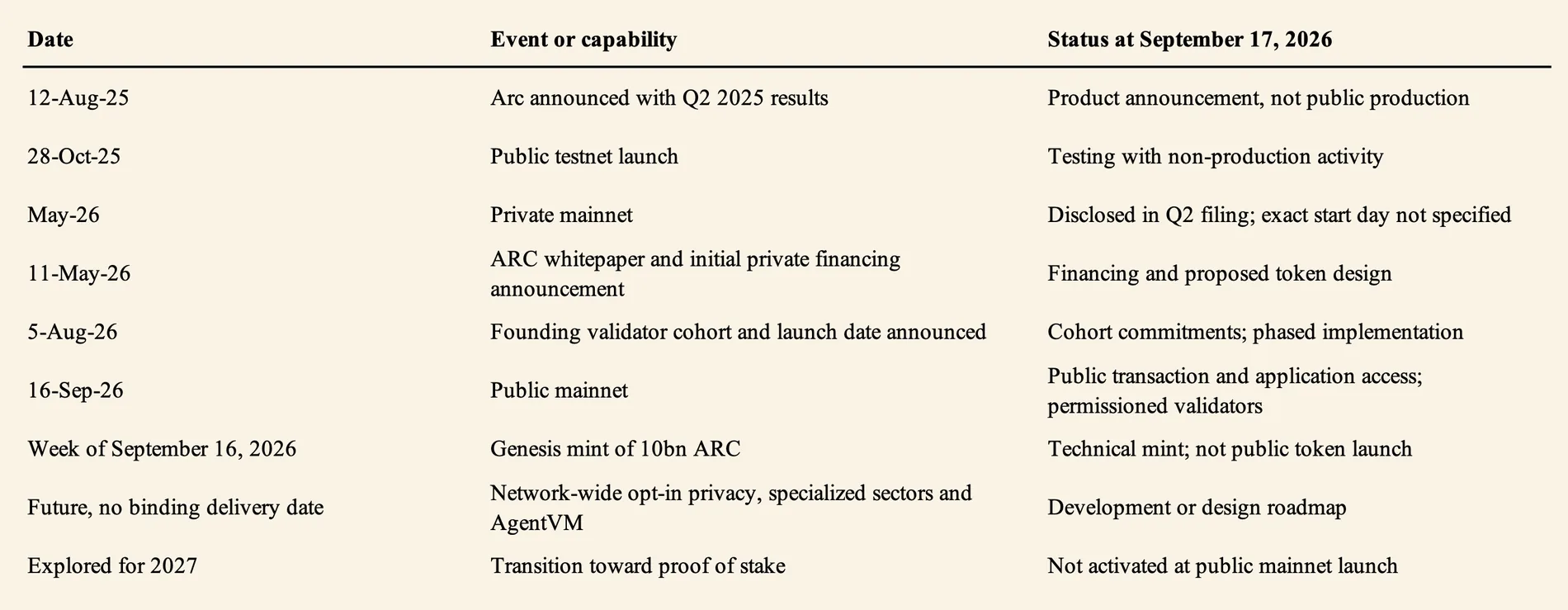
Arc uses an Ethereum-compatible execution environment, allowing developers to adapt Solidity applications and familiar tooling. Its documented design combines Reth execution with Malachite, a Rust implementation of Tendermint-style Byzantine fault-tolerant consensus. Validators reach agreement with more than two-thirds of voting power. This supports deterministic ledger finality under the protocol’s assumptions, but validator concentration and correlated outages remain important. A small institutional set can offer operational accountability while creating shared dependencies.[20]
Public access is not permissionless validation. Users can transact and developers can deploy applications, subject to applicable restrictions and individual application controls. Becoming a validator requires admission. Circle retains substantial authority over admission, upgrades and operational policy; a future token-governance framework does not decentralize those powers today. Investors should evaluate actual voting weights, operator diversity and change-control procedures, rather than treating institutional names as a substitute for governance analysis.[20][21]
Gas is paid in USDC, removing the need for an ordinary user to acquire a volatile network token. The documented fee mechanism smooths demand-sensitive fees; it does not promise identical costs for every contract or congestion level. Technical materials describe a roughly $0.001 target for a typical token transfer under normal conditions. That target is a design parameter, not an independently measured mainnet average. Applications can also sponsor users’ gas, moving the bill rather than eliminating it.[20]
The launch announcement describes subsecond finality, while technical benchmarks concern specified test configurations. Neither establishes production performance under peak financial-market stress. Consensus time excludes wallet checks, cross-chain attestations, currency conversion, sanctions screening and bank payout. A token transfer finalized in less than a second can still be part of a payment that takes much longer to complete.[17][20]
Privacy requires particular restraint. Circle explicitly says network-wide opt-in privacy remains in development. Proposed confidential balances and view keys should therefore not be described as generally available launch functionality. AgentVM and specialized network sectors are also roadmap items; the payment-sector target above 100,000 transactions per second is not observed mainnet throughput. Post-quantum signature support at launch is narrower than comprehensive post-quantum protection across the whole system.[17][18]
Documentation was not fully synchronized at the cutoff: some developer material still described testnet-only availability despite the public launch. The specific September 16 announcements establish the launch date, but operational teams should confirm production endpoints, contract addresses and supported features directly before implementation. The mismatch limits how confidently a reader can generalize from a reference page to deployed mainnet behavior.[17][20]
What a transaction would actually accomplish
Three illustrative workflows show where Arc could earn its place. They are commercial mechanisms, not claims that the named sequence has already generated paid production volume.
First, a U.S. company pays an overseas supplier. Its payment provider acquires or uses existing USDC and submits a transfer through a CPN-connected service. If conversion is required, StableFX can obtain quotes from liquidity providers and coordinate payment-versus-payment settlement between supported stablecoins. Both token legs settle together or neither does, reducing principal risk during the exchange. Liquidity comes from counterparties willing to quote and hold inventory, not from consensus itself.[25]
The beneficiary’s provider still has to redeem the local token or pay from its banking liquidity. Local issuer eligibility, banking hours and compliance requirements remain. The business may pay its provider a service charge and FX spread; the liquidity provider earns a spread, while network participants receive gas-related economics under the applicable fee arrangements. Circle may earn reserve or service income, but the customer’s entire payment fee should not be attributed to Circle. StableFX’s software role does not make Circle the principal counterparty to every FX trade.[25]
Second, an eligible treasury investor exchanges USDC for a tokenized fund interest. The fund’s administrator and transfer agent determine eligibility and maintain the legal ownership framework. An Arc contract can coordinate delivery of tokens against payment and make the resulting asset usable as collateral where an application accepts it. Fund management charges accrue under fund arrangements; lenders earn lending returns; applications may collect fees. The chain does not decide redemption rights or guarantee liquidity in the underlying securities.
This transaction might increase Arc’s asset activity while reducing idle USDC balances. If the fund subsequently invests or redeems the stablecoins, Circle’s group-wide reserve income need not rise. Conversely, settlement inventories and collateral requirements could create persistent additional USDC demand. The relevant measurement is the change in average balances across all supported networks, adjusted for funds merely moved between them.
Third, a company funds an agent wallet to purchase data or computing services within approved spending limits. Wallet policy determines authorization; the application verifies delivery; USDC settles the payment. Circle’s Gateway and agent services can aggregate small obligations and handle payment functions around the ledger. A blockchain records the settlement, not the truth or quality of the purchased output. AgentVM’s proposed confidential execution does not belong in this launch-stage workflow.[18]
The merchant receives revenue, the service provider may charge software fees, and the network processes the settlement. If millions of tiny transactions are batched, economic activity and transaction counts diverge. If an agent merely cycles funded balances among addresses, both can overstate real demand. Agent payments become valuable to shareholders when customers pay sustainable service fees or maintain incremental reserves, not simply because software rather than a person signs transactions.
Cross-chain infrastructure is a separate dependency throughout. CCTP burns native USDC on a source chain and authorizes minting on a destination after the required attestations. It can move liquidity to Arc without creating new consolidated circulation. Gateway, wallets, CPN, StableFX and investment products add useful functions, but their access rules, counterparties and revenue arrangements should not be confused with the base chain’s consensus rules.[26]
Adoption is a deployment question before it is a volume question
Circle’s launch materials describe more than 100 applications and more than 100 institutional and ecosystem participants. The same release also refers to organizations already live on, or exploring, private mainnet. Those descriptions do not establish that every logo represents a production application, operating validator or paying customer. A bank testing settlement, a wallet adding network support and a liquidity provider committing funds are commercially different forms of participation.[17]
Selected Arc participants and the evidence available
| Participant | Specific role and dated evidence | Stage and material uncertainty |
|---|---|---|
| BitGo | September 16 counterparty announcement: wallet and custody support, USDC deposits and withdrawals, gas management | Production capability confirmed by provider; customer utilization and fees undisclosed |
| Socure | Launch-period statement observed September 17: identity and onboarding support, including account-risk controls | Describes day-one integration; exact publication time, usage and revenue not established |
| BlackRock | August 5 validator cohort; September 16 materials name BUIDL among available assets | Cohort commitment and issuer-reported asset availability; node operation and Arc balances not independently verified |
| DTCC | August 5 founding cohort and tokenization integration plans | Announced participation; not evidence that DTC securities settlement is broadly live on Arc |
| Visa | August 5 founding validator cohort; September 16 phased rollout language | Cohort membership; individual live node and production volume unverified |
| BNY | September 16 named banking participant; established reserve-custody relationship is separate | Arc role lacks public utilization metrics; custody of USDC reserves is not Arc transaction activity |
| Aave | September 16 launch statement includes founder’s confirmation of a new Aave V4 market | Launch deployment described; independent liquidity, borrowing and paying-user totals unavailable |
| Morpho | September 16 cofounder statement describes Arc credit-market role | Launch integration described; loan balances and incentive-adjusted returns unverified |
| Uniswap | September 16 Circle announcement identifies day-one trading infrastructure | Issuer-announced availability; independent Arc liquidity and organic volume unverified |
Sources: launch materials, cohort announcement and counterparty evidence [17], [18], [22], [23], [24]. This is an evidence classification at the report cutoff, not a count of active institutions or paying customers. Link to this table.
Original exhibit
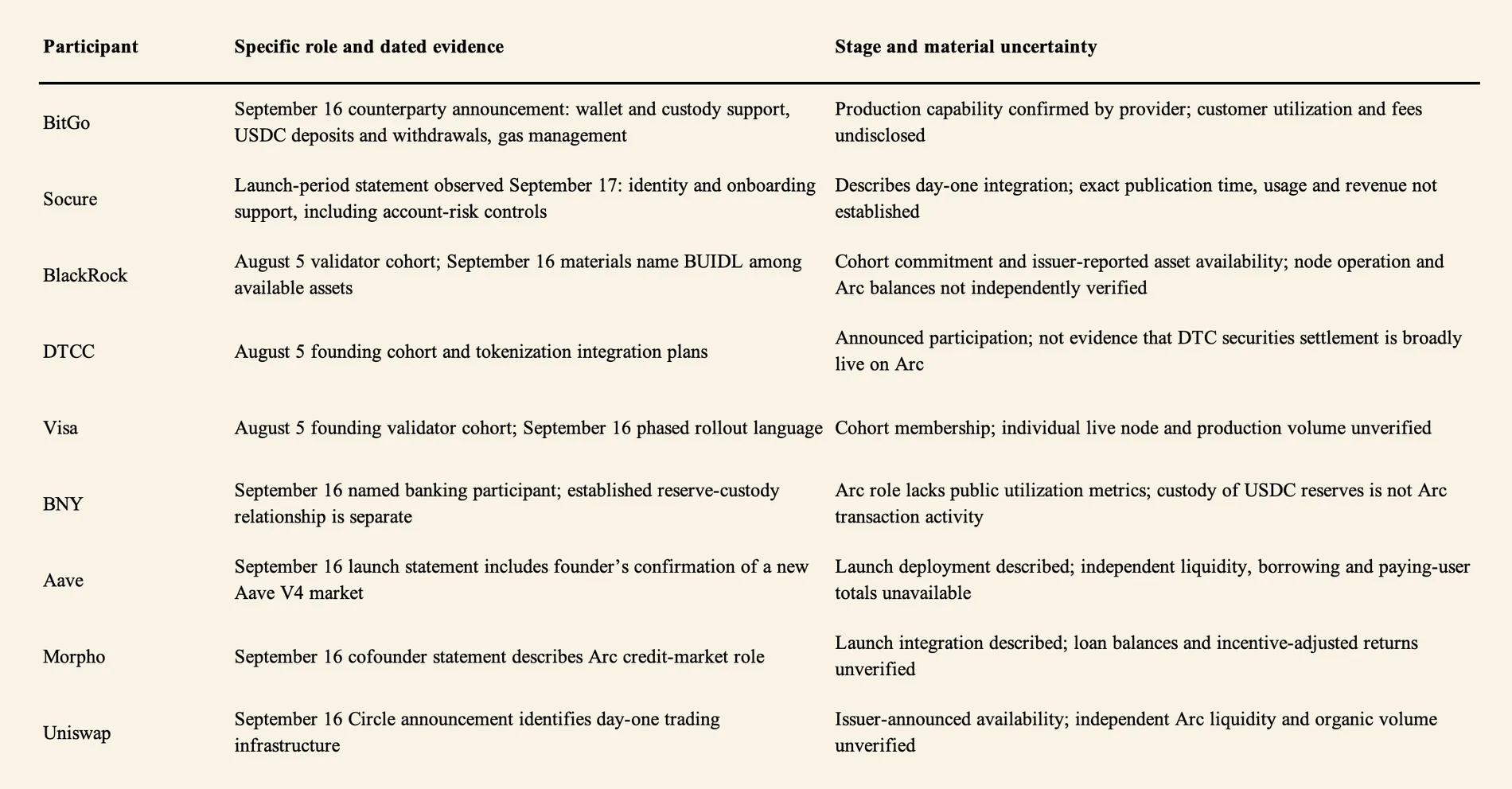
BitGo’s own announcement provides stronger evidence of an available operational capability than a general ecosystem list: it identifies supported wallet and custody functions. Even that does not disclose transaction volume or customer economics. For the founding validators, Circle explicitly describes a phased rollout. Without a verified mapping of consensus addresses to operators and voting power, the announced cohort cannot establish how many independent institutions actually secured the network during the observation window.[22][23]
That window covers September 16 and the research cutoff on September 17, less than two calendar days. The public explorer did not yield a reproducible statistical dataset through the available interface. Accordingly, this report does not publish an unverified mainnet transaction count, fee total, active-address number or stablecoin-balance estimate. This is a measurement limitation, not evidence of zero activity.[20]
Testnet’s reported transaction history cannot fill the gap. Test tokens are inexpensive, activity may be automated, and participation can be motivated by prospective rewards. Similarly, developer-community membership does not measure institutional customers. Wallet support can expand potential reach immediately, but the number of people able to connect a wallet says little about how many have a reason to maintain balances on Arc.
A useful assessment needs at least several months of chain-specific observations: daily transacting addresses, repeat cohorts, transactions by application, stablecoin supply reconciled to mint-and-burn events, fees actually paid, liquidity depth and borrowing utilization. The methodology should remove obvious self-transfers and identify subsidized activity where possible. Addresses should remain addresses, rather than being relabeled users. Institutional adoption also requires disclosures beyond the chain, including paid contracts, settlement failure rates, payout times and customer concentration.
The strongest early evidence would be recurring activity that persists after incentives fall, accompanied by net new group-wide USDC and disclosed service revenue. Large balances parked by affiliated market makers would be less persuasive. A busy launch can establish that infrastructure works under initial conditions; it cannot establish a durable customer acquisition advantage or product-market fit.
Institutions already have alternatives
Circle presents Arc as a response to fragmented financial infrastructure and the needs of programmable payments and markets. Its materials emphasize dollar gas, predictable settlement and integration with its platform. The comparison below is this report’s assessment, not a competitor list attributed to management. Some alternatives compete for blockchain execution; others solve a different part of the financial workflow.[17][18]
The relevant alternatives to Arc
| Alternative | Existing proposition and access | Consequence for Arc |
|---|---|---|
| Ethereum and Base | Established EVM assets and tooling; Base offers rapid preconfirmation, with later Ethereum settlement and separate withdrawal mechanics | Arc must justify migration of liquidity and applications; faster local finality alone is insufficient |
| Solana | Public execution environment with established USDC payment integrations, including Visa settlement initiatives | Competes for payments, liquidity and developers; customers need not adopt Arc to use USDC |
| Tempo | Payments-focused mainnet launched March 18, 2026; stablecoin-oriented design and Stripe-linked distribution | A close commercial comparator for payment applications and agent commerce |
| Plasma | Live EVM-compatible stablecoin network; selected zero-fee USDT transfers under its own routing conditions | Competes on stablecoin distribution and subsidized transfer cost; “free” is not universal application execution |
| Canton | Institutional applications and shared synchronization with privacy-oriented design and application-specific access | More direct competition for confidential regulated-asset workflows than for unrestricted retail activity |
| Stellar | Existing USDC and EURC support, payment anchors and on/off-ramp connections | Demonstrates that access to local money and payment partners can matter more than EVM compatibility |
| Banks and conventional rails | Deposit accounts, established legal claims, compliance and domestic payment connections | May complement Arc at endpoints or remove the need for a blockchain in a particular workflow |
Source: report synthesis and cited infrastructure documentation [26], [27], [28], [29], [30], [31], [32]. Competitive implications are analytical assessments retained from the September 17, 2026 report. Link to this table.
Original exhibit
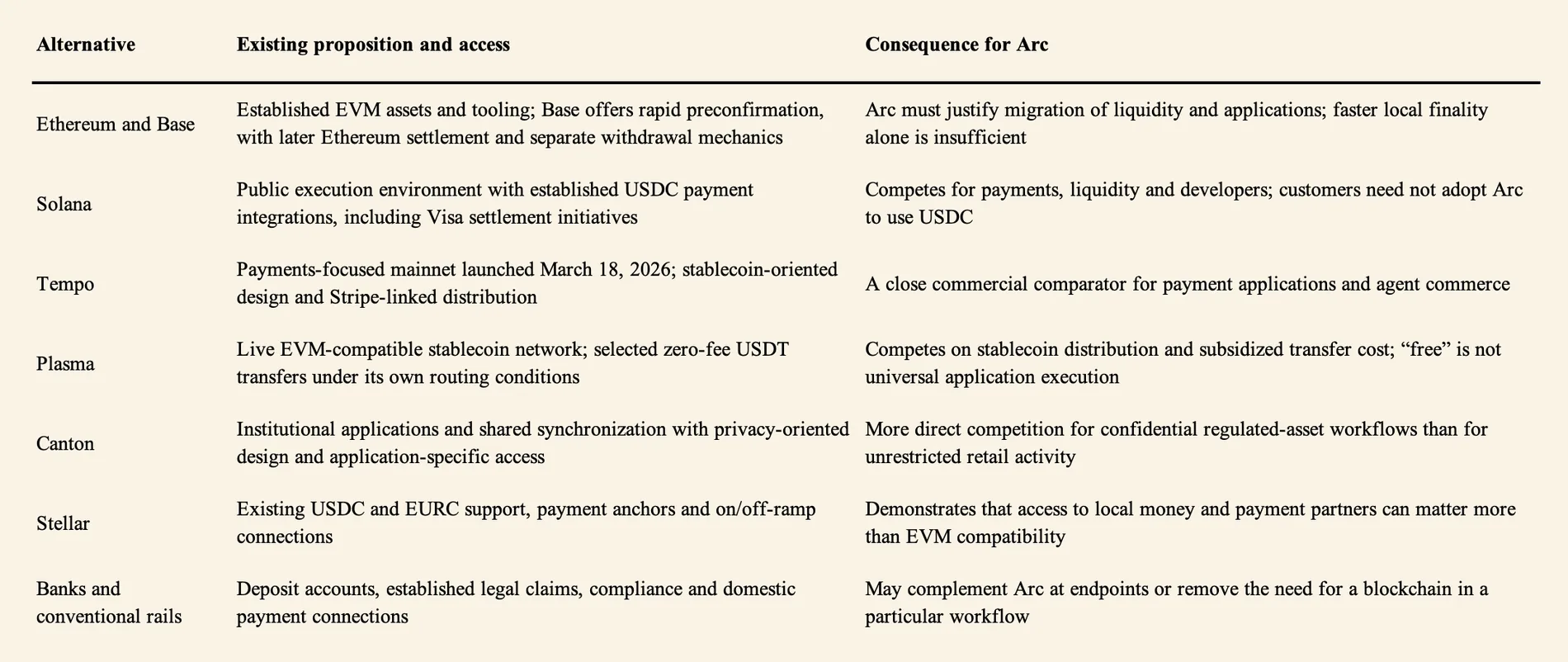
Ethereum’s ecosystem brings liquidity and established collateral relationships that a new chain must recreate or connect to. Base makes the distinction between user confirmation and underlying settlement explicit: rapid preconfirmation is not the same event as Ethereum finality, and a canonical bridge withdrawal has a different waiting period. Arc’s deterministic consensus can simplify one layer of the workflow without eliminating cross-chain settlement or banking dependencies.[27]
Tempo is a particularly relevant challenge because payment distribution is central to its proposition. A merchant already using Stripe may prefer infrastructure reached through that relationship. Plasma emphasizes stablecoin transfers and USDT distribution. Canton addresses institutions for which confidentiality, controlled asset access and existing market relationships can outweigh open application composability. Stellar’s payment anchors illustrate the enduring importance of converting tokens into local money. Solana’s documented Visa integrations establish that institutional USDC settlement predates Arc.[28][29][30][31][32]
Institutions can use several networks. They may keep collateral where borrowing markets are deepest, payments where distribution is cheapest, and regulated assets where privacy and legal arrangements fit. Moving an application involves audits, custody integration, liquidity provisioning and operational procedures, not merely redeploying compatible code. Arc therefore needs a measurable benefit at the complete-workflow level: cheaper financing, better conversion, fewer failed payments or lower integration cost.
Circle’s multichain position creates a tension. It benefits when USDC grows on a rival chain, even if Arc loses execution activity. A distributor may support Arc to offer customers choice while promoting its own network or stablecoin. Banks may welcome a shared settlement venue but resist dependence on an issuer that competes for customer balances. Institutional validators may also support several networks; participation should not be mistaken for exclusivity.
Neutrality is consequently a governance and commercial question. Investors should examine admission standards, upgrade rights, treatment of competing assets and whether fee policies favor Circle products. A permissioned validator model can be suitable for institutions, but describing it as neutral does not resolve conflicts between the platform operator and applications. More transparent rulemaking and credible limits on unilateral changes would matter more than the breadth of a launch-stage logo collection.
ARC financing arrives before staking
The token requires separate treatment from both the blockchain and CRCL. The September announcement reports a genesis mint of the full initial 10 billion ARC supply. Official token materials nevertheless state that ARC has not publicly launched and does not represent equity in Circle. Minting tokens, signing private purchase agreements, distributing tradable tokens, activating staking and activating governance are distinct events. The cutoff evidence establishes the first two, not the entire sequence.[17][21]
The whitepaper proposes an initial allocation of 60% to ecosystem purposes, 25% to Circle and 15% to reserves. The ecosystem category includes several potential uses rather than constituting a public float. Proposed issuance includes initial inflation of roughly 2%–3% declining over time, so 10 billion should not be treated as a permanently fixed maximum. Complete public allocation-level vesting and operative staking terms were not established by the launch materials.[21]
Token holders would not automatically receive Circle earnings. The proposed design keeps fees payable in stablecoins while introducing conversion and allocation mechanisms involving ARC, validator or staker compensation and burning. Illustrative burn percentages in the whitepaper are not an enacted fee-distribution contract. Circle’s governance powers also extend beyond any proposed token vote. Management’s description of ARC as a digital commodity is an attributed legal position, not a classification this report independently establishes.[21]
Private financing is more concrete. The Q2 filing reports agreements covering 807.5 million tokens at $0.30, or $242.25 million of commitments. The initially announced $222 million financing and the larger quarter-end commitment figure refer to different stages; $222 million had been received by June 30. Circle recorded the commitments as deferred revenue. Investor locks run for at least one year from a future proof-of-stake or delegated-proof-of-stake transition, with further restrictions lasting up to four years. Certain conditions trigger potential repayment rights, including failure to deliver the required transition by May 8, 2028. These proceeds are neither a CRCL equity issuance nor recurring software sales.[2]
On the August earnings call, management’s 310million–330 million full-year other-revenue outlook included approximately $180 million of expected token-related recognition. Excluding that expectation leaves 130million–150 million, below the previous 150million–170 million outlook. Management linked the change to resource allocation and softer blockchain-partnership revenue. Consequently, a rising reported non-reserve mix in 2026 could coexist with weaker underlying service expectations. The public launch alone does not establish how much token revenue was actually recognized; that requires subsequent accounts.[5]
Arc can produce several distinct economic streams. Validators may receive network compensation. Developers can charge application fees. Liquidity providers earn spreads or lending returns while bearing inventory and credit risks. Circle may earn software, payment or fund-related revenue and interest on genuinely incremental reserves. Token holders may benefit from proposed staking or supply mechanisms. Circle has not disclosed a separate Arc income statement or a complete launch-stage fee allocation in the materials reviewed. Forecasting shareholder returns requires those economics and the ongoing cost of network development and incentives.
Low fees also constrain the direct revenue opportunity. At an illustrative $0.001 per transfer, one billion transfers produce only $1 million of gross fees before their allocation. Actual contracts can consume more gas, and pricing can change, but this arithmetic explains why network activity alone is an inadequate shareholder thesis. A smaller number of high-value enterprise relationships, or persistent incremental stablecoin balances, could matter much more financially.
Multiplying Circle’s proposed token allocation by a private financing price would produce a nominal mark, not realizable cash. Restrictions, future issuance, market depth and the token’s unfinished utility all affect value. Adding that mark to a valuation that already capitalizes future Arc fees risks counting the same economic opportunity twice. The present report therefore gives neither Circle’s prospective token holdings nor an assumed public token price a separate contribution to enterprise value.
Over the next 12–24 months, the decisive evidence is manageable: growth in average USDC with better retained economics; recurring service revenue excluding token recognition; independently measured Arc activity and liquidity after incentives; disclosed validator operations and governance; and delivery of privacy and token milestones on usable terms. Failure in any one area would not necessarily invalidate Circle’s existing franchise, but it would narrow the justification for valuing it as a broader financial infrastructure business.
Circle’s issuance franchise produces substantial reserve income, but partners capture much of it. Arc could improve retained economics through deeper customer relationships and incremental USDC demand. One day after public launch, that potential remains unproven. Recurring earnings will determine its value to shareholders.
Cover Artwork

A Bust of Minerva with Armour and Weapons on a Stone Ledge
Anne Vallayer-Coster, c. 1777
References
1. 2025 Form 10-K, including audited consolidated accounts and distribution agreements. Circle Internet Group / SEC. March 9, 2026.
2. Form 10-Q for the quarter ended June 30, 2026, especially Notes 10–12, 15–17, 23 and MD&A. Circle Internet Group / SEC. August 5, 2026.
3. Circle Reports Second Quarter 2026 Results. Circle Internet Group. August 5, 2026.
4. Q2 2026 Earnings Presentation, operating metrics and financial reconciliations. Circle Internet Group. August 5, 2026.
5. Q2 2026 Earnings Call Transcript. Circle Internet Group / S&P Global Market Intelligence. August 5, 2026.
6. USDC Terms. Circle. Updated December 12, 2025.
7. USDC Transparency and Reserve Reporting; July 2026 USDC Reserve Examination Report. Circle / Deloitte & Touche. Transparency page accessed September 17, 2026; examination report August 27, 2026.
8. GENIUS Act Regulations: Notice of Proposed Rulemaking, Bulletin 2026-3. Office of the Comptroller of the Currency. February 25, 2026.
9. Circle Is First Global Stablecoin Issuer to Comply with MiCA, EU’s Landmark Crypto Law; MiCA Article 149: Entry into Force and Application. Circle; European Securities and Markets Authority. Circle announcement July 1, 2024; Regulation (EU) 2023/1114, May 31, 2023, accessed September 17, 2026.
10. Circle Internet Group Inc, CRCL:NYSE, quote and closing timestamp. Google Finance. September 16, 2026 regular-session close; accessed September 17, 2026.
11. Circle’s blockbuster IPO paves way for other crypto public listings. Reuters. June 5, 2025.
12. Circle’s stock should be worth less than half what it is now, analyst says. MarketWatch. July 8, 2025.
13. Circle wins licence for some US banking activities. Financial Times. July 10, 2026.
14. Circle shares fall as revenue miss overshadows quarterly profit beat. Reuters. August 5, 2026.
15. Bitcoin and crypto stocks remain down after US Senate fails to advance regulatory bill. Reuters. September 15, 2026.
16. Federal Reserve issues FOMC statement. Federal Reserve Board. September 16, 2026.
17. Circle Launches Arc Mainnet, an Economic Operating System for the Internet. Circle. September 16, 2026.
18. Arc Mainnet Is Live: The Economic OS for the Internet. Arc. September 16, 2026.
19. Circle Reports Second Quarter 2025 Results, including Arc announcement; Circle Launches Arc Public Testnet. Circle. August 12 and October 28, 2025.
20. System Overview; Gas and Fees; Developer documentation index; Arc Explorer, statistical data not reproducibly retrievable. Arc. Undated live resources; accessed September 17, 2026.
21. ARC: The Native Asset of the Economic OS for the Internet, whitepaper; ARC Whitepaper, token-status disclosures; Introducing the ARC Whitepaper. Arc / Circle. Whitepaper May 2026; introductory article May 11, 2026; token page accessed September 17, 2026.
22. Circle Announces Founding Validator Cohort and Major Integrations for Arc Ahead of September 16 Mainnet Launch. Circle. August 5, 2026.
23. Arc Mainnet Launches With Full BitGo Wallet and Custody Support. BitGo. September 16, 2026.
24. Arc and Socure day-one launch partnership statement. Socure, official LinkedIn account. Launch-period statement, accessed September 17, 2026; platform displays relative timestamp.
25. StableFX: Institutional Stablecoin FX. Circle. Undated product page; accessed September 17, 2026.
26. Cross-Chain Transfer Protocol. Circle Developers. Undated documentation; accessed September 17, 2026.
27. Transaction Finality. Base. Undated documentation; accessed September 17, 2026.
28. Tempo Mainnet. Tempo. March 18, 2026.
29. Canton Network: Institutional Applications and Network Design. Canton Network. Undated network and application materials; accessed September 17, 2026.
30. Plasma Network. Plasma. Undated network description; accessed September 17, 2026.
31. Stablecoins Basics. Stellar Development Foundation. Undated documentation; accessed September 17, 2026.
32. Visa Expands Stablecoin Settlement Capabilities to Merchant Acquirers. Visa, announcement republished by Circle. September 5, 2023.
Risk Disclaimer
insights4vc provides independent research based primarily on publicly available information believed to be reliable at the time of publication. Figures may change because of market prices, token supply, reclassification and methodology updates. Legal structures, investor rights and regulatory treatment vary by product and jurisdiction.
This article does not constitute investment, legal, tax, accounting or financial advice, or an offer, solicitation or recommendation regarding any security, token, fund interest or other asset. insights4vc makes no representation regarding the completeness or accuracy of third-party data. Readers should conduct independent due diligence and consult appropriately qualified advisers before making investment or business decisions.
Published by the insights4vc research team. See our research methodology, source standards and corrections policy. Dates and measurement periods are stated in each analysis.
Read next