Key Statistics
- Visa reports approximately $2 billion in cumulative settlement financed for Rain and at least $1.58 million in interest, attributing the figures to Credit Coop. [18]
- Visa reported about $5.2 billion of stablecoin-linked card volume completed in 2025. [45, 15]
- The four announced rounds total $338.5 million, consistent with Rain's description of more than $338 million raised. [27, 4]
Figures and examples retain the report's original period, scope and source definitions. Consult the analysis and references below before making comparisons.
Rain's proposed national trust bank would bring more of the assets behind its payment programs inside its own regulated perimeter. On October 5, the company announced an application to establish Rain National Trust Bank in New York, covering institutional custody, reserve administration and stablecoin issuance and redemption. As of October 8, this was a company-announced application, with no operating authorization established. [1]
The filing sharpens a question already present in Rain's card business. Owning more infrastructure can improve control and create additional fees. It also brings capital commitments, operational responsibilities and costs that must be recovered from customers. A growing share of payments can coexist with a shrinking share of their economics.
Rain has demonstrated that its infrastructure solves a real problem. Western Union and MoneyGram have launched products using it; crypto businesses use it to make onchain balances spendable. Its January financing valued the company at $1.95 billion. Yet public disclosure remains insufficient to connect payment growth to retained revenue, customer profitability or durable pricing power. [2, 3, 4]
The strongest evidence is more specific than the logos. Customer agreements reveal a division of revenue, funding obligations and control between Rain's issuing affiliates and the companies distributing its products. Those arrangements suggest a defensible operating business is possible. They also show why stablecoin settlement alone does not guarantee attractive infrastructure margins.
Partner Highlight

Umia is building an operating stack for token-native ventures that combines fundraising, legal formation, treasury management and market-based governance.
A corporate spending problem became an infrastructure business
Farooq Malik and Charles Naut founded Rain in 2021 after working on SignandWire, which connected signatures with investment payments. Requests to accept USDC exposed a related problem: organizations could hold substantial digital treasuries while struggling to pay conventional expenses. Rain's first answer combined corporate cards with spending controls. [5]
Their backgrounds help explain the execution. Malik had been treasurer and investment officer at the North American Development Bank. Naut had worked at Microsoft, built PlaybookHR, sold it to Intuit and worked on QuickBooks. The combination joined treasury experience to software for financial operations. [6]
Serving other companies' card programs changed the commercial model. Rain could acquire one enterprise relationship and reach that enterprise's customers, but had to support integrations, compliance, disputes and service continuity across multiple brands. Its current media kit dates the API issuing platform and Visa principal membership to 2024; the March 2025 financing announcement publicized that membership, so it should not automatically be treated as its commencement date. [7, 8]
Rain has also purchased capabilities around the payment. It acquired Uptop in November 2025 for loyalty, Fern in December for payment orchestration and conversion routing, and merchant-wallet company Ansa in August 2026. Fern's relationship began with adding Rain cards to its own stack. Ansa's acquired wallets held prefunded fiat balances, illustrating that Rain's expansion is broader than replacing every money movement with a blockchain transaction. [9, 10, 11]
These acquisitions could increase the services sold into an existing account. They also require integration and complicate comparisons of organic growth. Their strategic value will depend on whether customers buy more profitable services, rather than merely receive a larger product catalog.
Legal responsibility sits below the Rain brand. Group disclosures identify Signify Holdings, Rain Liquidity, Rain Payments Services, Rain Products and Nimbus, operating under Third National names, among the relevant entities. Roles differ across lending, payment processing and issuance. The group identifies SSB for banking services and states that Rain itself is not a bank. A customer must therefore identify the applicable issuer and contract, rather than assume every Rain product uses one legal structure or carries bank-deposit protection. [12, 7]
The card transaction creates several separate obligations
Consider a supported card program secured by stablecoins. The cardholder places eligible assets in a designated collateral arrangement, and the program establishes spending power. The merchant's acquirer routes an authorization request through the network; Rain's systems check the balance and program controls. Approval reserves spending capacity. It does not mean the merchant has received tokens or that the issuer's settlement obligation has disappeared. [13, 14]
Clearing establishes the amounts owed among participants. In direct stablecoin settlement, the issuer pays its network obligation using an accepted stablecoin. The acquiring side pays the merchant through ordinary payment infrastructure. Other stablecoin-linked cards convert funds into fiat before network settlement. The cardholder's funding asset, the issuer's settlement asset and the merchant's receipt can consequently be different. [15]
A secured-credit program creates a receivable from the cardholder while collateral protects repayment. A prepaid arrangement spends value funded in advance; a debit arrangement draws against the applicable account. These labels cannot be interchanged merely because the app displays a dollar balance. Rain's own corporate-card agreement describes credit, names Third National as issuer and establishes collateral and repayment rights. Takenos, by comparison, describes TakeCard as prepaid in its customer terms. [16, 17]
Repayment discharges the cardholder obligation; remaining collateral and program limits determine subsequent spending power. Unencumbered collateral can be released subject to those rules. Rain's corporate terms require notice for collateral withdrawal and permit liquidation when obligations are overdue or collateral becomes insufficient. Holding a wallet's keys therefore does not imply unrestricted control over assets already committed to card spending. [16]
Collateral also does not automatically provide the right liquidity at the right time. Visa's September 8 case study describes Rain using a Credit Coop revolving facility since August 2023 to fund network settlement. Repayment collections pass through a smart contract that services financing obligations. Visa reports approximately $2 billion in cumulative settlement financed for Rain and at least $1.58 million in interest, attributing the figures to Credit Coop. Another figure, more than $2.5 billion, covers Credit Coop's wider financing activity. [18]
These disclosures show repeated use of working capital, not a $2 billion facility or equity investment. Cumulative financing, current principal outstanding and facility capacity are separate measures. Dividing cumulative interest by cumulative financed payments would not produce an annual borrowing rate because neither average outstanding debt nor its duration is given. The published page also retains editorial qualification around statistics; the figures warrant attribution rather than treatment as audited financial results. [18]
Faster settlement can reduce some idle balances and currency mismatches. It cannot remove every reserve. Third National's platform terms, updated May 9, 2025, require prefunding or next-business-day funding and, unless the private agreement provides otherwise, a non-interest-bearing reserve of at least three times the largest daily settlement during the preceding 30 days. This is program funding in addition to cardholder collateral. It establishes a contractual baseline, not the balance required of every Rain customer. [19]
Rain's current issuing page instead advertises a one-day reserve. The difference reinforces why marketing comparisons cannot substitute for the applicable commercial agreement. [20]
Rain's broader product claims require similar precision. Rain's 2026 Mastercard principal membership established another network relationship; the release described onchain settlement for selected flows as exploratory. September's payout expansion covered more than 80 countries and 50 currencies for selected beta partners. Issuing eligibility, merchant acceptance and payout availability remain different operating footprints. [21, 22]
Revenue retention matters more than payment volume
The clearest public monetization evidence begins with Rain's founders describing interchange and subscription revenue in a May 2024 interview. Separate historical bill-payment terms provide for percentage payment fees and service fees. These establish more than one way to charge, but neither source supplies a current enterprise price list or a consolidated revenue mix. [23, 24]
Third National's platform agreement makes the sharing mechanism explicit. Customer revenue is linked to interchange-eligible volume after processing and network charges and adjustments for refunds, disputes and chargebacks. Commercial percentages sit in private agreements and may change with network economics. Service fees, bank and network charges, and physical-card pricing can also apply. The terms allocate extensive program losses to the customer. These provisions explain potential value capture and risk transfer without revealing Rain's actual retained share. [19]
The merchant's total acceptance charge cannot be assigned to Rain. The acquirer and network have their own economics; issuer interchange supports the program, and the issuer, infrastructure provider and distributing customer allocate what remains through contracts. Rewards are another use of the fee pool, potentially supplemented by subscriptions or promotional funding. A cashback offer therefore reveals neither Rain's take rate nor the customer's sustainable margin. [13, 25]
Six measures must remain separate. Payment volume measures money spent. Gross program fees describe charges generated around that spending. Rain's recognized revenue depends on its contractual role and accounting policy, while economically retained revenue describes the amount remaining after commercial sharing, an analytical measure here rather than a reported Rain metric. Gross profit and contribution profit then require the relevant servicing and operating costs. Without audited revenue policies, treating every pass-through as revenue, or automatically deducting every share as contra-revenue, would impose an unsupported accounting conclusion.
The sensitivity is substantial even at a fixed volume. In a purely illustrative program processing $100 million annually, assume the infrastructure provider retains 40 basis points after contractual sharing and network or partner charges: $400,000. If variable funding, servicing and expected losses consume 15 basis points, contribution before fixed costs is $250,000. Renegotiating retention to 25 basis points leaves $100,000 on identical volume and costs. These assumptions are not estimates of Rain's pricing or margins; they show why volume growth alone cannot establish operating leverage.
Larger customers could reduce acquisition and integration cost per dollar of spending while demanding lower pricing, bespoke controls and stronger service commitments. Contractual indemnities may transfer losses on paper, but collection still depends on customer solvency and enforceability. Security failures can create remediation and retention costs even when a contract assigns another party responsibility. This makes contribution after funding, fraud and support more informative than a headline infrastructure fee.
Additional accounts, wallets, conversion and payouts can raise revenue per relationship. Their availability does not establish separate monetization, positive margins or customer adoption. Implementation fees may compensate onboarding work rather than create recurring earnings. Rewards may increase activity while consuming subsidies. Proposed custody and issuance would introduce new potential fees, but handling USDC today does not confer ownership of its issuer's reserve income.
Rain's most attractive economic path would combine repeat spending with profitable service expansion and declining support costs per program. A weaker outcome would bundle more functions into a competitive fee while adding compliance, liquidity and integration obligations. The public product roadmap permits both outcomes; customer-level economics would distinguish them.
Capital buys time to prove the model
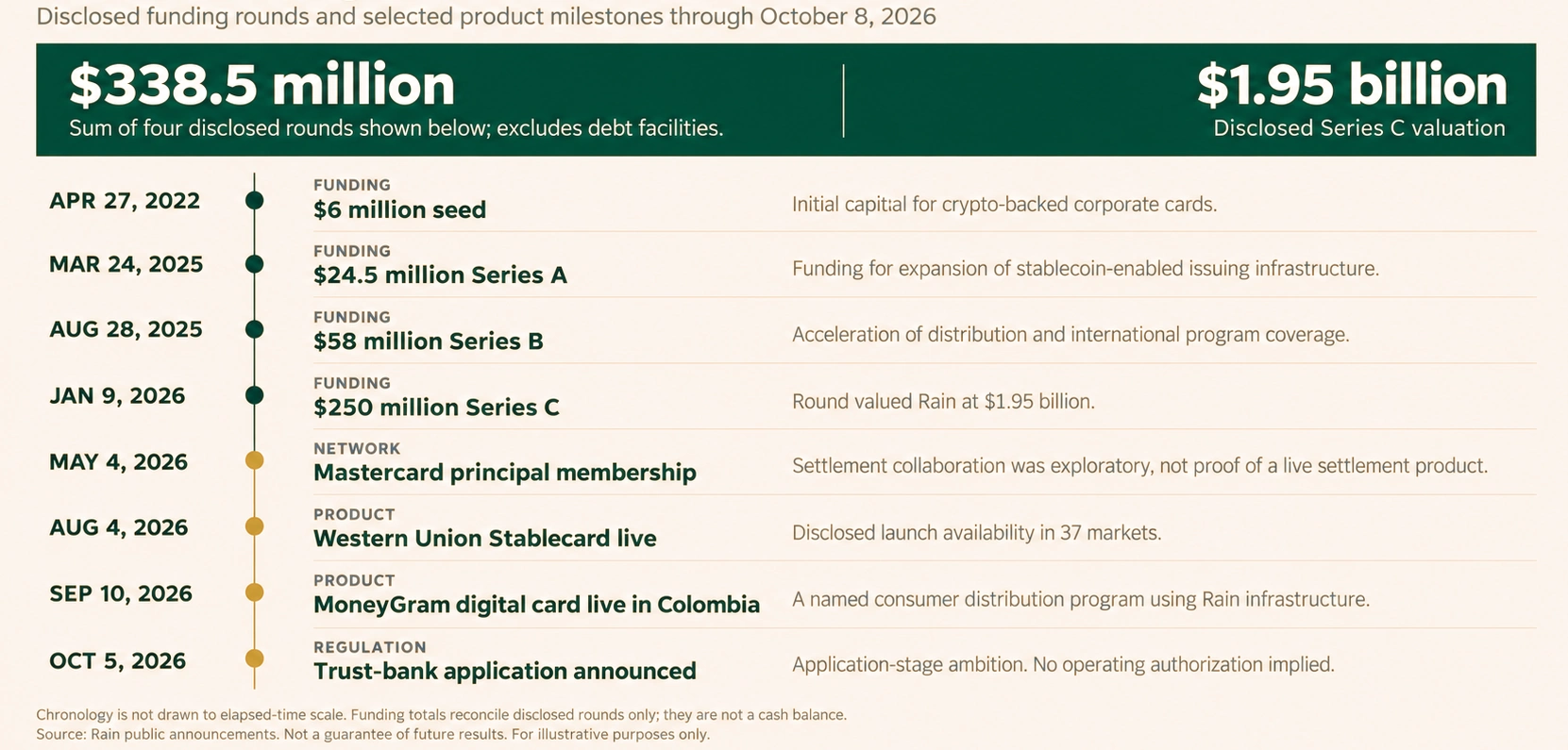
Rain announced a $6 million seed round in April 2022 led by Lightspeed, with investors including Coinbase Ventures and Uniswap Labs. A $24.5 million Series A followed on March 24, 2025, led by Norwest with participants including Galaxy Ventures and existing investors. The shift toward enterprise issuing made distribution and regulated execution more central to the financing story. [26, 8]
Sapphire Ventures led the $58 million Series B announced August 28, 2025, joined by Dragonfly, Galaxy, Endeavor Catalyst, Samsung Next, Lightspeed and Norwest. On January 9, 2026, ICONIQ led a $250 million Series C at a disclosed $1.95 billion valuation, with Sapphire, Dragonfly, Bessemer, Galaxy, FirstMark and other investors participating. The four announced rounds total $338.5 million, consistent with Rain's description of more than $338 million raised. [27, 4]
This chronology separates equity from revolving settlement finance and acquisitions. Round proceeds are not a current cash balance, and the announcements do not disclose a complete cap table, ownership changes or acquisition consideration. No earlier round valuation needs to be reverse-engineered from promotional growth multiples to understand the increase in expectations.
ICONIQ's investment account reports that customers valued speed to market, regulatory credibility and the direct Visa relationship. That is useful evidence from investor diligence, though an investor's published thesis is not independent verification of retention or profitability. The capital base can support enterprise integrations, geographic expansion and regulated subsidiaries before those investments generate cash. [28]
The valuation nevertheless requires more than transaction throughput. A business worth $1.95 billion must eventually support substantial durable earnings or a credible route toward them. A payments run rate is not an appropriate denominator for a revenue multiple. Applying a hypothetical take rate and then assigning a software multiple would conceal two assumptions inside one apparently precise valuation.
The appropriate test is whether recurring retained revenue grows with acceptable customer acquisition and service costs, whether profitable customers stay, and whether additional products improve returns on invested capital. Funding makes a longer proof period possible. It does not establish that returns from expansion exceed the capital and operating expense required to achieve them.
Growth disclosures establish activity more clearly than durability
Rain's January 9 release reported more than $3 billion in annualized transactions, more than 200 partners, a thirtyfold increase in active cards and a thirty-eightfold increase in annualized payment volume over the previous year. The company supplied no absolute active-card denominator. Its accompanying 2.5 billion figure described people potentially reachable through programs, not users already acquired. [4]
No later, comparably defined platform-wide payment run rate was verified in the reviewed material. August 2025's tenfold volume growth since January lacks a sufficiently specified period for a like-for-like comparison. Endeavor's July 2026 account reports twentyfold revenue and volume growth during 2025, without absolute revenue or a reconciliation to Rain's thirty-eightfold annualized measure. These may describe different metrics; the sources do not establish the explanation. [27, 29]
Other counters measure different layers. Rain's June rewards release described more than 100 live programs. January counted more than 200 partners, while October's announcement referred to more than 100 organizations. These lower bounds do not demonstrate churn. The CEO's August claim that payments reached more than 100,000 merchants measures recipients of purchases, rather than Rain's paying enterprise customers. [30, 1, 31]
There is some evidence beyond company-wide percentages. Rain reported that Avalanche Card rewards-beta participants spent 25% more than nonparticipants. The comparison suggests an engagement opportunity, but supplies no randomized design, incentive-adjusted profit or retention after rewards. Selection matters: already active spenders may be more likely to join a rewards test. [30]
Rain also reported more than $1 million of Exa card transactions during its first three months. The public post's exact publication date could not be independently established, so this is historical cohort evidence, not an October 2026 run rate. It is still a better indicator of an operating card relationship than Exa's earlier migration announcement or its pre-migration alpha-user count. [32, 33]
The unresolved issue is the quality of subsequent growth. Without recurring cohort spending, concentration and revenue retention, investors cannot determine whether additional volume comes from durable existing customers, new launches or incentives. Absolute retained revenue and contribution profit are needed to establish whether those payments improve the business. A larger active-card base would be encouraging; higher profitable spending per retained account would be more persuasive.
Customer distribution does not confer ownership of the entire stack
Western Union provides a test of established distribution. Its August 4 Stablecard launch covered 37 markets, with more than 60 a year-end target. Rain supplies wallet and secured-card infrastructure; Anchorage issues Western Union's USDPT on Solana. Western Union's customer FAQ names Nimbus, doing business as Third National, as the issuer and program manager and distinguishes the card from a prepaid product or bank account. [2, 34]
Rain can make a remittance balance useful after receipt without owning the remittance franchise or token issuance economics. The commercial question is whether recipients retain and repeatedly spend balances instead of immediately cashing out. Neither Western Union's global distribution nor the launch announcement supplies Stablecard active users or spending.
MoneyGram's September 10 launch offers a different combination: Rain's card infrastructure, Crossmint wallets and Stellar rails, with a digital card live in Colombia and a physical card planned later in 2026. This is an operating deployment with a narrow verified geography. It also shows that choosing Rain for cards does not require buying every adjacent service from Rain. MoneyGram's overall customer population cannot be credited to the new card. [3]
Ether.fi illustrates how a customer can preserve alternatives. In an April 2025 interview, CEO Mike Silagadze described Rain and Reap serving different card arrangements and identified ecosystem subsidies as part of cashback funding. The current Cash help page establishes an operating product but does not reconcile today's spending allocation between suppliers. Historical dual sourcing is evidence against assuming exclusivity, not proof that Rain has since lost share. [25, 35]
Across these programs, the distributing brand attracts the user and designs the proposition. The issuer controls regulated card access; other providers can control custody, tokens, funding or wallet services. Rain's privacy policy also distinguishes processing on a partner's behalf from its own compliance and fraud responsibilities. Customer ownership therefore has several dimensions: brand loyalty, data rights, permission to authorize spending and the claim to collect repayment need not belong to one company. [12]
Third National's platform terms also require issuer approval for program interfaces and marketing. Distribution ownership does not imply unrestricted product control. [19]
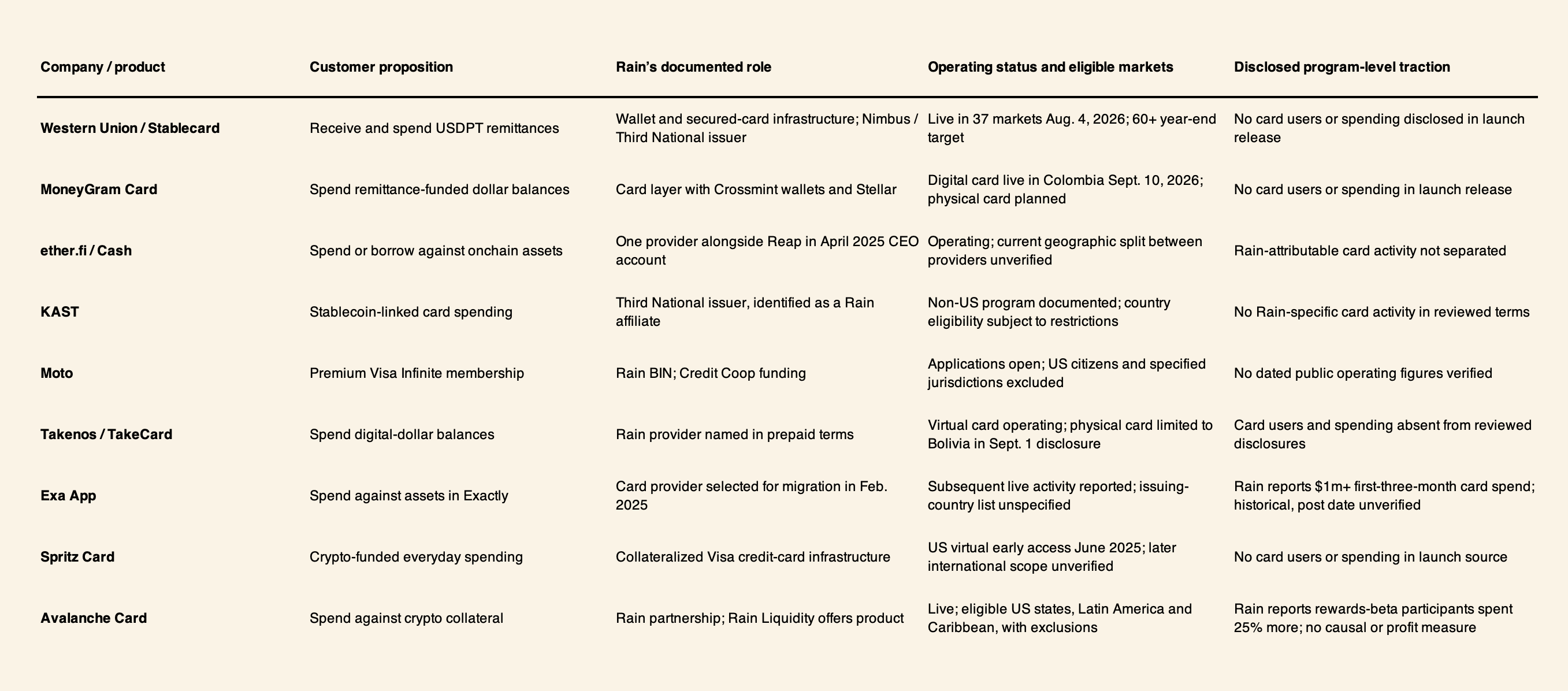
The following table separates documented relationships from the adoption they actually demonstrate. Metrics relate to the card program where available; whole-company users, remittance flows and merchant-network reach are excluded.
| Company / product | Customer proposition | Rain’s documented role | Operating status and eligible markets | Disclosed program-level traction |
|---|---|---|---|---|
| Western Union / Stablecard | Receive and spend USDPT remittances | Wallet and secured-card infrastructure; Nimbus / Third National issuer | Live in 37 markets Aug. 4, 2026; 60+ year-end target | No card users or spending disclosed in launch release |
| MoneyGram Card | Spend remittance-funded dollar balances | Card layer with Crossmint wallets and Stellar | Digital card live in Colombia Sept. 10, 2026; physical card planned | No card users or spending in launch release |
| ether.fi / Cash | Spend or borrow against onchain assets | One provider alongside Reap in April 2025 CEO account | Operating; current geographic split between providers unverified | Rain-attributable card activity not separated |
| KAST | Stablecoin-linked card spending | Third National issuer, identified as a Rain affiliate | Non-US program documented; country eligibility subject to restrictions | No Rain-specific card activity in reviewed terms |
| Moto | Premium Visa Infinite membership | Rain BIN; Credit Coop funding | Applications open; US citizens and specified jurisdictions excluded | No dated public operating figures verified |
| Takenos / TakeCard | Spend digital-dollar balances | Rain provider named in prepaid terms | Virtual card operating; physical card limited to Bolivia in Sept. 1 disclosure | Card users and spending absent from reviewed disclosures |
| Exa App | Spend against assets in Exactly | Card provider selected for migration in Feb. 2025 | Subsequent live activity reported; issuing-country list unspecified | Rain reports $1m+ first-three-month card spend; historical, post date unverified |
| Spritz Card | Crypto-funded everyday spending | Collateralized Visa-credit-card infrastructure | US virtual early access June 2025; later international scope unverified | No card users or spending in launch source |
| Avalanche Card | Spend against crypto collateral | Rain partnership; Rain Liquidity offers product | Live; eligible US states, Latin America and Caribbean, with exclusions | Rain reports rewards-beta participants spent 25% more; no causal or profit measure |
Status reflects dated announcements or live documentation accessed October 8, 2026. Missing program figures do not imply zero activity. Avalanche Card is offered by a Rain affiliate; it is not the same relationship as an enterprise customer. Exa’s historical disclosure is not a current run rate.
Original exhibit
Moto separates the premium experience from the payment infrastructure
Moto presents a Visa Infinite membership combining travel benefits and concierge services with a self-custodial wallet. Its advertised Full membership costs $250 monthly or $2,500 annually. The website accepts applications, subject to approval. This is consumer packaging around an infrastructure relationship, rather than evidence that Moto operates every service itself. [37]
The September 29 international card terms name Rain and define Third National as issuer. They describe secured credit, USDC collateral on Solana backing spending dollar for dollar, and automatic month-end repayment. The issuer funds merchant purchases; a separate clause assigns platform credit decisions to Moto. Those are distinct responsibilities, not sufficient evidence that one party finances every part of the product. Visa independently identifies Moto as a program under Rain's BIN using Credit Coop financing for monthly credit cycles. [39, 38]
Membership adds a separate economic layer. The terms offer Lite at $50 monthly or $500 annually. Full members receive an FX subsidy at Moto's expense; Lite can incur foreign-transaction fees up to 2.2%. Enrollment excludes US citizens and specified jurisdictions, despite international acceptance. Public subscription prices establish Moto's offer, without disclosing Rain's revenue share. [39]
The distinction matters to both businesses. Moto must persuade users that benefits and service justify membership, then fund those benefits and customer support. Rain needs reliable, recurring spending that generates enough retained fees to cover its own obligations. A premium retail price could support infrastructure spending, but it could equally be absorbed by rewards, travel benefits and acquisition. Neither outcome can be inferred from the price alone.
Official terms pages differ on trials, rewards and yield references, so this report uses the newer dated version for current pricing. Pledged assets remain subject to withdrawal and liquidation conditions. No dated public operating or financing amounts were verified for Moto. The case establishes a division of functions, while scale and profitability remain unmeasured. [44, 39]
Competitors can contest both the card and the broader account
Rain's realistic market consists of eligible customers who want stablecoin balances to support spending or money movement. Card issuing, cross-border funding and wallet settlement may be successive stages of one payment. Adding their market sizes would double-count activity; embedded finance describes distribution rather than a separate pool of money.
McKinsey and Artemis estimated approximately $390 billion in annualized stablecoin payment activity based on December 2025, using transaction identification and modeled assumptions. Visa reported about $5.2 billion of stablecoin-linked card volume completed in 2025. The latter also exceeds the former report's $4.5 billion card estimate, with no reconciliation of coverage. Neither denominator can establish Rain's market share from a January annualized run rate. [45, 15]
Bridge, owned by Stripe, directly contests the economics. Its current card page advertises customers retaining all interchange, alongside custom transaction fees and other monetization opportunities. The full infrastructure fee schedule is absent, so this does not establish a cheaper all-in product. It does force buyers to compare retained economics rather than merely issuing functionality. Visa's March announcement put Bridge cards live in 18 countries, with more than 100 planned, and described Lead Bank's role in stablecoin settlement. [46, 47]
Reap overlaps more directly with Rain's operating model. Payward completed its acquisition on July 1. Reap has Visa principal memberships in Hong Kong and Mexico, and its September expansion announcement describes existing stablecoin settlement in Asia-Pacific while targeting more than 100 markets. Direct issuing and stablecoin settlement are therefore meaningful capabilities but no longer unique ones. The announced footprint must still be distinguished from live programs. [48, 49, 50]
Marqeta's July 22 zerohash partnership proposes adding stablecoin custody, compliance and liquidity to established card infrastructure. The release describes a planned integration, not demonstrated joint adoption. Its strategic threat is customer convenience: an existing issuer relationship might be extended instead of replaced. Circle's April launch of CPN Managed Payments competes in adjacent orchestration and payouts, allowing customers to interact in fiat while Circle manages USDC operations. It is not, on that evidence, a substitute for every Rain card function. [51, 52]
These competitors can seek the broader account and price individual services accordingly. That is a strategic possibility, not proof of current loss-leading contracts. Rain could remain attractive as a specialist coordinating multiple assets, markets and providers, provided that coordination produces measurable improvements in reliability, time to launch and cost.
Switching costs are plausible: changing an issuer can require new agreements, cards, authorization logic, collateral arrangements and dispute processes. Exa's announced move to Rain nevertheless shows that providers can be replaced. Visa's acceptance network belongs to Visa, and more Rain customers do not automatically create a Rain-specific network effect. Its defensibility must come from accumulated operational knowledge and integration depth that customers continue to pay for. [33]
Shared infrastructure exposes brands to common failures
An August 28 exploit put that operational thesis under pressure. Blockaid's September 2 analysis traced roughly $1.1 million stolen from outdated Rain Solana collateral contracts. Its technical reconstruction found that a signature-verification flaw allowed an attacker to grant itself withdrawal authority. The affected assets were committed card balances, rather than private keys stolen from users' personal wallets. The analyst identified identical vulnerable code in multiple deployments, with at least two drained. [53]
Contemporaneous CoinDesk reporting described affected Avici and Tria customers and commitments to refund balances. Rain said the vulnerable deployments had been upgraded. Blockaid later reported completed Avici refunds, including additional cashback. This establishes more than a generic reimbursement promise for that program, but does not establish complete ecosystem reimbursement or Rain's final expense. Insurance recoveries and the ultimate allocation of losses were not verified. Rain's direct social statement could not be retrieved; its response is attributed through the accessible reporting. [54, 53]
The loss is not a defensible annual fraud rate: the relevant exposed balances, observation period and recoveries are not disclosed together. Its broader significance is common dependence. One infrastructure defect can damage several customer brands, making contract deployment, upgrades and monitoring core costs of the business. Stablecoin depegs, redemption interruptions and network or local restrictions create additional channels through which cheap token transfers can still produce expensive operating failures.
The proposed bank must earn its additional cost
Rain's announced trust bank would be separately capitalized, uninsured and limited in purpose. The company says it would not accept deposits, offer consumer accounts or make commercial loans; client assets would be segregated and issued-stablecoin reserves would not be lent, pledged or reused. Existing card and payment operations would continue through other subsidiaries. [1]
No Rain-specific filing appeared in the OCC digital-assets application listing reviewed on October 8. The agency's search tool states a five-day publication delay, so absence shortly after the announcement neither disproves filing nor establishes an approval. A receipt date and control number were not independently verified. The OCC's licensing manual distinguishes preliminary approval from final authorization and permits capital, liquidity and operating conditions. Rain-specific requirements remain unknown. [55, 56, 57]
The legal environment is contested. ICBA's October 2 complaint challenges the OCC's trust-chartering approach and alleges that it exceeds statutory authority. These are claims in litigation, not findings against Rain. The OCC describes its February rule as clarifying existing authority. The dispute increases uncertainty around the route without establishing the outcome of this application. [58, 59]
Custody, reserve administration and issuance could reduce vendor dependence and expand institutional fees. They would also introduce governance, reconciliation, compliance and capital costs before sufficient assets or customers arrive. A US trust charter would not confer worldwide permissions or replace merchant acquiring and card networks. The economic test is incremental risk-adjusted earnings relative to the capital and operating burden, not the prestige of a bank name.
The next three years should be judged by retained earnings capacity
The bull case over 24 to 36 months is that remittance launches produce recurring spending, existing programs expand without disproportionate incentives, and Rain sells profitable additional services into those relationships. Reliable operation and integrated workflows then support retention and lower unit costs. The trust bank becomes an additional source of institutional business after authorization, rather than a prerequisite for the card thesis.
The base case is continued activity growth with powerful customers negotiating away part of the benefit. Compliance, integrations and acquired products consume much of the operating leverage. Rain remains useful and grows revenue, while its financial quality depends on whether service expansion exceeds the costs of serving larger, more demanding accounts.
The bear case is that bundled rivals reduce pricing, customers spread programs across suppliers, and another incident or restriction raises costs. Volume could keep increasing while retained fees and contribution per dollar deteriorate. Regulatory delays would prolong spending without adding the proposed bank's revenue. These are analytical scenarios, not earnings forecasts; public evidence does not support numerical exit valuations.
Five measurable developments would change the judgment. First, quarterly actual payment volume alongside active cards and cohort spending would reveal recurring use. Second, a bridge from gross fees to retained revenue and contribution profit would expose the cost of growth. Third, revenue retention and the top-five customer share would show bargaining power and concentration. Fourth, program spending for major launches, measured alongside incentives and completed incident remediation, would connect distribution to economically durable activity. Fifth, OCC milestones, committed capital and subsequent trust-business fees would permit a return-on-capital assessment of regulatory expansion.
Rain has demonstrated a commercially relevant product and the ability to integrate it into established distribution. Its strongest potential advantage is the operating knowledge required to keep complex programs working across several institutions. The public contracts show ways to retain fees and transfer some risks, but customers and competitors can contest those economics. The threshold for a high-quality infrastructure business is sustained contribution growth from retained customers after funding, service and losses. Until that is demonstrated, the $1.95 billion valuation remains a bet on execution rather than a conclusion supported by disclosed earnings.
Sources
Reporting cutoff and source access: October 8, 2026. Undated documentation is treated as a current observation, not historical proof. Company disclosures, investor accounts and third-party estimates are attributed. Commercial interpretations and scenarios are insights4vc analysis. Syndicated releases count as one source.
[1] Rain Files Application With the OCC to Establish Rain National Trust Bank. Rain via PR Newswire, October 5, 2026.
[2] Western Union Launches Stablecard in Partnership with Rain. Western Union, August 4, 2026.
[3] Introducing the MoneyGram Card: Giving Customers More Freedom to Use Their Money, Wherever Life Takes Them. MoneyGram via PR Newswire, September 10, 2026.
[4] Rain Raises $250M Series C to Scale Stablecoin-Powered Payments Infrastructure for Global Enterprises. Rain via PR Newswire, January 9, 2026.
[5] Founder Story: Farooq Malik & Charles Naut of Rain. Circle Ventures, September 22, 2022.
[6] Rain Brings Stablecoins to Everyday Commerce in One Global Platform. Norwest, March 24, 2025.
[7] Media Kit | Rain company information, headshots, and logos. Rain, Undated; accessed October 8, 2026.
[8] Rain Announces $24.5 Million in Funding Led by Norwest to Expand Stablecoin-Powered Card Issuing Globally. Rain via Venture Capital Access Online, March 24, 2025.
[9] Rain Acquires Uptop to Integrate Rewards Into Its Full-Stack Platform for Enterprise Card and Wallet Programs. Rain via PR Newswire, November 12, 2025.
[10] Fern has been acquired by Rain. Fern, December 2, 2025.
[11] Stablecoin card issuer Rain acquires merchant wallet startup Ansa. The Paypers, August 12, 2026. The report omits Fern when counting acquisitions; its acquisition count is not used.
[12] Rain Privacy Policy. Rain / Signify Holdings and affiliates, Updated July 16, 2026.
[13] The Anatomy of a Stablecoin Card Swipe. Rain, Undated; accessed October 8, 2026.
[14] Rain Dashboard Agreement. Rain / Signify Holdings, Updated September 3, 2024.
[15] How stablecoin-linked cards are modernizing money movement. Visa, Updated March 31, 2026.
[16] Rain Spend Corporate Card Program Terms. Rain, September 3, 2024.
[17] Términos y Condiciones para TakeCard. Takenos, Undated; accessed October 8, 2026.
[18] Financing the next hundred stablecoin-linked card programs. Visa, Updated September 8, 2026. Rain figures attributed to Credit Coop; page retains an editorial qualification concerning statistics.
[19] Terms and Conditions. Third National, Updated May 9, 2025. Platform terms supplement private program agreements that can change default commercial provisions.
[20] Enterprise card issuing platform | Rain. Rain, Undated; accessed October 8, 2026.
[21] Rain is now a Mastercard Principal Member. Rain, Undated; accessed October 8, 2026.
[22] Rain Expands Global Payouts to More than 80 Countries in 50 Currencies. Rain via PR Newswire, September 8, 2026.
[23] Farooq Malik and Charles Naut, co-founders of Rain, on stablecoin-backed credit cards. Sacra, May 4, 2024. Direct founder interview; describes the historical product and monetization model.
[24] Rain Bill Payables Agreement. Rain, Updated October 1, 2023.
[25] Mike Silagadze (EtherFi): "We're building a true banking alternative on crypto rails". The Big Whale, April 29, 2025. Direct CEO interview; provider allocation and subsidy statements describe April 2025.
[26] Web3 startup Rain raises $6 million to launch corporate credit cards for DAOs. The Block, April 27, 2022.
[27] Rain Raises $58M Series B Led By Sapphire Ventures to Become the Enterprise Stablecoin Platform of Record. Rain via Chainwire / PR Newswire, August 28, 2025.
[28] Building the Future of Global Payments: Partnering with Rain. ICONIQ, January 9, 2026. Investor-authored investment thesis.
[29] Stablecoins didn't need Wall Street. Endeavor, July 6, 2026. Investor-affiliated source; growth definitions are not reconciled to Rain annualized metrics.
[30] Rain Launches Rewards, Bringing Integrated Loyalty to Card Programs Across Its Platform. Rain via PR Newswire, June 15, 2026.
[31] Rain CEO says stablecoin payments reach more than 100,000 merchants without them knowing it. The Block, August 19, 2026. Original interview with Farooq Malik at Wyoming Blockchain Symposium.
[32] Exa App: DeFi for everyday life with Rain and Exactly Protocol. Rain, official LinkedIn account, Undated; accessed October 8, 2026. Exact publication date not exposed in the inspected page; the card-spend figure covers the first three months after launch.
[33] Exa App Expands with Rain. Exa App, official Medium account, February 28, 2025.
[34] Stablecard by Western Union | Spend, Send & Earn in USD. Western Union, Undated; accessed October 8, 2026.
[35] Frequently asked questions. ether.fi, Undated; accessed October 8, 2026. Dynamically updated help page; does not establish current provider allocation.
[36] KAST Cardholder Agreement (Non-US). KAST, Effective March 20, 2025; accessed October 8, 2026.
[37] Moto Card | Homepage. Moto Card, Undated; accessed October 8, 2026.
[38] Credit Coop: financing infrastructure for stablecoin-linked card issuers. Visa, Updated September 8, 2026.
[39] MOTO CARD INTERNATIONAL SPEND CARD TERMS. Moto Finance, Published September 29, 2026; effective September 2026.
[40] ¿Cómo puedo acceder a mi TakeCard?. Takenos, September 1, 2026.
[41] The Premium Spritz Card Is Here. You're Gonna Want One.. Spritz, June 1, 2025; updated June 2, 2025.
[42] Avalanche Card Debuts with Accelerated Sign-Ups Across Southeast Asia, Africa and Latin America. Avalanche Foundation via Chainwire, February 26, 2025.
[43] Use your crypto, wherever. Avalanche Card, Undated; accessed October 8, 2026.
[44] Terms and conditions. Moto Card, Effective September 2026; accessed October 8, 2026. Differs from the separately published September 29 terms on trial and rewards conversion; conflicting benefits are not combined.
[45] Stablecoins in payments: What the raw transaction numbers miss. McKinsey & Company, with Artemis Analytics, February 18, 2026. Payment estimate is annualized December 2025 activity and includes modeled assumptions.
[46] Issue stablecoin-backed cards to users quickly & compliantly. Bridge, Undated; accessed October 8, 2026.
[47] Visa and Bridge Expand Collaboration, with Plans to Bring Stablecoin-Linked Cards to Over 100 Countries. Visa, March 3, 2026.
[48] Payward Completes Acquisition of Reap, Expanding B2B Offering with Global Payments Infrastructure. Payward, July 1, 2026.
[49] Reap Becomes Visa Principal Member in Mexico, Expands Stablecoin Card Issuing Globally. Reap, May 26, 2026.
[50] Reap and Visa Collaborate to Launch Stablecoin Card Programs Across 100+ Markets. Reap, September 23, 2026.
[51] zerohash and Marqeta Announce Partnership to Enable Stablecoin Spending Across Global Card Networks. Marqeta, July 22, 2026.
[52] Circle Launches CPN Managed Payments, a Full-Stack Platform for Seamless Stablecoin Settlement. Circle, April 8, 2026.
[53] $1.1M Rain Ecosystem Exploit: How Onchain Monitoring Gives Stablecoin Card Issuers Fleet-Level Coverage. Blockaid, September 2, 2026.
[54] A Solana-based $1.1 million crypto card hack crashed a neobank's token 49%. CoinDesk, August 29, 2026.
[55] Digital Assets Licensing Applications. Office of the Comptroller of the Currency, Undated; accessed October 8, 2026.
[56] Corporate Applications Search. Office of the Comptroller of the Currency, Undated; accessed October 8, 2026.
[57] Charters: Comptroller's Licensing Manual. Office of the Comptroller of the Currency, December 2021.
[58] Complaint, Independent Community Bankers of America v. Office of the Comptroller of the Currency, No. 1:26-cv-03441. Independent Community Bankers of America, Filed October 2, 2026. Party allegations in litigation, not judicial findings.
[59] National Bank Chartering: Final Rule. Office of the Comptroller of the Currency, February 27, 2026.
Cover Artwork

Simon Denis, c. 1786–1806
The Metropolitan Museum of Art
Risk Disclaimer
insights4vc provides independent research based primarily on publicly available information believed to be reliable at the time of publication. Figures may change because of market prices, token supply, reclassification and methodology updates. Legal structures, investor rights and regulatory treatment vary by product and jurisdiction.
This article does not constitute investment, legal, tax, accounting or financial advice, or an offer, solicitation or recommendation regarding any security, token, fund interest or other asset. insights4vc makes no representation regarding the completeness or accuracy of third-party data. Readers should conduct independent due diligence and consult appropriately qualified advisers before making investment or business decisions.
Published by the insights4vc research team. See our research methodology, source standards and corrections policy. Dates and measurement periods are stated in each analysis.
Read next