Key Statistics
- The May 2016 amendment specified €12.25 billion in upfront cash, the preferred shares, and €1 billion deferred for three years with 4% annual compound interest. [22]
- Stearns, tracing Nocera, reports $8.8 million of early recorded losses and a roughly $20 million broader estimate; these are alternative cost perimeters, not additive losses. [7] The available reconstructions establish a serious failure of control, but do not establish a consistent, audited decomposition between fraud, ordinary credit losses, launch expenses, and overhead. Nor should a percentage of delinquent accounts be relabeled a fraud rate or compared directly with losses as a percentage of purchase volume.
- For the preceding full year, FY2025, Visa generated $40.0 billion of net revenue and $23.994 billion of GAAP operating income, a 60.0% operating margin. [38, 40]
Figures and examples retain the report's original period, scope and source definitions. Consult the analysis and references below before making comparisons.
In September 1958, Bank of America mailed BankAmericards to households in Fresno, California. This was a launch through the postal system: potential customers received usable credit cards before asking for them. Joe Nocera's account puts the mailing at 60,000 cards. Visa's retrospective describes the other half of the operation: approaching local retailers with the prospect that many of their customers would soon carry one. The bank already served approximately 45% of Fresno's families. [1, 2]
The experiment joined two promises. A shopper could purchase without handing over cash. A merchant could accept that shopper without personally financing and collecting the debt. Those promises depended on more than recognizing a piece of plastic. Someone had to decide who could borrow, document purchases, identify abuse, produce correct bills, and bear losses when payment failed. [1]
That distinction matters throughout Visa's history. A payment instrument is visible; the allocation of obligations behind it usually is not. Distribution can put an instrument into millions of hands without producing a dependable business. Conversely, a useful business can survive major technological change while losing control over the economics that once made it attractive.
Visa's central achievement was eventually to make competing institutions support the same payment promise. Its central uncertainty is whether that position remains as valuable when money can move through different infrastructure.
Following the history makes the question more precise: which problems did the network actually solve, who paid for those solutions, and what prevents another arrangement from solving them more cheaply?
Partner Highlight

Umia is building an operating stack for token-native ventures that combines fundraising, legal formation, treasury management and market-based governance.
1. BankAmericard had to become a business
Cash required immediate payment. A check required the merchant to accept a claim on a bank account, collect it and bear the risk that it would not be paid. Bank of America did not introduce Americans to buying on credit. Stores and other businesses already offered their own accounts and cards. Diners Club, followed by American Express, demonstrated that one credential could work across unrelated establishments. But a charge card generally required full payment of its monthly bill. Revolving credit allowed the customer to carry a balance, pay interest, and borrow again as earlier debt was repaid. These were different businesses even when both presented a card at checkout. [3, 4]
Joseph P. Williams led BankAmericard's development and left the bank in late 1959 amid the launch's difficulties. [5] His product combined a payment mechanism with an unsecured lending commitment. The distinction is economically decisive. A customer paying promptly generates little or no lending income; a customer carrying debt generates interest but also funding costs and credit risk. More usage can therefore strengthen or weaken the business depending on repayment behavior and the costs of serving it.
Fresno gave the bank a concentrated base on which to test acceptance. The commonly repeated launch statistics describe different things. Nocera's 60,000 is a mailing count, not a count of active borrowers. Evans's published reconstruction describes roughly 300 initial retailers, followed by another 800 over five months. Those figures should not be confused with the tens of thousands of California merchants reached after expansion. The precise count is less consequential than the sequence: mailing made the card available, merchant recruitment made it useful, and actual use determined whether either investment paid. [2, 4]
Consider a hypothetical purchase under an early bank-card plan. The merchant recorded the sale and submitted its paper claim to the bank. The bank credited the merchant after deducting the agreed discount, then billed the shopper. Above a merchant's authorized transaction threshold, often called a floor limit, a separate approval was required. The plastic identified the account; it did not carry money. The merchant's receipt, the customer's borrowing, and the bank's payment obligation were distinct records of one purchase. The Federal Reserve's 1968 survey describes these mechanics across bank-card plans. [3]
For a small merchant, the service could replace a substantial administrative burden. Financing customers ties up working capital; billing and collecting small balances consume labor; a default can erase the margin on several successful sales. Paying the bank could therefore be rational even before any increase in sales. The relevant comparison was the merchant's entire cost of extending credit, not the price of printing a receipt. A large retailer with its own established credit operation faced a different calculation and could be less eager to surrender part of the customer relationship. [6]
The first expansion exposed the weakness in confusing availability with underwriting. Stearns, tracing Nocera, reports $8.8 million of early recorded losses and a roughly $20 million broader estimate; these are alternative cost perimeters, not additive losses. [7] The available reconstructions establish a serious failure of control, but do not establish a consistent, audited decomposition between fraud, ordinary credit losses, launch expenses, and overhead. Nor should a percentage of delinquent accounts be relabeled a fraud rate or compared directly with losses as a percentage of purchase volume.
Bank of America nevertheless kept financing the program. Larkin told Nocera that installment-credit management replaced the initial approach; the cleanup established collections and anti-fraud work and removed unreliable participants. [2] Evans records improvements in collection, merchant pricing, and acceptance, with an initial operating profit in 1961. [4] An operating profit is also a narrower claim than full recovery of accumulated investment. The bank's choice makes commercial sense without assuming it possessed certain knowledge of the outcome: abandoning the product would have discarded an assembled distribution base, while better screening and collections might preserve its useful service and change its costs.
Kenneth Larkin's contribution becomes clearest when the story moves beyond launchmanship. Bátiz-Lazo and Del Angel trace his contemporary 1966 account of gathering operational expertise into three volumes covering computing, collections, marketing, startup costs, and interchange. Larkin reported approximately 1.765 million cardholders, 61,000 accepting establishments, and $185 million of sales by the end of 1965. These were participant-reported operating statistics, not an independent profitability audit. But they show the business becoming reproducible: other banks could acquire an operating method rather than merely copy a card. [8]
Larkin also defended mass distribution as a way to make merchants believe that enough potential users existed, according to Nancy Shepherdson's reporting. [9] That position captures both its commercial logic and its weakness. Recruitment and risk control had to progress together. A bank could solve the acceptance problem by creating borrowers faster than it could evaluate, monitor, or collect from them. Conversely, credit discipline alone could produce a sound portfolio attached to a payment instrument that almost nobody accepted. The rescue required a workable combination of both.
2. Cooperation became an institution
National expansion began through licensing in 1966. A tax case concerning First Security's Idaho and Utah banks preserves unusually concrete evidence of what a license purchased. Their combined $25,000 initial expenditure bought operational material, training, computer programming and servicing, and access to BankAmericard's identifying marks; continuing royalties depended on sales. The contracts came from BankAmerica Service Corporation. By March 1967, the banks' card operations were functioning. The expansion was a sale of organizational capability as well as a brand. [10]
Implementation still happened locally. John Fisher of the institution later known as Bank One recalled that its computers were incompatible with Bank of America's, requiring the initial work to run at a local gas company during unused hours. [9] The incident identifies a practical limit to licensing: a shared commercial promise did not automatically produce shared information systems. Each new bank brought both distribution and another set of operational interfaces.
The franchise structure also put a competitor in charge of the common product. Banks wanted portable acceptance without making their customer relationships dependent on another bank's discretion. In the later NaBanco trial, testimony from Larkin and other participants supported the finding that licensees had grown in sophistication and sought an institution reflecting their own interests. The court also described uncertainty over payments between members: the original interchange arrangement depended on the merchant bank's interpretation of its discount and obligations to the issuer. [6]
Dee Hock became the central organizer. In 1969 he convened bankers in Sausalito to redesign the struggling program, an episode recorded in Visa's account of its founder. [11] The institutional change followed in 1970, but it was neither the original card launch nor the later creation of a worldwide Visa brand. National BankAmericard Inc., or NBI, became a for-profit, nonstock membership corporation. First Security's court record dates termination of its former licenses to June 30, 1970, following the sale of the U.S. licensing rights to NBI. Banks moved from being franchisees to participating in the institution governing their shared system. [10, 12]
The division of responsibility was substantial but bounded. Issuing banks extended credit and managed cardholder accounts; merchant banks contracted with retailers and received their transaction records. Proprietary members governed NBI through directors and committees and paid for its operation. Smaller agent members did not have the same issuing or governance powers. NBI did not impose uniform cardholder interest rates or merchant discounts, nor did it grant members exclusive territories. Those commercial choices remained points of competition. [12]
The common institution supplied something a collection of independent price lists could not: rules for accepting another bank's customers and allocating the resulting obligations. Stearns describes operating regulations governing marks, interbank procedures, penalties, and dispute interpretation. Members accepted rules as subsequently amended, reducing dependence on renegotiating each bilateral relationship. [7] This was the concrete content of cooperation. A merchant bank needed confidence that an issuing bank would perform even when the two disagreed about a transaction; each needed an established process for deciding whether the other's claim met the rules.
Calling this arrangement "chaordic," Hock's later term for combining order and autonomy, should not obscure its boundaries. It was an organization of identified financial institutions with differentiated membership rights, binding contracts, management, and legal remedies. It was not permissionless participation. Decentralizing commercial decisions did not abolish a governing center, and cooperation among banks did not automatically align their interests with those of merchants or consumers. [12]
One early dispute exposed the difference between protecting a network and protecting its members' freedom. Worthen Bank in Arkansas joined NBI, then sought to participate in Master Charge. NBI adopted a bylaw in September 1971 restricting dual participation, and Worthen sued. A federal district court ruled against the restriction in July 1972 as an automatically unlawful group boycott. [12] That was not the final legal outcome: in September 1973, the Eighth Circuit reversed and required a fuller examination of competitive effects. The appeal recognized that cooperation could create a nationwide product no member could supply alone, without deciding that every restriction was justified. [12]
The dispute later settled. After the Justice Department declined in October 1975 to endorse a revised exclusivity rule, an acquiring-only compromise proved impractical. NBI abandoned exclusivity in 1976 and banks could participate in both networks. [13, 14] The result came through litigation, regulatory uncertainty, and institutional choice, not a final judgment establishing that all dual-membership prohibitions were unlawful.
The economic tension remained. A bank serving merchants wanted to handle whichever cards shoppers brought through the door. A network wanted members sufficiently committed to support investment and compete against another network. Those interests overlap, but they are not identical. Hock's achievement was to establish machinery through which such disagreements could be decided while business continued. Building the institution did not resolve every conflict; it made conflict compatible with a common payment service.
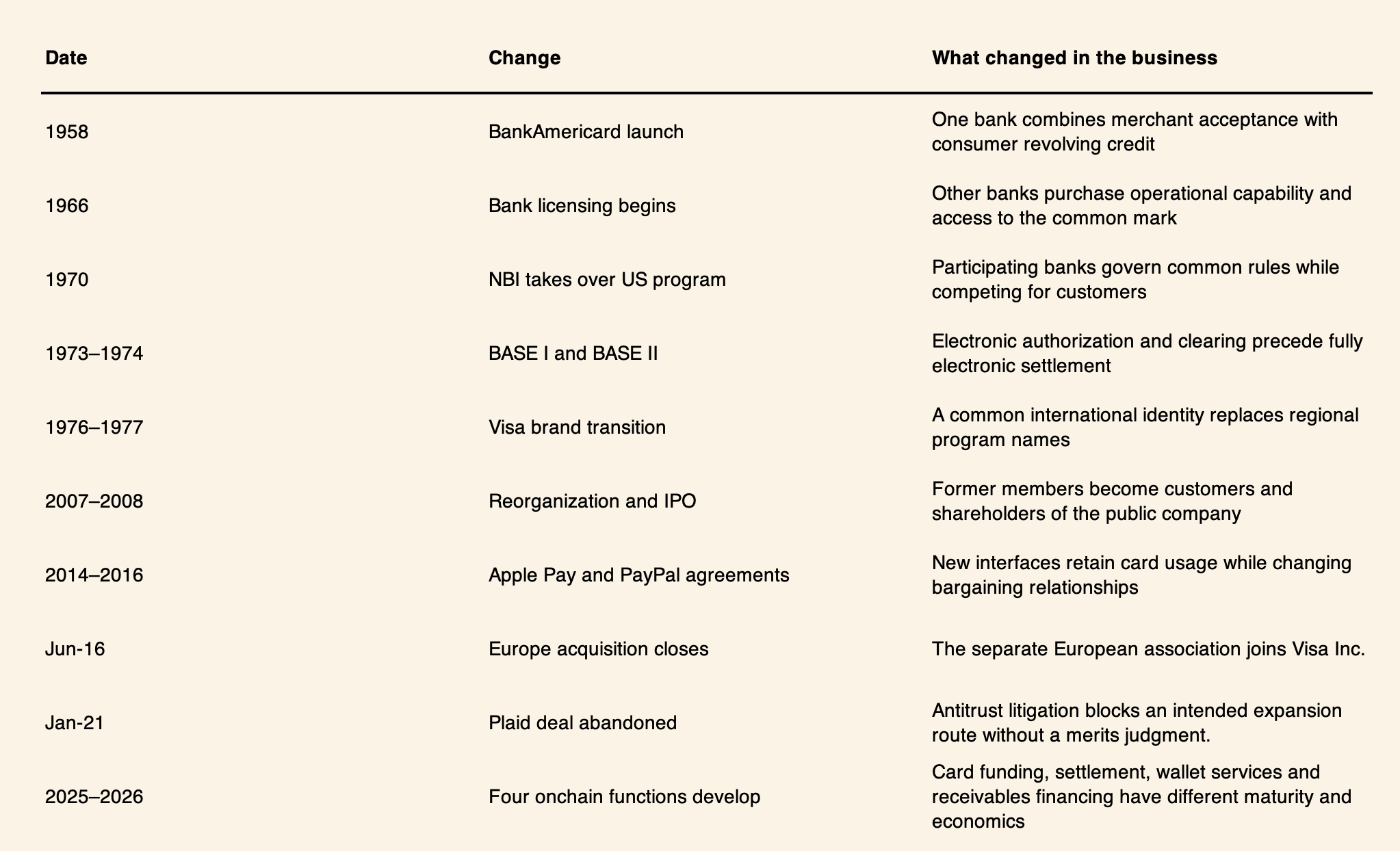
| Date | Change | What changed in the business |
|---|---|---|
| 1958 | BankAmericard launch | One bank combines merchant acceptance with consumer revolving credit |
| 1966 | Bank licensing begins | Other banks purchase operational capability and access to the common mark |
| 1970 | NBI takes over US program | Participating banks govern common rules while competing for customers |
| 1973–1974 | BASE I and BASE II | Electronic authorization and clearing precede fully electronic settlement |
| 1976–1977 | Visa brand transition | A common international identity replaces regional program names |
| 2007–2008 | Reorganization and IPO | Former members become customers and shareholders of the public company |
| 2014–2016 | Apple Pay and PayPal agreements | New interfaces retain card usage while changing bargaining relationships |
| June 2016 | Europe acquisition closes | The separate European association joins Visa Inc. |
| January 2021 | Plaid deal abandoned | Antitrust litigation blocks an intended expansion route without a merits judgment. |
| 2025–2026 | Four onchain functions develop | Card funding, settlement, wallet services and receivables financing have different maturity and economics |
Historical summary from the report's cited sources: [1], [10], [12], [16], [17], [18], [19], [20], [21], [22], [23], [24]. The original exhibit's “Jun-16” and “Jan-21” labels are written out as June 2016 and January 2021. Onchain status is as of the September 30, 2026 research cutoff. Link to this table.
Original exhibit
3. Information moved before money did
A common rulebook could make banks promise to honor one another's cards. It could not make a distant credit department answer the telephone quickly. The technical problem was to carry a purchase request across institutional boundaries while preserving the bank's responsibility for the account. Visa's later corporate chronology dates the launch of BASE I, its electronic authorization system, to 1973, and BASE II, for clearing and settlement, to 1974. These became foundations of VisaNet, rather than one instantaneous conversion to a completely electronic payment system. [16]
Aram Tootelian led the technical effort with TRW and specialist contractors. BASE I entered limited production on April 4, 1973, then continuous service in May. Banks retained their own account systems and initially often human authorization decisions. [7]
Consider a hypothetical purchase. Authorization asks whether it may proceed. Clearing exchanges the resulting transaction record and calculates what participants owe. Settlement discharges those interbank obligations through transfers of funds. A positive checkout response therefore precedes the movement of money. In the conventional arrangement described by bank supervisors, the network calculates banks' net positions, a settlement institution coordinates payment and a separate system such as Fedwire can carry the funds. The issuer subsequently collects from the cardholder. These are connected functions, but their clocks and risks differ. [29]
Hock's contemporary account makes the original division particularly clear. In his 1974 conference paper, he described BASE II replacing thousands of bilateral clearing drafts with fewer than 80 daily net drafts through the existing banking system. He put development cost below $7 million, excluding member banks' internal preparation, and specified November 1, 1974 for mandatory electronic receipt and March 1, 1975 for sending. He projected a 2.5-cent processing charge per item and first-year savings above $12 million. These were the operator's estimates, not an independent audit of realized savings. Electronic records simplified obligations; they did not invent a new settlement asset. [15]
Netting explains part of the efficiency. If a bank owes money for its cardholders' purchases while being owed money for purchases at its merchants, the offsetting amounts need not all travel separately. Only the balance must be funded. That reduces transfers and liquidity requirements, but does not manufacture liquidity or remove the obligation to pay. Similarly, a network's promise that a conforming purchase will be honored is a contractual allocation of risk, not evidence that the money has already arrived. The customer experiences speed because institutions agree what will happen after approval. [29]
Hock called the broader ambition electronic value exchange. His 1974 argument treated the card as an identification device, distinguished useful services from the physical instruments delivering them, and advocated competing networks over a government-centered monopoly. He also defended translating members' differently formatted data at the boundary instead of imposing identical internal systems. These were strategic claims from a participant seeking room to build his own network. They were not proof that competition would always remain effective or that every adjacent service belonged inside NBI. [15]
Indeed, BASE III attempted standardized card-account software inside member banks. Expanding requirements, weak performance and changing interfaces defeated it. NBI canceled the project, refunded advance license fees and cut staff in January 1976. Stearns establishes those consequences, but supplies no verified aggregate dollar loss. [7] Shared connectivity had not established competence in every adjacent service.
This distinction was already present in the contemporary policy debate. Justice Department antitrust official Donald Baker separated communications from the institutional arrangements governing how messages were acted upon. A telephone network could carry competing payment services. Shared physical transport therefore did not establish a need for one financial network or one set of commercial rules. Baker warned against assuming that a young electronic-payments market was inevitably a natural monopoly. His position challenged both an automatic public monopoly and private cooperation designed mainly to insure established participants against competition. It was an argument about market design, not a prediction that every entrant would survive. [15]
Nor was private ownership of the switch technologically preordained. Banks asked the Cleveland and Atlanta Federal Reserve Banks to support point-of-sale switching in 1973. The attraction was a common facility with broad access; smaller institutions feared exclusion from infrastructure controlled by larger competitors. In June 1974, the Board rejected funding the Atlanta experiment while its general policy remained unresolved and Congress considered a national commission. Its letter nevertheless offered potential assistance with standards, rules, arbitration and net settlement. Public settlement support and private transaction processing were separable choices, not mutually exclusive systems. [30, 31]
There was contemporary disagreement even about the appropriate fallback. Boston Fed economists favored preserving both public and private options, with access and cost more important than ownership. Full-cost pricing, they argued, would prevent free central-bank services from extinguishing private alternatives. The 1977 National Commission ultimately recommended leaving point-of-sale infrastructure to the private sector, while retaining grounds for reconsideration if competition, access or development proved inadequate. [15, 30] Visa's opportunity consequently reflected policy decisions as well as engineering. The system that emerged joined private operating rules and communications to the banking system's existing machinery for settling money.
4. A global mark, a local bargain
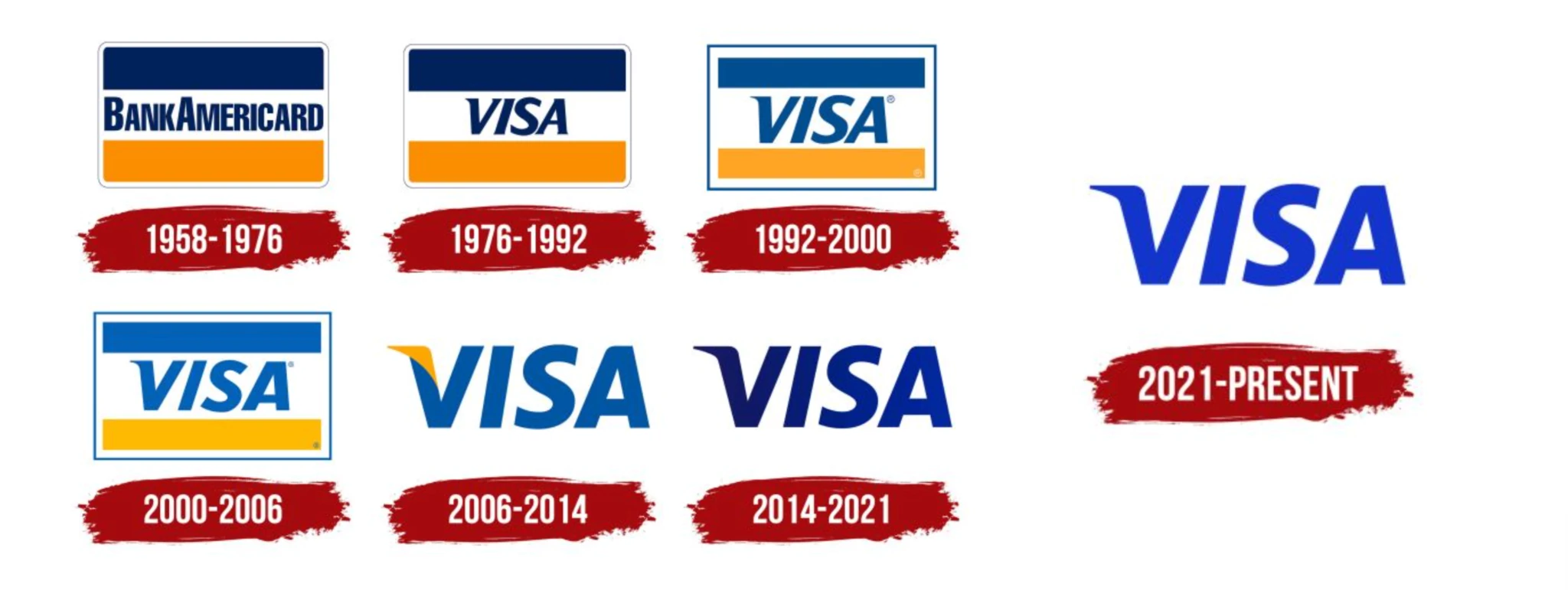
The organization also needed an identity that could travel. IBANCO, established in 1974, administered the international BankAmericard program. Its affiliates used names including Barclaycard in Britain and Chargex in Canada. The Visa name was adopted in 1976, followed by the public conversion during 1977. These were stages in a transition, not rival dates for a single event. The familiar colored bands carried recognition across the change. [17]
A common mark did not erase national conflicts. Archival research into Banco de Bilbao shows the Spanish bank valuing international acceptance while resisting the loss of its exclusive domestic position. France's Carte Bleue group, which joined IBANCO in 1976, pressed the international organization to end single-bank privileges in other European countries. Its proposal won majority support at the November 1976 Osaka meeting. Wider interoperability could threaten the local scarcity value that had persuaded an early participant to invest. Globalization meant negotiating those interests, not merely connecting another country's computers. [32]
Consider a hypothetical purchase with no assumed fee rate. The buyer is the cardholder; the seller is the merchant. The issuer provides the buyer's card account. The acquirer provides the merchant's access to card acceptance. These are the four parties in the conventional model. Visa connects them. Processors, payment facilitators and gateways can add links without changing this terminology. The merchant's acceptance charge, often called the merchant discount or merchant service fee, covers several components. Interchange generally flows from the acquirer to the issuer. Scheme fees compensate the network. The acquirer's own services and other processing costs also enter the merchant's price. Interchange is therefore neither Visa's revenue nor the entirety of the merchant's bill. [33]
The distinction changes the competitive analysis. Higher interchange can attract issuers and finance consumer benefits while increasing merchant costs. A mature acceptance network can also leave merchants with limited practical room to refuse. What helps recruit the next cardholder need not minimize the total cost of payments. [33] There is no single fee that captures this bargain across countries, credit and debit products, and merchant contracts.
Debit expanded the opportunity beyond borrowing. The same retail acceptance relationship could now connect a purchase to a deposit account. Its importance became visible in ordinary household behavior: the Federal Reserve's analysis of the Survey of Consumer Finances found that the share of U.S. families using debit cards rose from 17.6% in 1995 to 47% in 2001. People increasingly held several payment instruments, choosing among them rather than switching all their spending to one. The competition was occurring inside wallets as well as between networks. [34]
U.S. debit developed along different processing paths. Signature debit used the major card brands' infrastructure, while PIN debit also drew on networks associated with ATM access. The distinction shaped routing and issuer incentives. Federal Reserve research counted 25.3 billion debit payments in 2006, exceeding credit's 21.7 billion, although debit's dollar value remained much smaller. Faster authorization, changes to signature requirements and merchant-specific pricing also helped cards enter businesses such as quick-service restaurants. Growth came partly from making small everyday transactions economical and convenient. It did not require every customer to take out another loan. [35]
Acceptance, however, was never an unconditional endorsement of the network's rules. The 2003 U.S. merchant settlement required Visa to separate acceptance of its debit products from acceptance of other Visa products from January 2004. Merchants could challenge the package of products they were being required to take. [36] In a separate case, the Second Circuit in 2003 affirmed the finding that rules preventing member banks from issuing American Express or Discover cards violated antitrust law. The government's challenge to dual governance had failed at trial. The Supreme Court denied review in 2004. Cooperation among competing banks was permissible; every restriction adopted by their common organization was not. [14]
Regulators subsequently intervened in the bargain itself. The Federal Reserve's 2011 Regulation II capped interchange for covered U.S. debit issuers, with exemptions including institutions below $10 billion in assets. It also required access to at least two unaffiliated networks and protected merchant routing choice. Those provisions addressed different things: what the issuer could receive, and which network could process the purchase. Neither amounted to a general cap on Visa revenue. [37]
Visa's advantage was thus a collection of reinforcing assets: merchant acceptance made issuance useful; issuance justified acceptance; common procedures reduced repeated bilateral work. But Mastercard could offer a comparable organizing model, merchants could resist particular terms, and banks could distribute business across networks. Scale created bargaining power, not an escape from bargaining. This distinction would become more important when Visa's owners and its customers ceased to be substantially the same constituency.
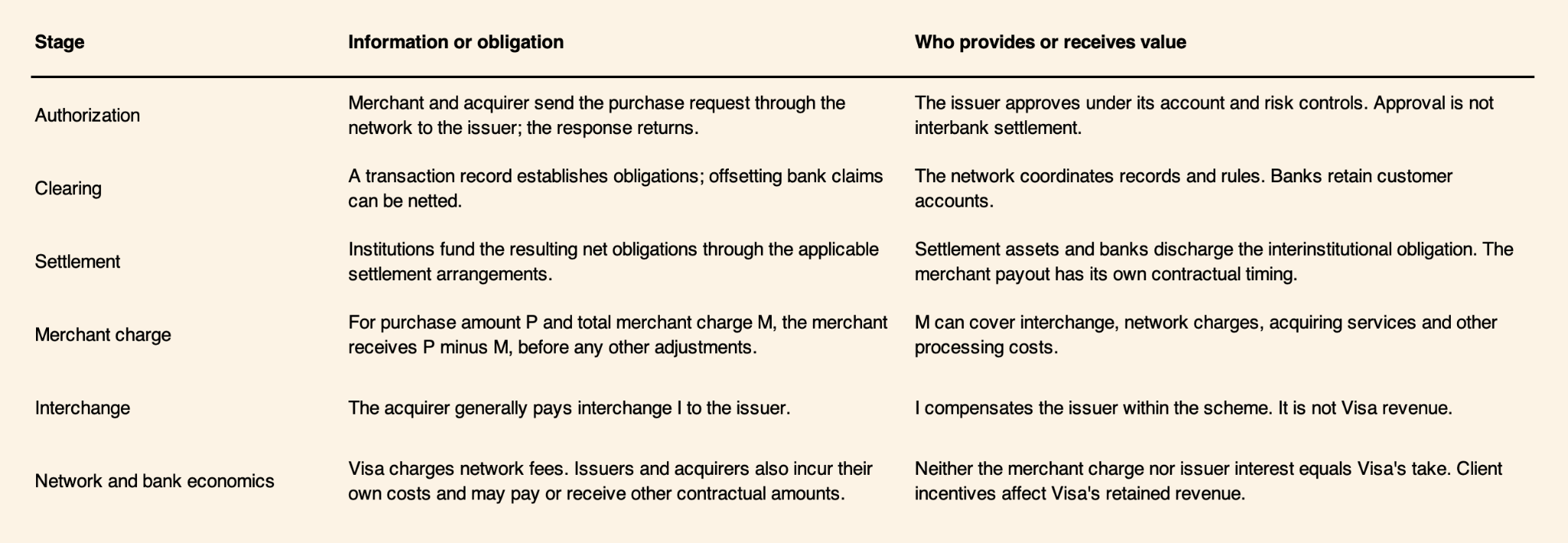
| Stage | Information or obligation | Who provides or receives value |
|---|---|---|
| Authorization | Merchant and acquirer send the purchase request through the network to the issuer; the response returns. | The issuer approves under its account and risk controls. Approval is not interbank settlement. |
| Clearing | A transaction record establishes obligations; offsetting bank claims can be netted. | The network coordinates records and rules. Banks retain customer accounts. |
| Settlement | Institutions fund the resulting net obligations through the applicable settlement arrangements. | Settlement assets and banks discharge the interinstitutional obligation. The merchant payout has its own contractual timing. |
| Merchant charge | For purchase amount P and total merchant charge M, the merchant receives P minus M, before any other adjustments. | M can cover interchange, network charges, acquiring services and other processing costs. |
| Interchange | The acquirer generally pays interchange I to the issuer. | I compensates the issuer within the scheme. It is not Visa revenue. |
| Network and bank economics | Visa charges network fees. Issuers and acquirers also incur their own costs and may pay or receive other contractual amounts. | Neither the merchant charge nor issuer interest equals Visa's take. Client incentives affect Visa's retained revenue. |
Illustrative mechanics, with no assumed fee rate. Sources: [29], [33], [38]. P is the purchase amount, M the total merchant charge, and I interchange. Link to this table.
Original exhibit
5. The customers sell the company
The conversion into a public corporation occurred in stages. Visa Inc. was incorporated in May 2007. Transactions from October 1 through October 3 brought Visa U.S.A., Visa International, Visa Canada and processing company Inovant beneath it; October 1 was the accounting date. Visa Europe remained a separate member-owned organization under contractual arrangements. It was not acquired in the IPO. [18]
Visa priced 406 million public shares at $44 on March 18, 2008. Trading began the next day; the offering closed March 25. The underwriters' additional allotment brought issuance to 446.6 million shares and net proceeds to approximately $19.1 billion. These figures distinguish the original offer from the enlarged sale and net cash from headline gross proceeds. [19] On March 28, Visa used about $13.45 billion to redeem former members' shares; on March 31, it placed $3 billion in an escrow account for covered litigation. The flotation monetized the banks' accumulated ownership while financing a mechanism for historical claims. [19]
The operating relationships survived, but their constitutional basis changed. Financial institutions became customers negotiating with a company accountable to outside shareholders. Transitional regional board seats preserved a limited bridge to the previous structure; a majority of directors were independent. Visa also warned that consolidation among banks could strengthen customers' bargaining power and increase demands for discounts or incentives. [18]
Economically, there were reasons for both alignment and conflict. Banks benefited from wider acceptance and useful services; Visa benefited from more activity. A corporation could consider investments across the network without requiring every project to match each member's immediate priorities. Yet shareholders wanted returns from that activity, while customer banks wanted attractive commercial terms. A higher network charge could increase Visa's revenue and reduce a bank's card profitability. An incentive could keep the bank's volume on Visa while reducing what Visa retained. The shared objective of growth did not settle the distribution of its proceeds.
The litigation arrangements were another form of continuity. Ownership could change without transferring every historical economic burden indiscriminately to new investors. Escrow and the special share structure separated particular legacy liabilities from the public stock's economics. The result was neither a complete break with the banks nor their continued collective control. It was a negotiated division of future opportunity and past exposure. [19]
Europe completed the organizational consolidation eight years later. The November 2015 announcement described a maximum €21.2 billion transaction: €16.5 billion upfront and a potential earn-out, including interest, of €4.7 billion. Before closing, the earn-out was removed. The May 2016 amendment specified €12.25 billion in upfront cash, the preferred shares, and €1 billion deferred for three years with 4% annual compound interest. The acquisition closed June 21, 2016. [22]
Accounting numbers answer another question. At closing, cash, the fair value of preferred shares and discounted deferred consideration totaled $20.810 billion before adjustments. After accounting for settlement of the pre-existing European framework agreement and treasury stock, purchase consideration was $18.784 billion. The final allocation completed in fiscal 2017 retained that total. Calling the purchase simply a €21.2 billion acquisition confuses the original maximum with what was ultimately agreed and recorded. [22]
The European transaction bought an existing regional business and reunited governance, technology investment and commercial strategy. It did not suddenly create European acceptance. The customers who had owned the regional organization received consideration, while Visa acquired the opportunity, and responsibility, to extract an adequate return from integrating it. For the public company, cooperation remained the operating necessity. The question was now how much value could remain with shareholders after winning that cooperation.
That question also changes how growth should be evaluated. A new bank portfolio can enlarge reported volume while carrying expensive incentives. An acquisition can broaden capability while requiring integration expenditure and a return on the purchase price. Ownership reform made these trade-offs more legible to capital markets; it did not eliminate them. The relevant outcome became profitable cooperation, with investment and customer concessions weighed against the cash ultimately available to shareholders.
6. The interface changes and the bargaining continues
E-commerce loosened the connection between a card payment and a plastic object. A browser could initiate a purchase; a merchant gateway could organize its processing. The underlying account and acceptance network could remain. By 2014, Visa-owned CyberSource and Authorize.Net were integrating Apple Pay into online merchants' payment management. Visa had moved into services surrounding checkout as well as maintaining the network beneath it. [20]
Apple Pay demonstrated how technical adaptation and control of the customer could move in different directions. Visa announced its Token Service alongside Apple's service in September 2014. A substitute digital credential replaced sensitive account information, permitting supported cards to operate in devices and applications. Apple added a device interface, authentication and contactless convenience. The purchase still drew on a participating issuer's card account. Credential tokenization was a security mechanism for using that account; it did not turn bank money into a blockchain asset. [20]
The commercial distinction matters too. Issuing banks pay Apple under the relevant arrangements, not merchant acquirers handing Apple a universal share of a swipe fee. Acquired's published correction explicitly flags this error; it also corrects the episode's count of the parties in the card model. No uniform Apple Pay rate should be projected across countries and card products. [39] For Visa, preserving network usage did not mean preserving exclusive influence over the experience in which consumers selected their cards. The device operator could become a valuable distribution partner with its own bargaining position.
PayPal made that bargaining unusually visible. Its July 2016 U.S. agreement with Visa committed it to show Visa cards as an equal, clear funding choice, let consumers establish them as preferred, and stop encouraging Visa cardholders to connect bank accounts through ACH, the U.S. bank transfer system. It would also cooperate with issuers on customers moving existing ACH flows to cards. In return, PayPal received access to Visa's token services through the Digital Enablement Program, a route toward contactless retail acceptance, volume incentives and greater certainty about future fees. Visa Direct would support withdrawals through eligible Visa debit cards. [21]
The bargain protected an economically important position in the payment journey. Visa gained a partner's commitment about funding choice. PayPal gained capabilities and improved terms that could make cooperation worthwhile. Neither the press release nor the technology demonstrates that card funding was inherently cheapest. The agreement instead shows an incumbent purchasing alignment through commercial concessions while a digital intermediary traded some steering freedom for access and predictability. [21]
The limits appeared in the proposed $5.3 billion Plaid acquisition. Announced in January 2020, it met a Justice Department challenge that November. The department alleged that buying Plaid would remove a developing competitive threat in online debit. Visa rejected that characterization, arguing that the businesses were complementary. In January 2021, the parties terminated the agreement and the litigation was dismissed. There was no final judgment establishing the government's theory on the merits. Visa's stated confidence that it could have won did not make the acquisition happen. [23, 24]
Apple Pay, PayPal and Plaid therefore tell different stories: technical integration, negotiated accommodation and a blocked strategic route. Together they undermine a simple claim that every new interface inevitably strengthens Visa. A company can retain a role while conceding economics or control, and it cannot assume that purchasing adjacent infrastructure will be available. Stablecoins reopen all three possibilities. They might finance a familiar card purchase, replace an interinstitutional settlement asset, or support a competing arrangement that no longer needs the same network bargain.
7. The business at the cutoff
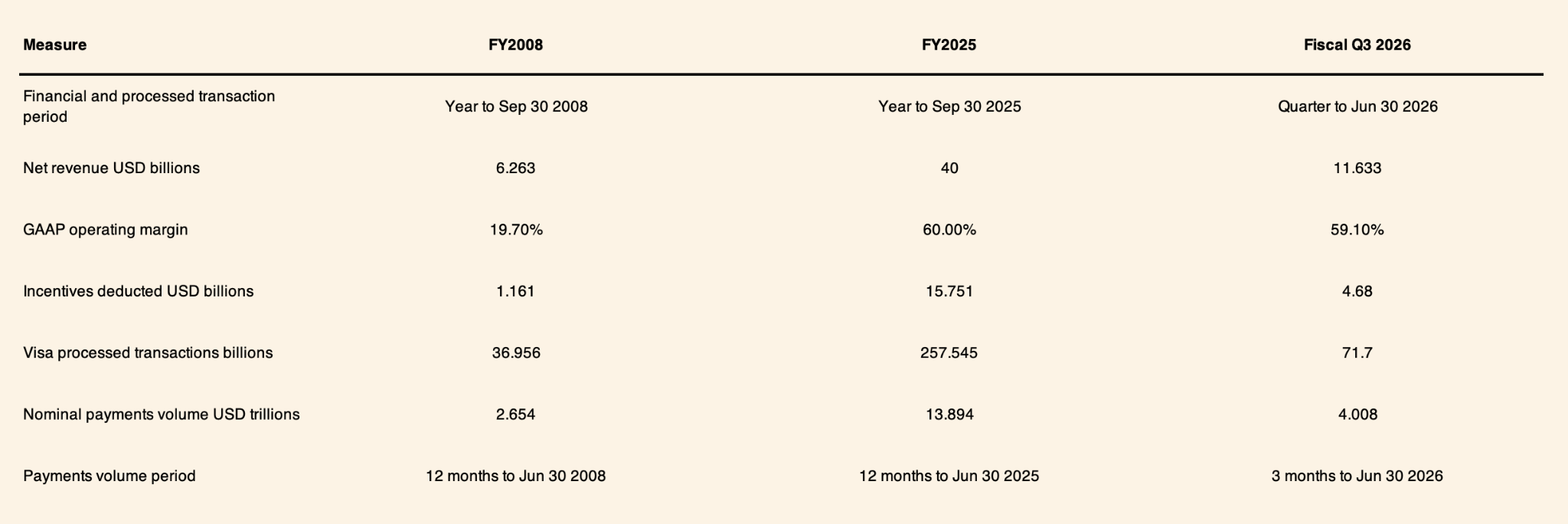
Visa entered the onchain debate with a profitable operating business, not simply a recognizable brand. Its fiscal year ended on September 30, 2026, but that year's complete results were not yet published. The latest reported quarter ended June 30. For the preceding full year, FY2025, Visa generated $40.0 billion of net revenue and $23.994 billion of GAAP operating income, a 60.0% operating margin. These are network and service economics, rather than the interest margin of a card lender. [38, 40]
Net revenue already reflected $15.751 billion of client incentives. Those deductions equaled 28.3% of revenue before incentives, calculated from the disclosed categories. Visa's scale therefore coexists with substantial payments to retain and develop its distribution. Incentives are generally revenue deductions, although payments for distinct goods or services can be expenses. Contractual estimates make their recognition different from cash paid in the same period. [38] The former members' bargaining power did not disappear when ownership changed; it became visible partly through commercial contracts.
In fiscal Q3 2026, net revenue reached $11.633 billion, up 14% year over year. GAAP operating income was $6.877 billion, implying a 59.1% margin. Operating expenses included $563 million of severance and a $237 million special litigation provision; Visa's adjusted earnings removed those and other specified items. Client incentives increased 18% to $4.680 billion. [40] Purchases on Visa-branded credentials totaled $4.008 trillion, while Visa processed 71.7 billion payment and cash transactions. These are different denominators: branded purchases can be processed elsewhere, and processed transaction counts include cash activity. [40, 41]
Cross-border volume rose 12% in constant dollars excluding intra-Europe activity, or 13% including it. International transaction revenue increased only 6%. [40] CFO Chris Suh attributed the slower revenue growth principally to comparison with the previous year's currency-volatility peak and to mix. [40] This is a practical warning against translating every dollar of additional payment activity into the same revenue opportunity. Corridor, currency conversion, services and negotiated terms matter.
Timing matters too. Q3 service revenue primarily used the preceding quarter's payments volume, whereas other revenue categories reflected current activity. [40] Dividing current net revenue by aggregate volume cannot reveal a universal transaction fee. Such a ratio mixes different services, timing conventions and contractual prices, even before deciding whether the denominator includes cash.
Nor does avoiding ordinary cardholder lending eliminate financial risk. Visa indemnifies participating institutions against certain settlement failures by other clients. In the nine months through June 2026, maximum daily settlement exposure reached $168.6 billion; collateral requirements and risk controls mitigate that exposure without abolishing it. [40] Its disclosures also identify operational disruption, cyber incidents and legal exposure. [38] The business earns attractive margins by maintaining a functioning institutional system, whose obligations extend beyond transmitting payment instructions.
Legal limits remain unsettled. The Justice Department's 2024 debit monopolization allegations survived Visa's motion to dismiss in June 2025; that ruling did not establish liability, and September 2026 docket entries show continuing discovery. Visa disputes the claims. Separately, the revised merchant agreement received preliminary approval in June 2026, with a November 16 fairness hearing still ahead. Its proposed changes to interchange and acceptance rules were not a finally approved settlement at the cutoff. [42, 43, 44]
| Measure | FY2008 | FY2025 | Fiscal Q3 2026 |
|---|---|---|---|
| Financial and processed transaction period | Year to Sep 30 2008 | Year to Sep 30 2025 | Quarter to Jun 30 2026 |
| Net revenue, USD billions | 6.263 | 40 | 11.633 |
| GAAP operating margin | 19.70% | 60.00% | 59.10% |
| Incentives deducted, USD billions | 1.161 | 15.751 | 4.68 |
| Visa processed transactions, billions | 36.956 | 257.545 | 71.7 |
| Nominal payments volume, USD trillions | 2.654 | 13.894 | 4.008 |
| Payments volume period | 12 months to Jun 30 2008 | 12 months to Jun 30 2025 | 3 months to Jun 30 2026 |
Sources: [18], [38], [40], [41]. Values are transcribed from the published exhibit. Full years and a quarter are shown separately; payments volume and processed transactions have different definitions. The fiscal Q3 2026 operating margin is GAAP operating income divided by net revenue, rounded to one decimal place. Research cutoff: September 30, 2026. Link to this table.
Original exhibit
8. Four ways to remain in the transaction
Visa's onchain strategy is best understood by following the obligation being paid. A consumer spending stablecoins, a bank settling with Visa, a company managing token balances and a lender financing receivables perform different transactions. Combining their volumes would conceal more than it reveals.
The clearest continuity is the acceptance interface. Under the Bridge product announced on April 30, 2025, a purchase draws on a customer's stablecoin balance; Bridge handles conversion, while the merchant receives local currency. Lead Bank supplies the financial-institution partnership, and developers embed the card program through Bridge. The launch covered issuance in six Latin American countries, not the whole geography of Visa acceptance. [25]
By March 3, 2026, Visa said Bridge-enabled cards were live in 18 countries, with more than 100 planned by year-end. The 175 million-plus merchant locations represented potential acceptance, not 175 million stablecoin customers. Phantom and MetaMask were named users of the card infrastructure, but the release did not quantify their active spenders or Bridge-specific payment volume. It also added a separate capability: through Lead Bank, institutional obligations could settle with Visa onchain. A stablecoin-funded purchase therefore need not imply stablecoin settlement, and stablecoin settlement need not change what the merchant receives. [45]
The second case changes the asset moving between institutions. By December 2025, Cross River and Lead Bank had begun settling Visa obligations in USDC on Solana. Visa described seven-day settlement windows and possible collateral reductions, not the disappearance of liquidity requirements. Someone must still acquire usable tokens, maintain access to redemption and fund obligations when due. [46]
On April 29, 2026, Visa added Arc, Base, Canton, Polygon and Tempo to its settlement pilot, alongside Ethereum, Solana, Avalanche and Stellar. Its reported annualized pace was $7 billion; September 8's release said it had exceeded $20 billion. These are company-reported run rates, not completed annual totals or revenues. The releases do not specify comparable observation windows or activity by chain. They indicate expansion without supporting a precise like-for-like growth calculation. Neither nine supported chains nor aggregate activity establishes meaningful production volume on each. [26, 28]
The third case reaches beyond settling card obligations. Announced July 16, Visa Stablecoin Platform, or VSP, packages wallets, bank-account connections and controls for accessing Open USD, the proposed Open Standard stablecoin. It entered testing with selected clients. Visa's product documentation names Ethereum, Solana and Tempo, describes volume and geographic restrictions, and requires a Visa Access ID and business identification number. Its portal is available, but API access is described as forthcoming. Visa describes clients using its wallet technology as their own custodians; clients can alternatively connect an existing provider. Open Standard is the announced operator; the reviewed documents do not establish OUSD's licensed issuing entity or jurisdiction. Visa's minting interface is not evidence that Visa issues the currency. [27, 47, 48, 49]
Here, the ownership question from Visa's history returns in a different form. Open Standard's June proposal offered partners reserve earnings less an operating charge and free minting and redemption. On September 24, it named Visa, Mastercard, Coinbase, Shopify and Stripe as intended founding investors, announcing more than $1 billion in collective near-term launch liquidity. Founders and participating partners would earn additional equity according to supply and activity they generated; a shareholder-representative board would develop over time. Visa's individual investment, ownership percentage, voting rights and liquidity commitment were not publicly disclosed. [48, 49]
The comparison with early Visa concerns incentives to cooperate, not institutional equivalence. This is proposed shareholder governance around a stablecoin, not a bank association transferring control of a shared card network. Distribution would buy influence, potentially giving participants a reason to use common money rather than support another issuer's economics. But there is no evidence yet that those incentives deliver adoption or attractive returns to Visa.
Status matters especially here. September's announcement still referred to what would happen once OUSD became live. July's beta language cannot establish unrestricted commercial issuance. The announced liquidity is not demonstrated circulating supply. Open Standard's published restrictions also exclude partner promotion in the European Economic Area and other listed geographies. VSP's own beta-country list, named production clients, operating volumes and pricing were not publicly disclosed. Infrastructure fees, distribution income and investment returns are possible revenue channels, not established earnings. [27, 47, 48, 49, 50]
The fourth case finances the gap between settlement and collection. Credit Coop receives authorized Visa settlement files and combines them with onchain repayment records to size and administer revolving credit. The borrower draws to meet its Visa obligation; incoming cardholder payments pass through the Spigot smart contract, which routes repayment before funds reach the operating account. Visa's disclosed role is network data and access. The materials do not say that Visa funds or guarantees the facilities. [28, 51]
Rain has used this financing since August 2023. Visa's case study reports approximately $2 billion financed for Rain within more than $2.5 billion across Credit Coop's platform since 2023. These are cumulative flows through revolving facilities, not outstanding loans; adding them would double-count. The underlying figures came from Credit Coop, with onchain event counts dated August 19, 2026. Its reported zero defaults describe past participating facilities, not an audited prediction of safety. [52]
Moto and Xplace, both card programs under Rain's BIN, are financed on the same Credit Coop infrastructure.
See Moto's public launch announcement for additional product context.
Moto is a Visa Infinite card built for modern wealth, with zero FX fees globally, 24/7 concierge, exclusive access to hotels, dining and travel, and a $2,500 annual membership.

Automation improves payment control; it cannot manufacture cash when receivables fail. Participating lenders supply capital, but the public materials do not establish their complete identities, facility-specific first-loss arrangements or final loss waterfall. Nor does comparing Spigot to a bank lockbox prove identical insolvency rights. Visa's potential benefit is more reliably financed network activity. Whether it also earns data or arrangement fees is not publicly disclosed. Across these four cases, useful infrastructure is evident. Its contribution to Visa's earnings remains unquantified. [28, 51, 52]
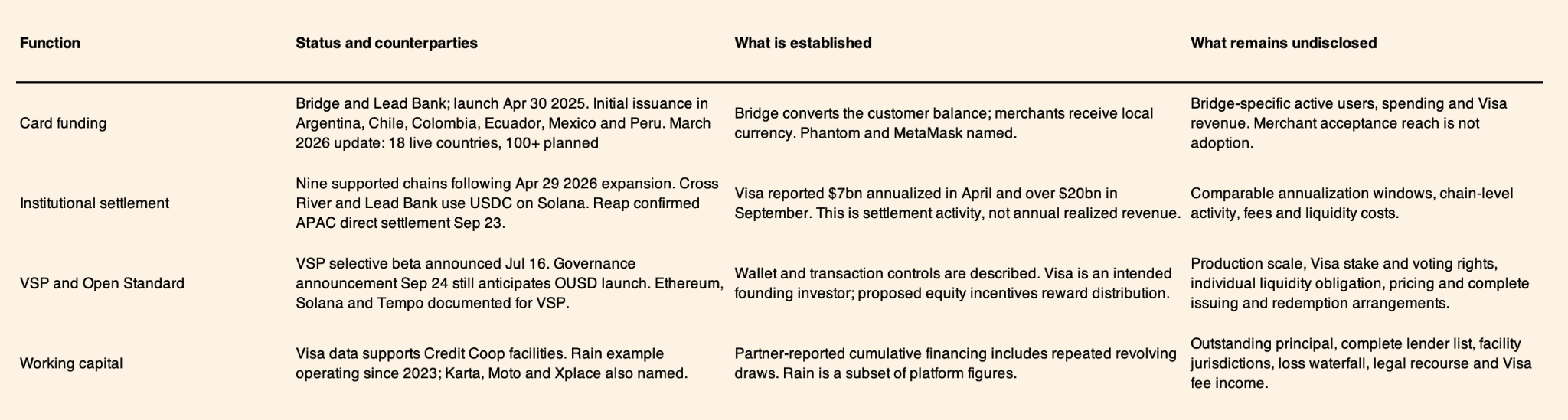
| Function | Status and counterparties | What is established | What remains undisclosed |
|---|---|---|---|
| Card funding | Bridge and Lead Bank; launch Apr 30 2025. Initial issuance in Argentina, Chile, Colombia, Ecuador, Mexico and Peru. March 2026 update: 18 live countries, 100+ planned | Bridge converts the customer balance; merchants receive local currency. Phantom and MetaMask named. | Bridge-specific active users, spending and Visa revenue. Merchant acceptance reach is not adoption. |
| Institutional settlement | Nine supported chains following Apr 29 2026 expansion. Cross River and Lead Bank use USDC on Solana. Reap confirmed APAC direct settlement Sep 23. | Visa reported $7bn annualized in April and over $20bn in September. This is settlement activity, not annual realized revenue. | Comparable annualization windows, chain-level activity, fees and liquidity costs. |
| VSP and Open Standard | VSP selective beta announced Jul 16. Governance announcement Sep 24 still anticipates OUSD launch. Ethereum, Solana and Tempo documented for VSP. | Wallet and transaction controls are described. Visa is an intended founding investor; proposed equity incentives reward distribution. | Production scale, Visa stake and voting rights, individual liquidity obligation, pricing and complete issuing and redemption arrangements. |
| Working capital | Visa data supports Credit Coop facilities. Rain example operating since 2023; Karta, Moto and Xplace also named. | Partner-reported cumulative financing includes repeated revolving draws. Rain is a subset of platform figures. | Outstanding principal, complete lender list, facility jurisdictions, loss waterfall, legal recourse and Visa fee income. |
Research cutoff: September 30, 2026. Card funding: [25], [45]. Institutional settlement: [26], [28], [46], [53]. VSP and Open Standard: [27], [47], [48], [49], [50]. Working capital: [28], [51], [52]. Annualized activity and cumulative financing are not realized annual revenue or outstanding principal. Link to this table.
Original exhibit
9. Three futures for the next payments network
The next three to five years need not produce one winner across payments. At a consumer checkout, acceptance, credit, fraud handling and recourse are bundled into the purchase. A remittance is more sensitive to the cost of reaching the recipient and converting into spendable local money. For a business paying suppliers, invoices, approval controls and reconciliation matter alongside transfer speed. Treasury departments also need reliable redemption and liquidity outside banking hours. Each use case creates a different opportunity to substitute infrastructure, and a different reason to retain an intermediary.
The alternatives extend beyond stablecoins. On September 24, 2026, the ECB announced a feasibility assessment for linking its TIPS instant-settlement platform with Brazil's Pix. It described technical, legal, operational and business work still to be done, not an operating corridor. Nevertheless, the project shows that cross-border interoperability can develop around central-bank settlement rather than card networks or stablecoins. [54]
The BIS, from its monetary-system perspective, favors tokenized bank money anchored in central-bank reserves and questions stablecoins' ability to preserve par acceptance, supply liquidity flexibly and resist illicit use. That is a useful framework for evaluating settlement assets, not a forecast of Visa's earnings. [55]
A stronger Visa
Visa could turn existing bank and merchant relationships into distribution for new settlement and treasury services. Stablecoin-funded cards could bring spending onto Visa that previously stayed in wallets or cash. Institutions could pay for dependable conversion, controls, reporting and integration even as blockchain transfer costs fall.
The necessary conditions are repeat usage, competitive delivery costs and commercial terms that leave Visa an adequate return after partners receive their share. Observable signs would include disclosed recurring service revenue, retained institutional clients and growth in flows originating outside the existing card business. More supported chains alone would tell us little.
A relevant Visa with different economics
Visa could process more activity while capturing less value from each dollar moved. Corporate treasury and B2B transfers may favor subscription or fixed service fees over charges linked to transaction value. Banks and wallets could use several providers and negotiate aggressively. Existing card payments might shift to cheaper settlement without creating new purchases.
A cheaper settlement asset does not itself change interchange or Visa's charges; pressure on those prices requires competing routes or new commercial terms. Visa would remain useful, but growth in activity would overstate growth in its economic opportunity.
The signposts are revenue growing more slowly than comparable activity, rising incentives and service expansion that requires more operating expense. Those patterns would need to be adjusted for geography and product mix before being attributed to stablecoins.
Loss of valuable flows
Wallets, banks or commerce platforms could combine direct transfers with acceptable consumer protection and merchant services, removing Visa from selected payment chains. Domestic account-to-account systems may be enough for local purchases. Stablecoins or linked instant-payment systems could win remittances and some cross-border business flows.
The necessary conditions include distribution, dependable local conversion, workable disputes and savings large enough to change behavior. Evidence would be sustained migration of purchases and valuable cross-border transactions, not exchange transfers or repeated movements between wallets.
Issuers could lose interchange and deposit relationships while Visa loses network revenue; those are separate exposures and need separate measurement.
Automated shopping adds another requirement: a merchant must be able to verify what a software agent was authorized to buy and who bears the loss when it exceeds that authority. Visa can compete to provide those controls. Their necessity does not give it an exclusive right to supply them.
Visa's history establishes its ability to coordinate institutions, distribute common standards and renegotiate its position as technology changes. The current evidence establishes live stablecoin-related activity alongside products and governance arrangements still being introduced. It does not establish the eventual revenue or margin contribution of those activities.
Our assessment is that continued relevance is easier to support than preservation of today's economics. We would become more constructive with transparent recurring revenues, repeat commercial use and demonstrably new flows. We would become less constructive if valuable transactions moved elsewhere while incentives and integration costs consumed the gains from higher activity.
Visa's durability will depend on who chooses its services, what they pay and how much of that payment Visa retains.
Bibliography
References correspond to citation numbers used throughout the report. Dates refer to publication or filing unless otherwise stated. Undated sources were accessed September 30, 2026.
[1] Visa Inc., 2013 Annual Report, 2013.
[2] Joe Nocera, A Piece of the Action / The Day the Credit Card Was Born, 1994.
[3] Federal Reserve System, Bank Credit-Card and Check-Credit Plans, 1968.
[4] David S. Evans, More Than Money, 2010.
[5] Myrna Oliver, J.P. Williams, 88, Los Angeles Times, 2003.
[6] U.S. District Court, NaBanco v. Visa, 1984.
[7] David L. Stearns, Think of It as Money: A History of the VISA Payment System, 2007.
[8] Bátiz-Lazo & Del Angel, The Dawn of the Plastic Jungle, 2016.
[9] Nancy Shepherdson, Credit Card America, 1991.
[10] U.S. Tax Court, First Security Bank of Idaho v. Commissioner, 1975.
[11] Visa, Dee Hock: In Memoriam, 2022.
[12] Eighth Circuit, Worthen v. National BankAmericard, 1973.
[13] Litan & Pollock, The Future of Charge Card Networks, 2006.
[14] U.S. Courts / DOJ, United States v. Visa, 2001-2004.
[15] Federal Reserve Bank of Boston, The Economics of a National Electronic Funds Transfer System, 1974.
[16] Visa Inc., VisaNet: The Technology Behind Visa, 2013.
[17] Visa, Visa Brand Chronology, historical corporate chronology.
[18] Visa Inc., FY2008 Form 10-K, 2008.
[19] Visa Inc., IPO Pricing and Related Transactions, 2008; Form 8-K.
[20] Visa Inc., Visa and Apple: A New Era of Mobile Payments, 2014.
[21] PayPal & Visa, Partnership to Extend Consumer Payment Choice, 2016.
[22] Visa Inc., Visa Europe Acquisition, 2015-2017; transaction amendment.
[23] U.S. Department of Justice, Visa and Plaid Abandon Merger, 2021.
[24] Visa & Plaid, Mutual Termination of Merger Agreement, 2021.
[25] Visa, Visa and Bridge Partner on Stablecoin Payments, Apr. 30, 2025.
[26] Visa, Visa Adds Five Blockchains for Stablecoin Settlement, Apr. 29, 2026.
[27] Visa, Visa Stablecoin Platform, Jul. 16, 2026.
[28] Visa, Visa Brings Onchain Lending into Everyday Payments, Sep. 8, 2026.
[29] FDIC, Risk Management Manual: Merchant Processing, 2007.
[30] Federal Reserve History, Electronic Point-of-Sale Payments, 2024.
[31] Federal Reserve Board, Atlanta Payments Project Letter, 1974.
[32] J. Carles Maixé-Altés, Contested Cards and Banking Competition, 2026.
[33] Reserve Bank of Australia, Interchange and Scheme Fees, 2024.
[34] Federal Reserve Board, Families' Use of Payment Instruments, 2006.
[35] Federal Reserve Bulletin, Recent Payment Trends in the United States, 2008.
[36] Visa / Merchant Plaintiffs, Visa Check/MasterMoney Settlement, 2003.
[37] Federal Reserve Board, Debit Card Interchange and Routing Rule, 2011.
[38] Visa Inc., FY2025 Form 10-K, 2025.
[39] Ben Gilbert & David Rosenthal, Acquired: Visa, 2023.
[40] Visa Inc., Q3 FY2026 Earnings Release, Jul. 28, 2026; Form 10-Q.
[41] Visa Inc., Q3 FY2026 Operational Performance Data, Jul. 28, 2026.
[42] U.S. District Court, United States v. Visa, Memorandum Opinion, Jun. 23, 2025.
[43] U.S. District Court / PacerMonitor, United States v. Visa Docket, Sep. 2026.
[44] Interchange Settlement Administrator, Interchange B2 Settlement, accessed Sep. 30, 2026.
[45] Visa, Visa and Bridge Expand Stablecoin Cards, Mar. 3, 2026.
[46] Visa, U.S. Stablecoin Settlement Launch, Dec. 16, 2025.
[47] Visa, Visa Stablecoin Platform: Product Overview, accessed Sep. 30, 2026.
[48] Open Standard, Introducing Open USD, Jun. 30, 2026.
[49] Open Standard, Company Structure and Leadership, Sep. 24, 2026.
[50] Open Standard, Geo Restrictions and Prohibited Use Cases, accessed Sep. 30, 2026.
[51] Visa, Onchain Settlement Financing, Sep. 8, 2026.
[52] Visa, Financing Stablecoin-Linked Card Programs, Sep. 8, 2026.
[53] Reap, Reap and Visa Launch Stablecoin Card Programs, Sep. 23, 2026.
[54] European Central Bank, ECB to Assess TIPS-Pix Interlinking, Sep. 24, 2026.
[55] Bank for International Settlements, The Next Generation Monetary and Financial System, Jun. 29, 2025.
Cover Artwork

Nicolas Poussin, c. 1658
Risk Disclaimer
insights4vc provides independent research based primarily on publicly available information believed to be reliable at the time of publication. Figures may change because of market prices, token supply, reclassification and methodology updates. Legal structures, investor rights and regulatory treatment vary by product and jurisdiction.
This article does not constitute investment, legal, tax, accounting or financial advice, or an offer, solicitation or recommendation regarding any security, token, fund interest or other asset. insights4vc makes no representation regarding the completeness or accuracy of third-party data. Readers should conduct independent due diligence and consult appropriately qualified advisers before making investment or business decisions.
Published by the insights4vc research team. See our research methodology, source standards and corrections policy. Dates and measurement periods are stated in each analysis.
Read next