Key Statistics
- In July 2026, Frontrun reported 46 identified funding rounds, with an average lead time of 83 days and $2.36 billion subsequently raised.
- PitchBook generated $174.7 million in second-quarter 2026 revenue, equivalent to almost $700 million annualized.
Figures and examples retain the report's original period, scope and source definitions. Consult the analysis and references below before making comparisons.
Accessibility update: . 4 exhibits are now available as selectable, accessible tables, with the original images retained below each table. Research cutoff: August 20, 2026; provider pages accessed August 17, 2026. Figures and assessments retain their original reporting periods.
Venture capital has always been an information business. The advantage often lies in timing: a founder tells a former colleague before updating a profile, a new company starts hiring before appearing in a database, or investors begin following a team before a financing is announced.
That edge matters because venture returns are highly concentrated. Research cited in a 2026 Oxford Academic study found that 4.5% of invested dollars generated roughly 60% of returns in one long-running limited-partner dataset.[1] Missing a handful of exceptional companies can therefore shape an entire fund. But finding them early is only part of the problem. Investors still need to form conviction, gain access, secure meaningful ownership and remain right over several years.
The private-market data industry is now moving closer to the point where companies form. PitchBook, Crunchbase, Dealroom, Tracxn and CB Insights remain core systems of record for transactions, funds, valuations and company histories. PitchBook generated $174.7 million of revenue in the second quarter of 2026, implying an annualized run rate of almost $700 million.[2] Newer platforms are not replacing that layer. They are extending it with faster updates, behavioral data and signals that appear before conventional company records.
Three shifts stand out.
First, companies such as Harmonic and Specter are building continuously updated graphs of companies and people rather than relying mainly on periodic profiles. Second, specialist products are looking for earlier behavioral signals. Evertrace tracks indicators of founder formation, including incorporation, technical activity, research and domains. Frontrun monitors changes in the X follow graphs of selected venture investors. Third, APIs and model context protocol, or MCP, are moving this data into funds' own software and AI workflows. Crustdata represents the infrastructure side of that market, while Affinity adds first-party relationship data from email, calendars and CRM activity.
Adoption is visible, but evidence of investment alpha is not. Harmonic says hundreds of venture teams use its platform, Specter reports more than 300 investment firms, Evertrace more than 200 funds, and Affinity more than 3,300 private-capital firms. Tracxn, which is publicly listed, disclosed 2,289 customer accounts for FY2026.[3][4][5][6] Most of these figures are company-reported. Vendors rarely disclose the full set of companies surfaced by their models, making precision, recall, false-positive rates and the economic value of individual leads difficult to assess.
No single signal appears sufficient on its own. Employee departures can be early but ambiguous. Incorporation is objective but common. GitHub activity can be valuable in developer-led markets but has limited relevance elsewhere. Hiring velocity and employee migration offer broader signals, while revenue, customers and usage tend to be more decision-useful but arrive later. Investor attention can provide an early indication when several credible sector specialists converge on the same company, although the signal is platform-dependent and can become reflexive.
The strongest sources of defensibility are likely to sit deeper in the data stack: historical time-series that cannot be reconstructed later, accurate entity resolution across people and companies, permissioned first-party fund data, and distribution through CRM systems, APIs and agents. Public data is not necessarily proprietary. A five-year history of correctly timestamped changes can be.
AI is likely to make this infrastructure easier to query rather than eliminate the need for it. As research, classification and workflow become cheaper, clean data, provenance and institutional context become more valuable. Investment judgment, access and relationships remain outside the reach of a simple automation layer.
The likely outcome is a broader private-market intelligence market rather than a standalone sourcing-software category. Established databases will add discovery and prediction. CRMs will become orchestration layers. Large firms will combine external feeds with proprietary data and internal scoring systems, while smaller funds will rely on integrated products and a limited number of specialist signals.
By 2030, natural-language sourcing across company, people, behavioral and relationship data is likely to be routine. Fully autonomous investment selection is less plausible. The scarce inputs in venture capital remain judgment, access, trust and ownership.
1. Venture capital has always been an information business
Venture sourcing starts with fund mathematics. Returns are concentrated enough that one or two investments can determine the performance of an entire portfolio. The cost of omission is therefore unusually high: missing the right founder can matter more than improving the analysis of dozens of average opportunities.
That does not make maximum deal flow the objective. More companies can mean more noise, less attention and weaker relationships. The goal is to increase the probability of seeing companies that fit the fund while preserving enough time to evaluate them and compete for an allocation. Sourcing software is useful only if it improves that equation or reduces the cost of doing so.
The economics can be substantial. Consider a $100 million seed fund targeting 10% ownership. If earlier discovery is the difference between owning 10% and 5% of a company that eventually exits for $2 billion, the gross difference is $100 million before dilution, follow-ons and carry. But the probability of capturing that advantage is small. A signal that generates 500 irrelevant leads, consumes analyst time and does not improve access can destroy rather than create value.
The expected value of early discovery can be expressed as:
probability of identifying an eventual outlier × probability the fund can act and win × incremental ownership or price advantage × eventual outcome, less data, software and attention costs.
Earliness matters most where allocations are scarce: elite repeat founders, fast-forming rounds and emerging technical clusters. It matters less in later-stage investing, capital-intensive sectors with long validation cycles, or processes intermediated by bankers and broad auctions. Contacting a founder too early, without a credible reason to engage, can also be counterproductive.
Meanwhile, the opportunity set has become harder to monitor manually. Dealroom's 2026 ecosystem work covers more than 325 cities across 77 countries, while Startup Genome studies millions of companies across hundreds of ecosystems.[7] The NVCA recorded more than 15,000 US venture deals in 2025.[8] Dealroom tracks about 4,900 active dedicated VC firms and roughly 9,500 active investors when corporate, accelerator and crossover investors are included.[9]
There is now more observable activity than any partner network can continuously process. The sourcing problem is no longer access to information alone, but deciding which information deserves attention.
2. From Rolodexes to private-market databases
Traditional venture sourcing has always relied on multiple channels. Personal networks connect investors with founders, operators, angels, lawyers, bankers, limited partners and portfolio executives. Universities, accelerators, demo days and conferences concentrate discovery, while referrals and inbound submissions extend a fund beyond its immediate network.
Those channels remain valuable because they carry context and trust, not just names. Their weakness is coverage. Networks reflect geography, career history and social structure. Events are periodic. Inbound often arrives only after a founder has decided to raise, and a referral may indicate quality or simply a strong network.
Private-market databases addressed a different problem: making companies, transactions, investors and funds searchable at scale. PitchBook, Crunchbase, Dealroom, Tracxn and CB Insights are most useful once an entity can be identified through a company name, domain, financing or investor relationship. PitchBook reports coverage of 12.9 million companies, 3.2 million deals and 171,000 funds. Crunchbase says it processes 30 million verified updates a year, while Tracxn tracks millions of companies alongside financial and cap-table data.[10][11][12]
Relationship platforms added another layer. Affinity, 4Degrees and proprietary systems organize conversations, notes, ownership and warm paths. A company database can identify which startup fits a thesis. A relationship graph can show who can reach it and what the firm already knows.
These categories are increasingly overlapping. Established databases are adding predictive scores and AI research. Discovery products are accumulating historical records. CRMs are incorporating external data and agents. The boundaries are converging, but the underlying questions remain distinct.
3. The startup information timeline and venture intelligence stack
A startup becomes visible gradually. Long before a financing announcement, there may be a founder departure, new legal entity, domain registration, GitHub activity, early hires or changes in an investor network. Each additional signal reduces uncertainty, but usually at the cost of lead time.
| Stage | Observable events | Information value | Representative tools |
|---|---|---|---|
| 0. Latent founder | Departure, research, GitHub activity, co-founder interaction | Earliest, highest ambiguity | Evertrace, Harmonic, Specter, proprietary talent graphs |
| 1. Formation | Incorporation, domain, stealth title, trademark, GitHub organization | Objective formation clues, uneven global coverage | Evertrace, Harmonic, registries, Crustdata-based systems |
| 2. Network formation | Early hires, angels, investor follows, professional connections | Can reveal relevance before product or funding | Frontrun, Specter, Affinity plus external data |
| 3. Initial activity | Website, hiring, launch, open source, app-store listing | Company becomes easier to classify | Harmonic, Specter, Dealroom, Tracxn, Crunchbase |
| 4. Traction | Headcount, traffic, downloads, customers, developer adoption | Later but more decision-useful | Harmonic, Specter, Crustdata, Coresignal, established databases |
| 5. Fundraising | Introductions, investor convergence, legal changes | Highly relevant, but the round may already be circulating | Frontrun, Specter, CRM and email data |
| 6. Public confirmation | Announcement, media coverage, database entry | Reliable record, little information advantage | PitchBook, Crunchbase, Dealroom, Tracxn, CB Insights |
Source: the report's analytical framework and provider descriptions [3], [4], [5], [6], [10], [11], [12], [14], [22], [37]. Stages are a research framework, not a universal sequence or a measured investment-return ranking. Provider descriptions retain the original August 2026 snapshot. Link to this table.
Original exhibit
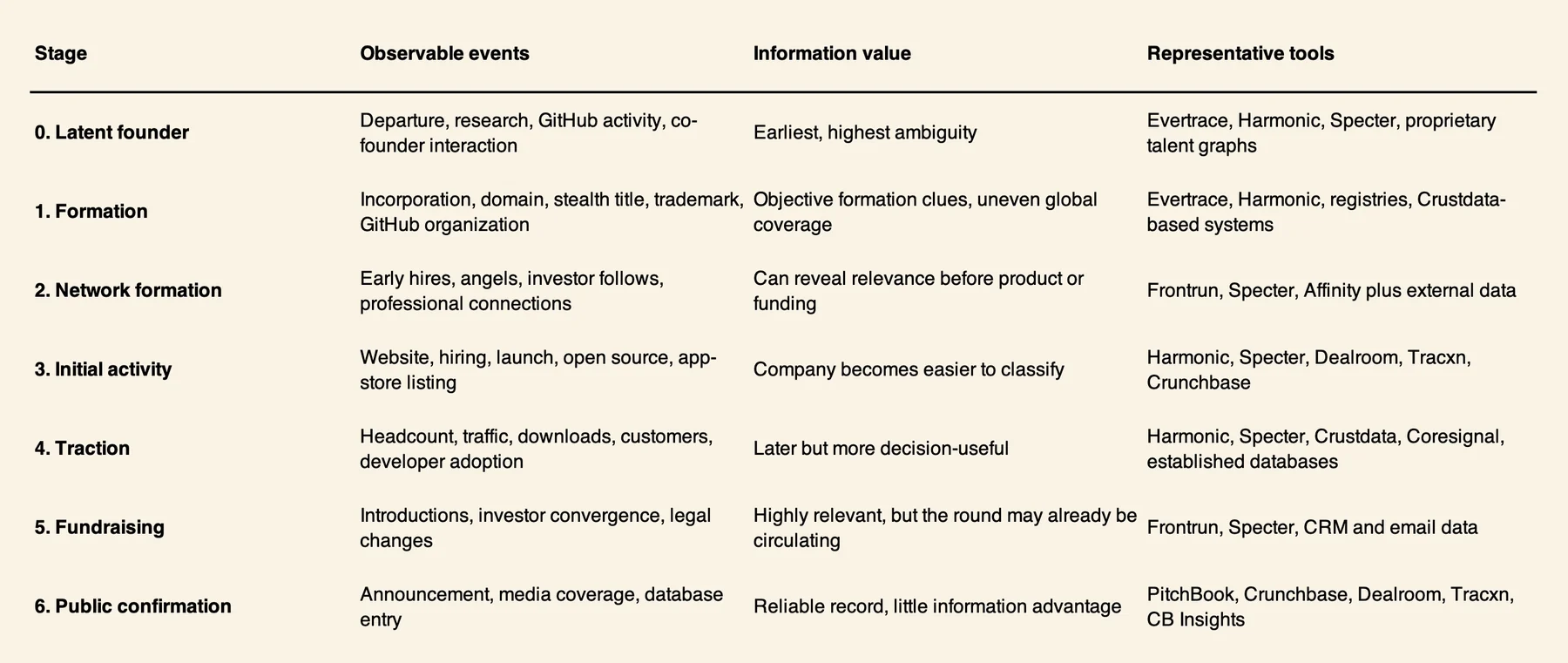
The trade-off is straightforward: signal confidence generally rises as earliness falls. A researcher leaving a laboratory may start a company, join another team or remain in academia. A newly incorporated entity may be a holding company. A registered domain may never launch. At the earliest stages, software is ranking hypotheses about companies that may not yet exist. Once a business is hiring, launching products or generating traction, the object being measured is far clearer.
That timeline has produced several overlapping layers of venture intelligence rather than a single new software category.
Founder-intent and pre-formation intelligence. Evertrace is the most focused specialist, while Harmonic and Specter also monitor founder movement and early company formation. Signals include registries, employment changes, technical activity, research, grants and domains.
Evertrace - Website
Investor-attention intelligence. Frontrun monitors changes in selected investor follow graphs on X. Specter incorporates investor interest into a broader dataset. These products treat the behavior of relevant investors as a signal that an entity deserves attention, rather than as proof of company quality.
Specter - Website
Continuous company intelligence. Harmonic and Specter maintain continuously updated company and people graphs. Dealroom, Tracxn, Crunchbase and CB Insights are moving in the same direction through alerts, growth indicators, predictive scores and AI research. The distinction from a traditional database is increasingly about refresh rate and data architecture rather than a clear category boundary.
Private-market data infrastructure. Crustdata, People Data Labs, Coresignal and Aviato provide APIs, bulk datasets and agent-ready access for firms building their own sourcing systems. Grata and SourceScrub offer similar programmatic access with more emphasis on private equity and M&A. The trade-off is control versus complexity: buyers gain flexibility but take responsibility for entity resolution, scoring and workflow design.
Relationship intelligence. Affinity and 4Degrees draw on permissioned communication and institutional history. Attio provides a more flexible AI-native CRM with APIs and MCP, although it requires more configuration for venture workflows. This layer can be particularly defensible because competitors cannot buy another fund's meeting history, notes or introduction paths.
Established private-market platforms. PitchBook remains the scale system of record. Dealroom is strong in startup ecosystems and regional partnerships, Tracxn in global taxonomies and structured company research, Crunchbase in its contributor and usage network, and CB Insights in market research and predictive scoring.
These layers increasingly operate as one architecture:
external data streams + fund CRM, email, calendar and notes + entity graph + signal models + LLM or agent + human investment workflow
Most of that stack can already be assembled. The harder problems are less visible: matching the same person or company across sources, preserving accurate historical timestamps, obtaining reliable outcome labels, maintaining the right to use the underlying data and building an investment process that actually acts on the signals.
The interface is becoming easier to build. The quality of the underlying data and joins remains the constraint.
4. Founder detection: finding companies before they exist
Founder detection pushes venture sourcing to its earliest point: before a company is fully formed or publicly visible.
Evertrace, founded in Copenhagen in 2024, is one of the clearest specialists in the category. The company says more than 200 VC funds use its platform to monitor signals including trade registries, GitHub activity, patents, research, grants, domains, app stores, Product Hunt and social platforms.[5] It raised at least $600,000 in a publicly reported 2025 round.[13]
The value comes from combining weak signals rather than relying on any single event. A senior researcher may leave a company, incorporate a new entity with a former colleague, create a technical organization and register a domain. None of those actions is decisive alone. Together, they can justify closer attention.
This approach is particularly relevant in deep tech, AI and university-linked investing, where research output and technical activity can become visible well before commercial traction.
The limitations are structural. Registry coverage varies by country, professional titles are often self-reported, and domain or company records can be delayed, obscured or reused. GitHub is informative in open-source and developer-led markets but far less useful in areas such as biotechnology, industrial manufacturing or many enterprise businesses.
There is also a modeling risk. Systems trained on historical venture outcomes can overweight familiar patterns, including prestigious employers, universities and established startup hubs. A model that becomes too dependent on founder archetypes may reproduce the same biases investors are trying to escape.
Founder detection is therefore best treated as a ranking system rather than a prediction engine. The relevant question is not whether software can identify every future company, but whether it can consistently surface a manageable number of high-quality leads earlier than existing channels.
Useful measures include precision among the top weekly leads, geographic and sector coverage, time to first investor review and conversion into high-quality founder conversations. Public evidence today is stronger on adoption and workflow utility than on demonstrated investment returns.
There is also a practical constraint to extreme earliness. Founders who have not announced a company may not respond well to automated outreach based on inferred intent. The better use case is often to identify a relevant signal early, then approach through a credible relationship or with a clear reason to engage.
Founder detection and relationship intelligence are therefore more complementary than competitive. One identifies whom to watch; the other determines whether and how the fund should reach them.
5. Investor attention as alternative data
Investor attention offers a different kind of early signal. The premise is simple: investors can reveal information through observable behavior before a financing becomes public. Following a founder, connecting with a new company or several sector specialists converging on the same account may indicate that something is happening behind the scenes.
A single follow means little. A cluster of relevant investors moving within a short period can be more informative, particularly when those investors have expertise in the company's sector.
Frontrun - Website
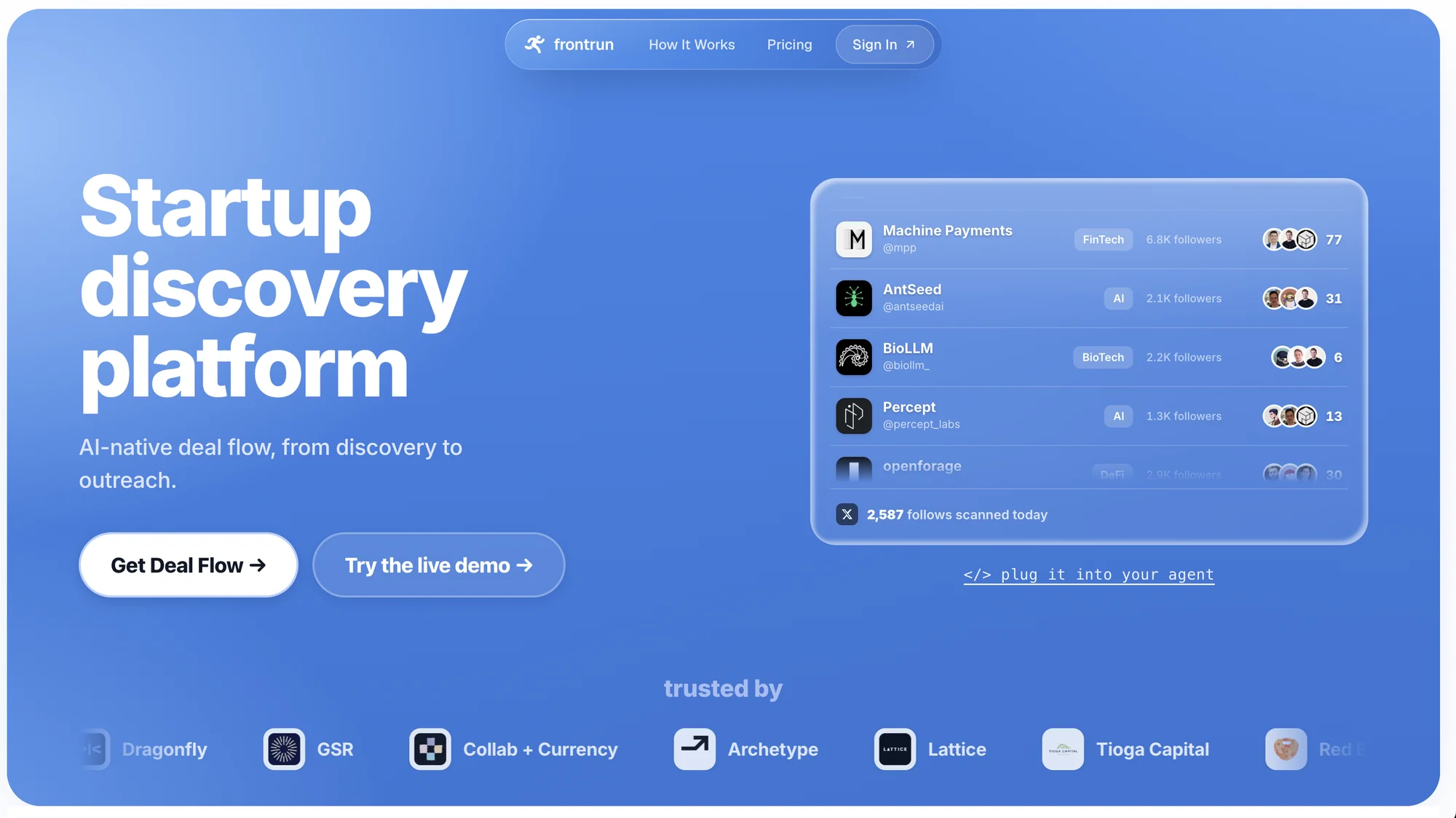
Frontrun is the clearest specialist built around this idea. The product says it tracks the X follow graphs of more than 2,000 venture investors, detects convergence around small or unlaunched accounts and then resolves founders and classifies companies. Its Starter plan costs $49 a month for 100 tracked accounts, while the $99 Pro plan covers 250 and adds API and MCP access.[14] That makes it closer to a specialist signal feed than an institutional private-market database.
The company also publishes a running record of startups it says were identified before financing announcements. In July 2026, Frontrun reported 46 such rounds, with an average lead time of 83 days and $2.36 billion subsequently raised.[15] Examples included Orthogonal, flagged 213 days before a $4.3 million round; Ornn, 162 days before a $33 million a16z-led round; and naturalpay, 159 days before a $30 million Series A led by Forerunner.
That distinction matters. The published record shows that investor-attention signals can precede public financing announcements, but it does not reveal the full population of companies flagged by the system. There is no public denominator showing how many signals led nowhere, surfaced companies already known to investors or remained irrelevant to a particular fund.
Without that denominator, the data cannot establish predictive accuracy or investment alpha. It demonstrates lead time, not whether a fund using the signal would consistently make better investments.
The quality of the underlying observer also matters. A security investor following an early security company carries more information than a generalist doing the same. Two independent specialists may be more useful than ten investors from the same social circle. Any effective attention model therefore needs to weight sector expertise, independence and timing rather than simply count follows.
The signal also carries platform risk. Frontrun depends heavily on X, where API access and pricing can change, particularly for commercial use.[17][18] Attention itself can also become reflexive. If investors know their follows are being monitored, they can delay, obscure or delegate that activity. A signal that becomes widely watched may become less informative.
Investor attention is therefore better viewed as a prioritization layer than a standalone measure of company quality. Its value increases when combined with founder movement, hiring, company activity and a fund's own relationship data.
A durable advantage would come from identifying the right observers, maintaining a long timestamped history and showing that attention signals add information beyond simpler indicators such as hiring growth, accelerator participation or general social momentum.
6. Continuous private-company intelligence
The bigger shift in venture data may be continuous representation rather than predicting companies before they form. Instead of maintaining periodic company profiles, newer platforms track how teams, products, networks and commercial signals change over time.
Harmonic - Website
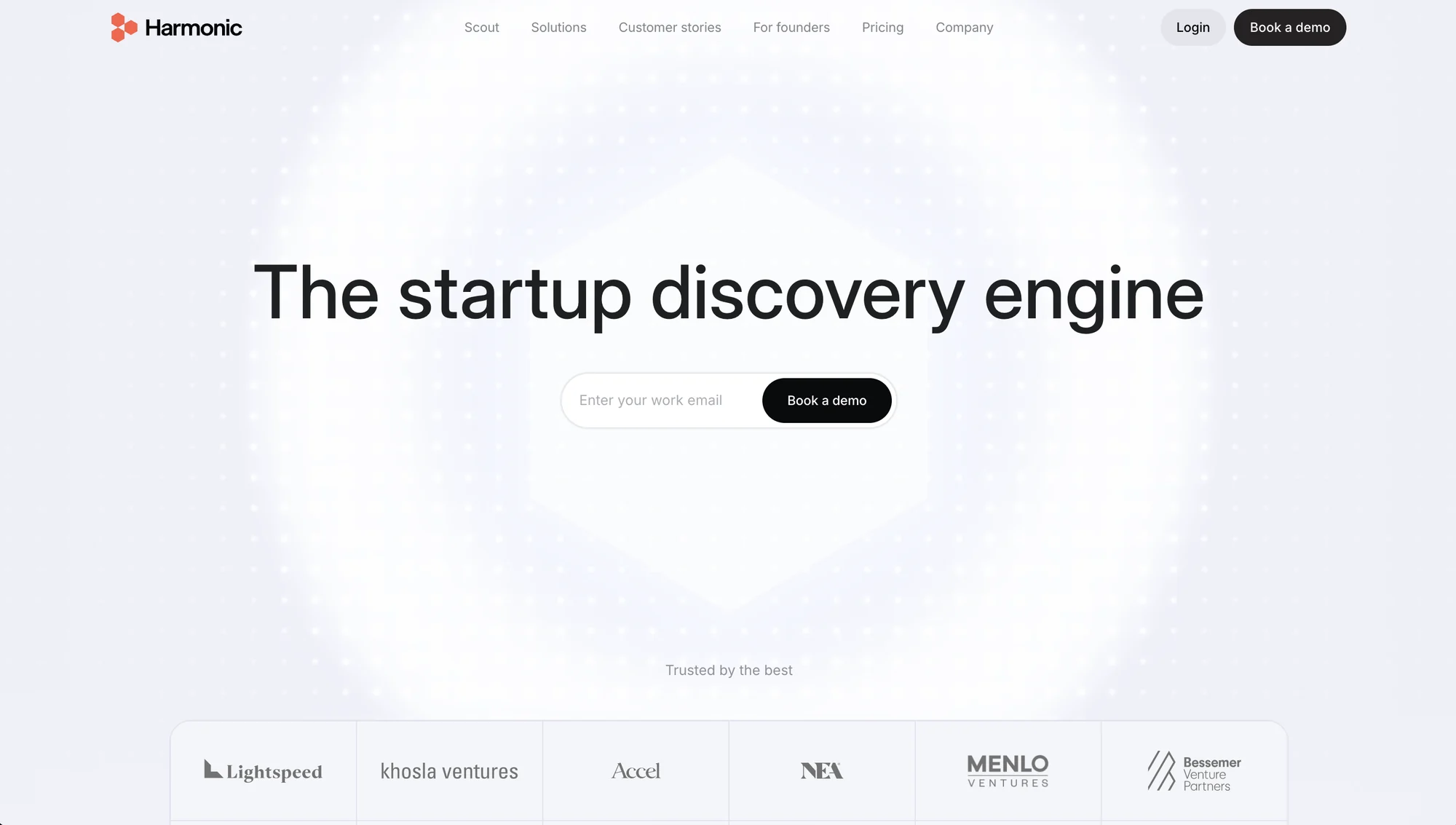
Harmonic says it tracks more than 35 million companies and 195 million people from incorporation through scale, combining firmographics, team data, historical changes and network context.[3] Its platform connects external company data with LinkedIn connections, email, calendar and CRM activity, and now includes Scout, an AI research agent, alongside API, bulk-data and MCP access. Harmonic has raised $30 million and says hundreds of venture teams use the product.[19]
Specter takes a similar approach across a broader graph. The company reports coverage of more than 50 million companies, 500 million people and 300,000 investors, with signals spanning transactions, talent, revenue, news and investor interest.[4] It offers API, bulk-data and MCP access, as well as integrations with Affinity, Attio and Salesforce, and says more than 300 investment firms use the platform.
Both are better understood as continuously updated knowledge graphs than databases of startup profiles. The distinction matters. A conventional search might identify European infrastructure companies. A live graph can ask which of those companies added two senior compiler engineers in the past quarter, are seeing rising open-source activity and have not already entered a fund's pipeline.
That requires more than collecting large volumes of data. Entity resolution is one of the central technical problems. A single company can have a legal entity, trading name, domain, GitHub organization and X account, while the same founder may hold several overlapping roles. Funding events can appear under different dates, currencies and company names. A bad join can turn several accurate observations into one incorrect conclusion, and an AI interface can make that error appear more convincing.
Established private-market platforms are moving toward the same model. Dealroom now combines company data with signals, alerts, AI research and MCP access, with premium plans starting at $14,500 a year and an MCP tier at $20,000.[20] Crunchbase says it refreshes 15 million predictive signals each week and reports anticipating 84% of funding events, although the published figure does not show the corresponding false-positive rate.[11] CB Insights has long incorporated predictive scoring through Mosaic.
Synaptic occupies a similar but somewhat later-stage position in the stack. Originally developed inside Vy Capital, the platform combines alternative signals such as hiring velocity, web traction, product reviews and other company-level data to identify private businesses gaining momentum. Its emphasis is less on detecting companies at formation and more on measuring acceleration once a company has a visible operating footprint, making it particularly relevant for growth, crossover and portfolio-monitoring workflows.
Synaptic - Website
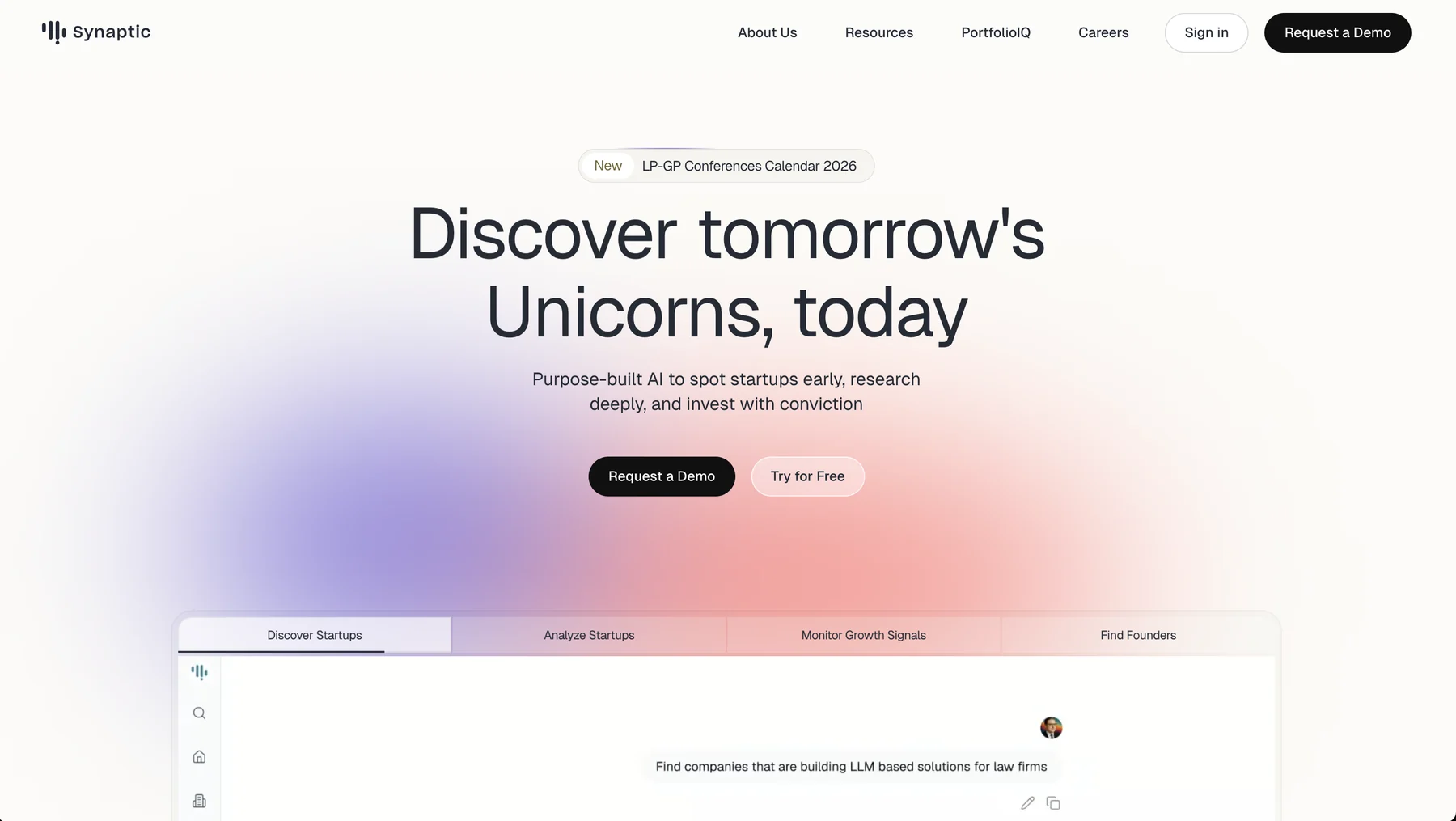
The divide between static databases and continuous intelligence is therefore narrowing. What began as a differentiator for newer platforms is becoming a standard feature of private-market data.
The competitive question is shifting from who has the largest company database to who can maintain the cleanest historical record of how companies, people and networks change over time.
7. From data feeds to proprietary fund intelligence
As venture data becomes easier to buy, the more durable advantage is shifting from access to information toward the way a fund combines, remembers and acts on it.
The infrastructure layer illustrates the change. Crustdata, People Data Labs, Coresignal and Aviato sell company, people, hiring and event data through APIs and bulk feeds, while platforms including Dealroom, Harmonic, PitchBook, Tracxn and Grata also provide enterprise data access. Crustdata, which raised a $6 million seed round in 2025, is built particularly around this model, offering company, people, jobs, posts and watcher APIs alongside data files and MCP tools.[21] Rather than forcing investors into another interface, these products allow a fund to bring external data into its own warehouse, CRM and AI workflows.
But buying the feed is not the same as owning an advantage. Coverage figures can be difficult to compare across providers, and institutional buyers still need to test freshness, match rates, provenance and historical depth.[22] More importantly, proprietary value usually begins after the data arrives. A typical architecture moves from external APIs and bulk data → entity resolution → historical event store → fund-specific labels → ranking and alerts → AI research → CRM writeback → human feedback. The raw source may be replaceable. The accumulated history of how the fund interpreted and acted on it is not.
Relationship data makes that distinction clearer. External intelligence can identify a promising company; internal context determines whether the fund can reach it, whether someone has already met the founder, why the team passed previously and who should act next. Affinity has built its position around this layer, automatically capturing email and calendar activity and combining it with pipelines and third-party enrichment. The company reports more than 3,300 private-capital firms, 25 billion communication events and 130 billion structured relationships.[6] Its plans range from $2,000 to $2,700 per user annually, with AI, agents, MCP and additional enrichment included at higher tiers.[23] 4Degrees offers a smaller purpose-built alternative, while Attio provides a more flexible programmable CRM at lower entry cost.[24]
The significance is not the CRM interface itself. Meeting history, rejected deals, portfolio introductions, partner notes and previous investment decisions are among the few datasets a competing fund cannot simply license. Used consistently, they form an institutional memory that becomes richer with every deal reviewed. That also makes governance important: permissions, retention policies, conflicts and personal-data rules can matter as much as the underlying model.
Some of the largest investment firms have taken the idea further by building their own systems. SignalFire began developing Beacon in 2013 and says the platform now tracks more than 80 million companies, 600 million people and millions of open-source projects across 40 datasets. It uses talent mobility, GitHub activity and other signals to recommend companies and founders, while LLMs support classification and routing.[25] EQT launched Motherbrain in 2016 and has since embedded proprietary data and AI systems across sourcing, screening and portfolio work.[26] Moonfire has built quantitative sourcing and evaluation tools since 2020, Tribe Capital uses data science more heavily in underwriting, and firms including Insight Partners and Coatue have also described proprietary technology supporting investment research.[27][28]
These examples point to a hybrid model rather than a choice between software and internal infrastructure. Large funds can justify engineers, data teams and proprietary systems because the cost is small relative to their assets and the value of winning one additional exceptional investment. Yet even sophisticated firms continue to buy external data. Rebuilding every registry, employment graph or company database internally is rarely the source of advantage.
The better strategy is to own what becomes more valuable with time: entity resolution, historical events, fund-specific labels, relationships, rejection reasons, investment outcomes and workflow feedback. External collection can remain partly replaceable.
For smaller funds, the economics are different. Rebuilding ingestion and entity resolution from scratch is unlikely to produce an edge. An integrated intelligence platform, a clean relationship CRM and one or two specialist feeds aligned with the fund's thesis can deliver much of the same coverage without an internal engineering organization.
The strategic divide is therefore not between funds that buy software and funds that build it. It is between firms that merely consume data and those that compound what they learn from it. As interfaces and AI research become cheaper, institutional memory is likely to become one of the most defensible assets in venture intelligence.
8. Which signals matter, and when does earliness help?
No sourcing signal offers everything at once. The earliest signals tend to be noisy; the strongest commercial signals arrive after much of the informational advantage has disappeared. The practical question is therefore not which signal is best, but which combination is useful for a particular stage, sector and investment strategy.
| Signal | Earliness | Decision value | Main limitation |
|---|---|---|---|
| Senior employee departure | Very high | Medium-low alone | High ambiguity |
| Repeat founder / founder quality | Very high | Medium-high | Widely observable, can crowd pricing |
| Incorporation / legal formation | High | Low-medium | Weak base rates, uneven coverage |
| Domain / trademark / social account | High | Low-medium | Easy to replicate, high noise |
| GitHub / open-source momentum | High | High in developer markets | Narrow sector relevance |
| Patents / papers / grants | High | Medium-high in deep tech | Sector-specific |
| Early high-quality hires | Medium-high | Medium-high | Often visible only after capital is committed |
| Hiring / headcount velocity | Medium | Medium-high | Can lag financing |
| Product launch / app activity | Medium | Medium | Fragmented and noisy |
| Traffic / downloads / developer usage | Medium-low | High when normalized | Expensive and context-dependent |
| Customer / revenue evidence | Low | High | Difficult to observe early |
| Investor convergence | High | Medium | Observer-dependent and platform-sensitive |
| Fund CRM, email and notes | Variable | High for fund relevance | Limited to the institution's own universe |
Source: insights4vc analytical synthesis in Section 8, drawing on the report sources. Qualitative ratings are editorial judgments, not statistically estimated scores; earliness does not establish predictive accuracy or investment performance. Link to this table.
Original exhibit
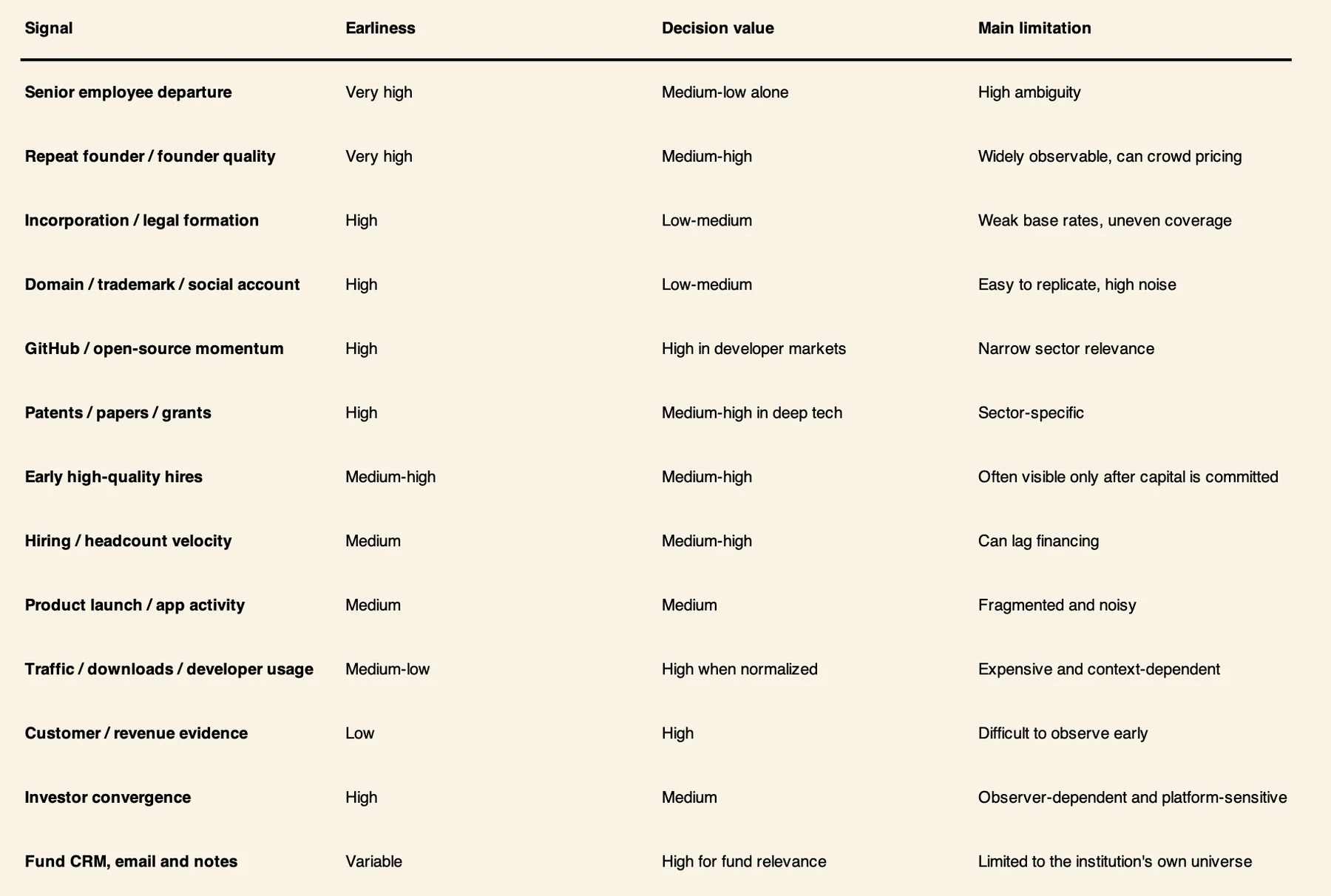
Human-capital signals work because teams usually become visible before operating metrics. A repeat founder or a cluster of strong early hires can justify attention long before revenue appears, although those signals are also widely watched and can increase competition. Technical signals are more powerful where the product leaves a public footprint. GitHub activity can be highly informative for developer infrastructure, while patents, research papers and grants carry more weight in deep tech.
Formation data is earlier but weaker. Incorporation and domain registration provide objective timestamps, yet most new entities never become venture-scale companies. Hiring offers stronger evidence of commitment but may follow an unannounced financing. Commercial signals such as customers, usage and revenue have the highest decision value, but usually appear after the company has become easier for competitors to identify.
Network signals sit somewhere in between. Investor activity can matter, but only when weighted by expertise and independence. Ten investors from the same social cluster may carry less information than two unrelated specialists converging on the same company. The same principle applies to angel participation and professional connections: the identity and context of the observer matter more than raw volume.
A fund's own data can be more relevant than any external feed because it contains intent. A previous partner meeting, a portfolio referral, a rejected investment or repeated email engagement says something about both the company and the institution's ability to act. That information is harder to standardize, but it is also much harder for competitors to reproduce.
The best systems should therefore avoid collapsing every signal into a universal score. They should show why a company surfaced, when the underlying events occurred and where the information came from. A pre-seed AI investor may place heavy weight on research-lab departures and GitHub momentum. A growth investor in vertical software may care far more about hiring composition, customer evidence and revenue.
This also changes how earliness should be measured. Lead time is useful only if it improves a fund's ability to form conviction, build a relationship or secure a better allocation or price.
Three months can be decisive in a competitive seed round. A modest signal around an elite repeat founder can justify immediate attention because the probability of another financing is already high. Early mapping of a new technical category can also allow a partner to develop a view before consensus forms.
In other markets, speed matters less. Biotechnology, defense and climate infrastructure often require technical, regulatory or procurement diligence that cannot be compressed simply by discovering the company earlier. In later-stage investing, revenue quality and unit economics dominate formation signals. And in banker-led or broadly intermediated processes, knowing about a company first does not necessarily create access.
There is also a risk of optimizing for earliness itself. A sourcing system can consistently identify companies before everyone else and still perform poorly if it overweights founder pedigree, social attention or activity that never translates into a strong business.
The more useful objective is time-adjusted decision quality: bringing the right company to the right investor early enough to act, but with enough evidence to justify the attention.
In most cases, accuracy matters more than extreme earliness. Lead time becomes economically important when access, ownership or price is genuinely scarce.
9. Where the value accrues: economics, data moats and AI agents
The venture-intelligence market is easier to understand from the bottom up than through broad software-market forecasts. Dealroom tracks roughly 4,900 active dedicated VC firms and about 9,500 active venture investors once corporate arms, accelerators and crossover investors are included.[9] The broader customer base extends to family offices, growth-equity teams, private-equity origination, corporate innovation groups and public agencies.
The narrow market for early-stage sourcing tools is relatively small. A product charging $99 a month would need about 8,400 continuously paying accounts to reach $10 million in annual recurring revenue before churn and discounts, already comparable with the global population of dedicated venture firms. Low-priced specialist products therefore need to move beyond individual VC users through institutional contracts, adjacent customer groups or data licensing.
Enterprise economics are more attractive. Dealroom publicly prices its premium products at $14,500 to $20,000 a year for three seats, while Affinity's pricing puts a 15-person team at roughly $30,000 to $40,500 annually before enterprise features.[20][23] Pricing for PitchBook, Harmonic, Specter, CB Insights and most private-market APIs is generally negotiated directly.
Revenue at the established end of the market shows how large the category can become. PitchBook generated $174.7 million in the second quarter of 2026, equivalent to an annualized run rate approaching $700 million.[2] Tracxn reported FY2026 revenue of INR 84 crore, roughly $10 million using an INR 84 per dollar assumption, across 2,289 customer accounts.[12] Its cost structure is also instructive: employee expense remains far larger than cloud infrastructure. Producing high-quality private-company data is still partly a human operation, not simply a web-scraping business.
M&A points in the same direction. Datasite acquired private-company search platform Grata for more than $200 million in 2025, according to the Wall Street Journal, and subsequently agreed to acquire SourceScrub.[29][30] The strategy combines transaction workflow, AI-based discovery and curated company data, suggesting that standalone sourcing features may ultimately be more valuable inside broader private-market intelligence platforms.
Business models will vary with the product. Seat-based SaaS offers predictable recurring revenue but carries enterprise sales and support costs. APIs can scale with usage, although live collection, third-party data and compute reduce the apparent marginal economics. Low-cost self-service products can acquire users efficiently, but the buyer universe is relatively small. The strongest vendors are likely to combine entry-level products with institutional contracts, data licensing and agent access.
The moat is history, not raw data
Public information can become proprietary through time.
An X follow, LinkedIn profile, job posting or company website can often be observed by multiple providers today. A correctly timestamped record showing how those signals changed over five years cannot be recreated retrospectively. The same applies to deleted technical projects, historical employee movements, old company descriptions and changes in hiring patterns.
Defensibility therefore compounds across several layers:
- Historical time-series. Snapshots become more useful when they form a continuous record of change.
- Entity resolution. Correctly linking people, domains, legal entities, products and investors determines whether signals can be trusted.
- Outcome data. Funding rounds, revenue growth, failures and exits allow models to be calibrated against what happened later.
- First-party fund context. Meetings, notes, rejected investments, portfolio relationships and investment outcomes cannot be purchased by competitors.
- Workflow feedback. Which alerts were opened, rejected or advanced creates a fund-specific learning loop.
- Distribution. Integration into CRM, email, Slack, APIs and agent workflows increases usage and switching costs.
Raw coverage is much less defensible. A database claiming 100 million companies is not necessarily stronger than one with fewer, cleaner records. Predictive scores are also reproducible if they are built from the same public inputs. The more durable assets are accumulated history, clean joins and proprietary customer context.
That creates an important tension for vendors. Network effects are possible if customers contribute corrections and outcomes, but investment firms have little incentive to share the information that constitutes their own edge.
Platform risk becomes part of the product
Much of the emerging intelligence stack depends on external platforms.
LinkedIn restricts scraping and copying of profiles under its user agreement.[31] X can change API pricing, permitted use and access requirements.[18] GitHub provides public APIs but applies rate limits.[32] Company registries, app stores and domain databases all have different access rules and economics.
Privacy adds another constraint. European data-protection guidance does not treat publicly accessible professional data as unrestricted simply because it can be observed online.[33] Vendors need clear provenance, deletion processes, permissions and the ability to replace individual sources.
A platform that depends heavily on one external network without durable access faces two risks at once: its data supply can disappear and its collection costs can rise.
This means data rights and source diversification belong inside the moat analysis. A technically impressive product built on fragile access may have weaker economics than a slower system with stable sources.
AI changes the interface faster than the underlying economics
AI agents are likely to accelerate the shift without removing the need for the underlying infrastructure.
The traditional workflow was sequential: search a database, filter companies, research them manually, email a colleague and enter the result into a CRM. The emerging workflow is event-driven. New data updates a company graph, a model detects a relevant change, an AI system matches it against the fund's thesis, an agent assembles the research, relationship data identifies a path to the founder and the result is written back into the team's workflow.
Different vendors already occupy pieces of that architecture. Harmonic combines its company graph with Scout, APIs and MCP. Specter connects continuous signals with integrations and AI interfaces. Frontrun exposes investor-attention data through API and MCP. Crustdata supplies data tools that an internal agent can call. Affinity is moving from relationship CRM toward an orchestration layer through its own agents.
LLMs materially reduce the cost of working with these systems. They can translate investment theses into searches, classify companies, normalize descriptions, build market maps, prepare research briefs and route opportunities. MCP reduces the integration work required for a model to call multiple data sources.
But AI does little to solve the hardest data problems. An agent answering a compound sourcing query still depends on correct entity matches, accurate timestamps, consistent definitions and permission to use every underlying source. Better language models cannot recover a company history that was never collected or correct an identity graph that joined the wrong entities.
The practical division of labor is already becoming visible. Monitoring, summarization and CRM maintenance can be heavily automated. Thesis matching and prioritization work well with human review. Automated outreach is easy technically but carries relationship risk. Autonomous investment selection remains a much weaker proposition.
SignalFire has made a similar distinction in describing its own use of LLMs: software can gather, classify and route information at scale without replacing investor judgment or founder communication.[25]
The economic implication is important. AI is likely to commoditize parts of the interface faster than it commoditizes the data underneath it. Natural-language search and automated research will become easier to reproduce. Historical datasets, entity resolution, proprietary fund context, permissions and workflow distribution will not.
The largest share of durable value is therefore unlikely to accrue to the best standalone chatbot for venture capital. It should accrue to the systems that own or control the information an agent needs to produce a reliable answer.
10. Competitive landscape, consolidation and the five-year outlook
There is no meaningful single ranking for venture-intelligence software. The market spans systems of record, early-signal products, relationship platforms and data infrastructure, each solving a different part of the investment workflow. The more useful comparison is by use case.
| Use case | Leading options | Best fit |
|---|---|---|
| Pre-seed founder discovery | Evertrace, Harmonic, Specter | Evertrace is the focused pre-formation specialist; Harmonic and Specter add broader company and people context |
| Stealth-company detection | Harmonic, Evertrace, Specter | Combines talent movement, formation data and company graphs |
| Investor-attention signals | Frontrun, Specter | Frontrun is the specialist feed; Specter incorporates attention into a broader signal graph |
| Broad startup intelligence | Harmonic, Dealroom, PitchBook | Harmonic for continuous discovery; Dealroom for ecosystems; PitchBook for institutional records and research |
| Private-company data infrastructure | Crustdata, Coresignal, People Data Labs | Strong for proprietary systems, but requires internal data engineering and quality control |
| Relationship intelligence | Affinity, 4Degrees, Attio | Affinity has the deepest private-capital adoption; alternatives trade specialization for flexibility and price |
| Emerging manager | Dealroom or Harmonic + Attio; optional specialist feed | Broad coverage without a large internal data team |
| Large institutional VC | PitchBook + Affinity + Harmonic/Specter + internal layer | Records, relationships and continuous discovery become complementary |
| Proprietary sourcing system | Crustdata/Coresignal + CRM + warehouse | The advantage comes from owning history and labels rather than the interface |
Source: original report comparison and provider materials [3], [4], [5], [6], [10], [14], [20], [22], [23], [24]. “Leading options” and “best fit” are the report's qualitative assessments, not an independently measured product ranking. Capabilities and commercial terms may have changed since the August 2026 snapshot. Link to this table.
Original exhibit
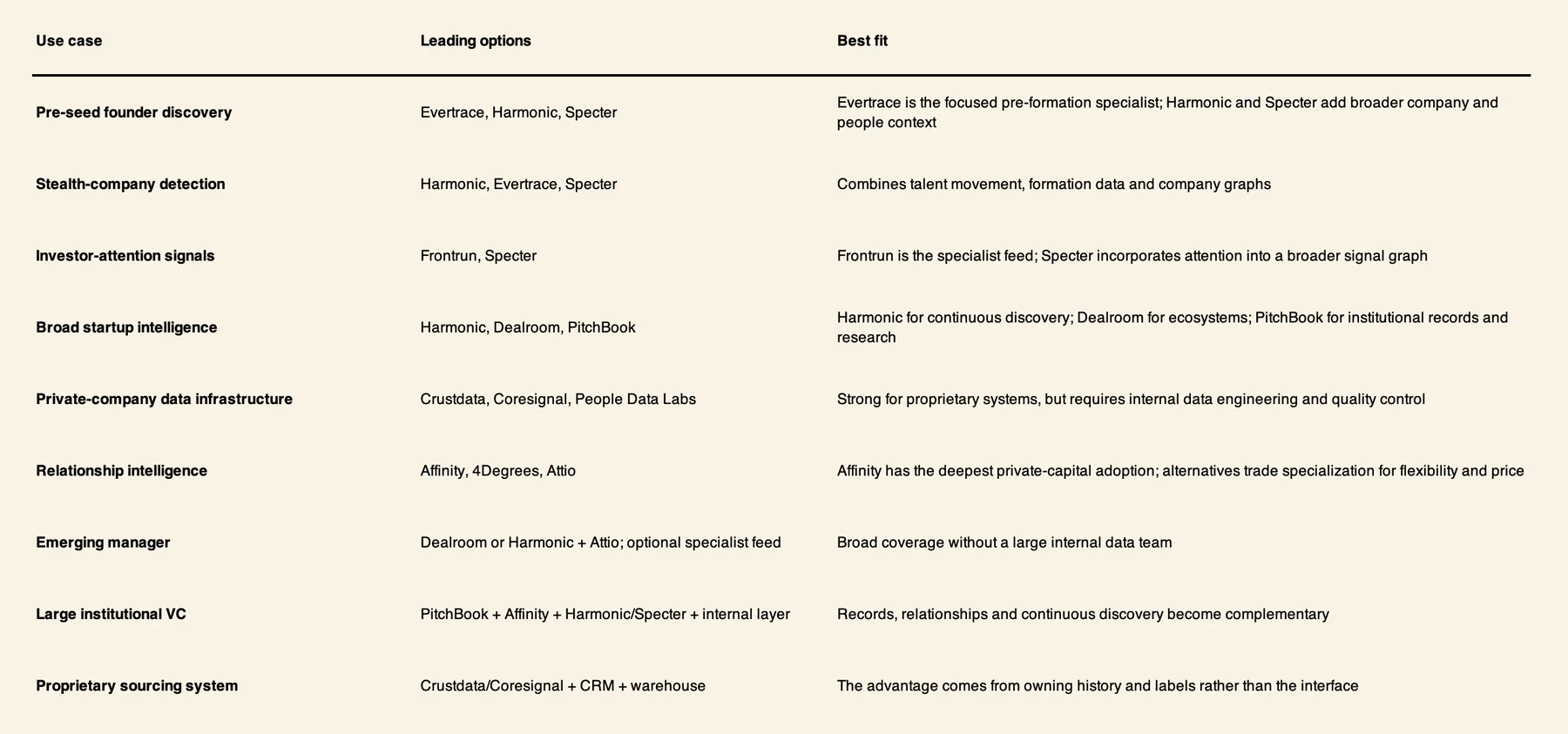
Strategic strength is highest where a company controls a distinct layer of the stack. PitchBook has scale, transaction depth and institutional research. Harmonic has built a clear position around continuous venture-specific company and people intelligence. Affinity sits on permissioned relationship data and established private-capital workflows. Dealroom benefits from ecosystem partnerships and regional distribution, while Crustdata is well positioned as infrastructure for firms building their own agents and sourcing systems.
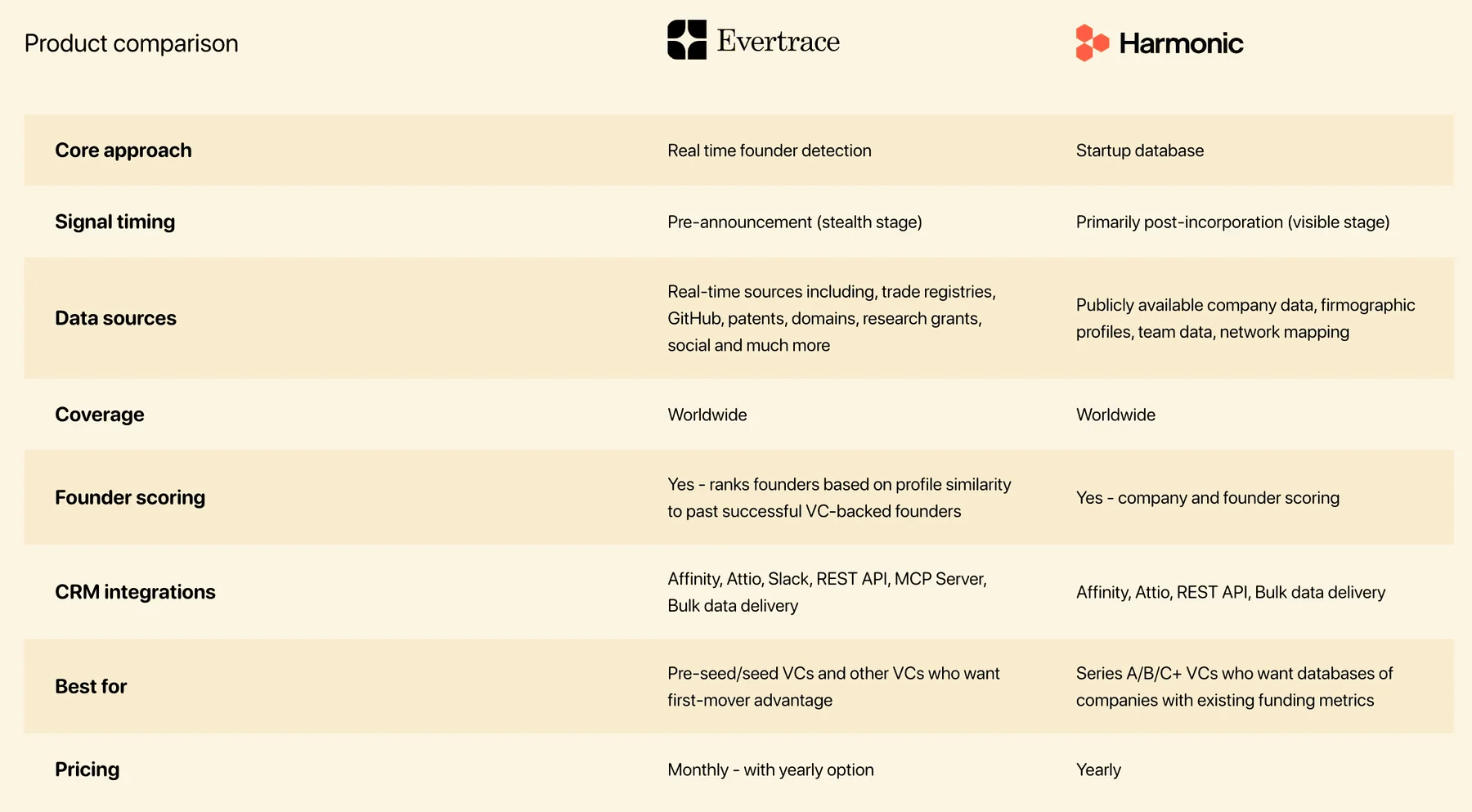
Evertrace vs Harmonic
| Product comparison | Evertrace | Harmonic |
|---|---|---|
| Core approach | Real time founder detection | Startup database |
| Signal timing | Pre-announcement (stealth stage) | Primarily post-incorporation (visible stage) |
| Data sources | Real-time sources including, trade registries, GitHub, patents, domains, research grants, social and much more | Publicly available company data, firmographic profiles, team data, network mapping |
| Coverage | Worldwide | Worldwide |
| Founder scoring | Yes - ranks founders based on profile similarity to past successful VC-backed founders | Yes - company and founder scoring |
| CRM integrations | Affinity, Attio, Slack, REST API, MCP Server, Bulk data delivery | Affinity, Attio, REST API, Bulk data delivery |
| Best for | Pre-seed/seed VCs and other VCs who want first-mover advantage | Series A/B/C+ VCs who want databases of companies with existing funding metrics |
| Pricing | Monthly - with yearly option | Yearly |
Source: transcription of the original report exhibit; provider background appears in [3], [5]. The simplified product positioning in this exhibit is not an exclusive capability boundary. The article also describes Harmonic's early-company detection and continuous intelligence. This table retains the original August 2026 comparison and is not a fresh pricing or feature verification. Link to this table.
Original exhibit
The specialist layer is more fragmented. Specter offers unusually broad signal coverage, Evertrace has a focused founder-detection wedge, and Frontrun provides an inexpensive and legible investor-attention feed. Each faces a different constraint: validation and breadth of adoption for newer platforms, model and execution risk for focused products, and platform dependency for signals built heavily on external social networks.
The market also extends well beyond venture-specific tools. Grata and SourceScrub are established in private-company discovery for private equity and M&A. Inven applies AI to target search, Beauhurst has deep regional company data, Coresignal and People Data Labs provide workforce infrastructure, Aviato offers company and people APIs, Attio is becoming a programmable CRM layer, and Visible focuses more heavily on portfolio and founder-investor workflows.
That breadth points toward private-market intelligence as the durable category, rather than venture sourcing as an isolated software market.
Consolidation is likely to accelerate
The first signs are already visible. Datasite's acquisition of Grata for more than $200 million and its planned acquisition of SourceScrub combine transaction workflow, AI-based discovery and curated private-company data.[29][30]
The same logic applies elsewhere. Large systems of record can acquire early-signal datasets that take years to reconstruct. Relationship platforms can add external discovery. Continuous company graphs can add specialized investor or founder signals. CRM products can become orchestration layers while specialist feeds increasingly sit behind APIs and agents.
AI strengthens both sides of that market structure. It reduces the need for investors to work inside several separate interfaces, which weakens standalone software as a moat. At the same time, it makes specialized datasets easier to consume because an agent can call them only when required.
The likely outcome is a small number of broader intelligence platforms surrounded by focused data providers, with the largest investment firms building proprietary systems on top.
The largest white space is inside the fund
Most predictive models learn from visible positive outcomes: companies that raised capital, grew quickly or exited successfully. Investment firms possess a different dataset.
They know which companies they saw, which they ignored, which they declined, which deals they lost, which investments partners disagreed about and which decisions they later regretted.
A permissioned system combining those negative labels with relationship history and subsequent outcomes could learn something closer to a fund's actual investment process than a generic market model. It could distinguish between a company that was objectively weak and one the fund liked but could not access, or between a deal rejected for valuation and one rejected because the thesis was wrong.
That dataset is difficult to build because investment outcomes are sparse, delayed and affected by the fund's own decisions. But it is also difficult for competitors to reproduce. This makes closed-loop, fund-specific intelligence one of the more credible long-term sources of differentiation in the category.
Other opportunities remain attractive but narrower. Cross-platform behavioral graphs gain value as historical records accumulate but are expensive to maintain and exposed to platform rules. Sector-specific products can achieve higher precision at the cost of smaller markets. Automated warm-introduction discovery addresses a clear investor need but raises privacy and relationship-management issues. LP intelligence could eventually use sourcing data to assess whether managers consistently identify companies before consensus, although comparisons would need to control carefully for stage, geography and strategy.
The interface will likely commoditize first. The underlying data architecture will not.
Over the next five years, competitive advantage should increasingly depend on who can maintain the cleanest historical graph, combine external information with proprietary fund context and preserve feedback from investment decisions.
The strongest platforms will not simply surface more companies. They will help an investment team notice the right change, understand why it matters, identify a credible path to the founder and remember what the institution learned afterward.
Venture investing will remain a human and relationship-driven business. Its information infrastructure is becoming continuous, programmable and increasingly embedded in the investment process.
Conclusion: venture intelligence becomes infrastructure
Venture sourcing is becoming more data-driven, but the change is happening faster in information collection than in investment judgment.
The traditional private-market database is not disappearing. PitchBook, Dealroom, Crunchbase, Tracxn and CB Insights still provide the records on which much of the industry depends. What is being added is a faster layer built around people movements, company changes, technical activity, investor behavior, relationships and continuously updated signals. Harmonic, Specter, Evertrace and Frontrun represent different parts of that shift, while Crustdata and similar providers make the underlying data available to funds building their own systems.
The strongest signals are unlikely to work in isolation. Founder departures and incorporation are early but noisy. Technical activity can be powerful in the right sectors. Hiring provides stronger evidence but often arrives later. Customers and revenue carry more decision value but less information advantage. Investor attention can help prioritize companies, but its value depends on who is paying attention and whether the signal adds information beyond simpler indicators.
That makes time-adjusted decision quality a more useful objective than raw lead time. Discovering a company first matters when it improves access, ownership or price. Otherwise, accuracy and relevance matter more than being early.
The same logic determines where economic value is likely to accrue. Raw public data and AI interfaces should become easier to reproduce. Historical time-series, clean entity resolution, permissioned relationship data, fund-specific decisions and accumulated workflow feedback are harder to rebuild. Large investment firms are therefore likely to combine external feeds with proprietary scoring, history and relationship systems, while smaller funds rely on integrated SaaS and a narrower set of specialist feeds.
AI will accelerate this structure rather than overturn it. Monitoring, classification, research preparation and CRM maintenance can increasingly be automated. Natural-language sourcing should become routine. But an agent is only as reliable as the timestamps, joins, permissions and definitions underneath it. The query interface is becoming the easy part.
The largest unresolved opportunity may sit inside investment firms themselves. Funds possess years of positive and negative decisions: companies they backed, rejected, missed, lost access to or later regretted. Combined with relationships and subsequent outcomes, that history could support intelligence systems tuned to how a specific fund actually invests rather than to a generic model of venture success.
The durable category is therefore unlikely to be standalone "venture sourcing software." It is broader private-market intelligence infrastructure, combining records, continuous data, behavioral signals, relationships and AI-assisted workflows.
The winners will not simply show investors more companies. They will help a specific investment team notice the right change, understand why it matters, reach the founder credibly and retain what the institution learns.
Venture capital remains a human and relationship-driven business. Its information infrastructure is becoming continuous and programmable.
Sources
[1] Bringing ownership in: a conjunctural approach to venture capital valuations. Socio-Economic Review, Oxford Academic, January 31, 2026.
[2] Morningstar, Inc. Reports Second-Quarter 2026 Financial Results. Morningstar, 2026.
[3] About Harmonic. Harmonic, accessed August 17, 2026. See also Harmonic pricing and coverage.
[4] Specter: AI-powered startup data and deal sourcing. Specter, accessed August 17, 2026. See also Specter integrations.
[5] Evertrace: founder detection engine. Evertrace, accessed August 17, 2026. See also About Evertrace.
[6] Affinity: relationship intelligence for private capital. Affinity, accessed August 17, 2026.
[7] Global Tech Ecosystem Index 2026. Dealroom, 2026. See also Global Startup Ecosystem Report 2025.
[8] 2026 NVCA Yearbook. National Venture Capital Association, 2026.
[9] Power Law Investor Ranking 2026. Dealroom, 2026.
[10] PitchBook data coverage. PitchBook, accessed August 17, 2026.
[11] Crunchbase data and predictive signals. Crunchbase, accessed August 17, 2026.
[12] Q4 FY2026 Investor Presentation. Tracxn Technologies, 2026.
[13] VC data intelligence platform raises $600,000. Tech.eu, April 2, 2025.
[14] Frontrun getting started and pricing. Frontrun, accessed August 17, 2026. See also Frontrun MCP documentation.
[15] 46 startups we flagged before they raised (2026). Frontrun, July 27, 2026.
[16] 10 raises this week, flagged 120 days early. Frontrun, August 14, 2026.
[17] X API pay-per-usage pricing. X Developer Platform, accessed August 17, 2026.
[18] X Developer Agreement. X Developer Platform, April 27, 2026.
[19] Harmonic raises $23 million Series A. TechCrunch, November 7, 2022.
[20] Dealroom pricing. Dealroom, accessed August 17, 2026.
[21] Crustdata closes $6 million seed round. Crustdata, October 22, 2025.
[22] Crustdata real-time B2B data API. Crustdata, accessed August 17, 2026. See also Crustdata MCP documentation.
[23] Affinity pricing for private capital CRM. Affinity, accessed August 17, 2026.
[24] Attio pricing. Attio, accessed August 17, 2026. See also Attio raises $52 million Series B.
[25] VC GPT: How LLMs are strengthening SignalFire's in-house AI. SignalFire, October 12, 2023.
[26] Motherbrain: a powerful synergy of AI and human expertise. EQT, accessed August 17, 2026. See also Why private capital needs to embrace AI.
[27] Moonfire proprietary technology and sourcing model. Moonfire Ventures, accessed August 17, 2026. See also Doubling down on data and technology.
[28] A quantitative approach to product-market fit. Tribe Capital, July 14, 2019.
[29] Private equity-backed Datasite acquires Grata. The Wall Street Journal, June 3, 2025.
[30] Datasite to acquire SourceScrub. Francisco Partners, August 8, 2025.
[31] LinkedIn User Agreement. LinkedIn, November 3, 2025.
[32] Rate limits for the REST API. GitHub Docs, accessed August 17, 2026.
[33] Guidelines 1/2024 on processing personal data based on legitimate interest. European Data Protection Board, October 8, 2024.
[34] Affinity raises $80 million Series C. Affinity, September 8, 2021.
[35] Dealroom raises $7 million to expand global startup mapping. Dealroom, January 28, 2026. See also About Dealroom.
[36] Crunchbase announces $50 million Series D. Crunchbase, 2022.
[37] CB Insights platform and Mosaic scoring. CB Insights, accessed August 17, 2026. See also Mosaic score methodology.
[38] 4Degrees integrations and company background. 4Degrees, accessed August 17, 2026. See also 4Degrees founders and origin.
[39] About PitchBook. PitchBook, accessed August 17, 2026.
Cover Artwork

Among the Sierra Nevada, California
Albert Bierstadt, c. 1868
Risk Disclaimer
insights4vc provides independent research based primarily on publicly available information believed to be reliable at the time of publication. Figures may change because of market prices, token supply, reclassification and methodology updates. Legal structures, investor rights and regulatory treatment vary by product and jurisdiction.
This article does not constitute investment, legal, tax, accounting or financial advice, or an offer, solicitation or recommendation regarding any security, token, fund interest or other asset. insights4vc makes no representation regarding the completeness or accuracy of third-party data. Readers should conduct independent due diligence and consult appropriately qualified advisers before making investment or business decisions.
Published by the insights4vc research team. See our research methodology, source standards and corrections policy. Dates and measurement periods are stated in each analysis.