Key Statistics
- TeraWulf's August 5 disclosure showed $31.9m of HPC lease revenue in Q2, approximately 71% of total revenue.
- In its August 11 results, CoreWeave reported 1.5 GW of active power, approximately $104bn of backlog and Q2 revenue of $2.575bn.
- In August, TeraWulf reported approval for up to 482 MW of electric service at Justified and estimated $4.0bn–$4.5bn of site and initial-hall investment, excluding customer computing equipment.
Figures and examples retain the report's original period, scope and source definitions. Consult the analysis and references below before making comparisons.
What determines whether a bitcoin miner can become an AI data center operator?
The decisive variable is not announced megawatts. A credible pivot requires energized power, AI-ready buildings, high-density cooling, a financeable customer contract and the balance sheet to deliver on schedule. The market is therefore separating miners with contracted HPC revenue and project financing from companies that still depend mainly on a large power pipeline and the bitcoin price.
- Contract quality: long-duration commitments and strong counterparties matter more than headline capacity.
- Technical readiness: liquid cooling, fiber, redundancy and construction delivery determine whether mining sites can support AI workloads.
- Financing: project debt and customer backstops can reduce dilution, but increase execution and concentration risk.
- Evidence of revenue: visible HPC revenue is the clearest dividing line between an operational pivot and a strategic announcement.
Research updated October 3, 2026. Originally published February 11, 2026. The company comparison, delivery milestones, financing analysis and source register below have been substantively refreshed using company releases and regulatory filings available through October 3. Figures retain their stated reporting dates. The share-price charts are historical illustrations from the original edition, not current market data. The former numerical rankings have been replaced with an evidence-based comparison.
Bitcoin miners have a potentially valuable entry point into AI infrastructure: land, power connections and experience operating energy-intensive facilities. But access to electricity is the beginning of a data-center project, not the finished product. The financial transformation only becomes tangible when a customer accepts usable capacity, rent or compute-service revenue starts, and that revenue supports the capital invested.
By October 2026, the companies discussed here occupy distinctly different stages of that transition. Some report meaningful AI or colocation revenue. Others have large signed leases with delivery scheduled for 2027 or 2028. Both can represent serious businesses, but they should not receive the same description. A contracted megawatt is a future obligation as well as a commercial achievement.
Our central assessment is therefore narrower than a ranking of winners: the strongest evidence of a successful pivot is a repeatable process for turning financeable demand into accepted, revenue-producing infrastructure. A large development pipeline expands the opportunity set; it does not establish that process. This distinction matters to readers assessing infrastructure suppliers, counterparties or listed equities.
Bitcoin miners and AI data centers: what has actually been delivered?
The table separates delivery evidence from larger commercial commitments. It is deliberately not a league table. Dates differ because companies report at different intervals, and their capacity definitions are not standardized.
| Company | Reported delivery or operating evidence | Contracted or future capacity | What still needs to happen |
|---|---|---|---|
| Core Scientific | 437 MW billing by mid-July; Q2 colocation revenue $136.7m. [1] | Approximately 1.1 GW leased, including the new approximately 530 MW AMD agreements. [2] | Deliver additional sites; distinguish billing milestones from the full future portfolio. |
| Applied Digital | 250 MW critical IT operational at Polaris Forge 1 on October 2. [3] | 400 MW contracted at that campus; July results reported 1,410 MW contracted across five campuses. [4] | Complete later buildings and campuses; convert construction activity into recurring rent. |
| TeraWulf | 102 MW revenue-generating IT capacity at Lake Mariner after July delivery, versus 81 MW at June 30. [5] | 336 MW additional Lake Mariner construction; separate 401 MW Justified lease targeting 2027–28. [6] | Commission successive halls and finance development without confusing power approval with completion. |
| IREN | Horizon 1: 50 MW IT delivered to Microsoft in August. Company operating ARR: $1bn at August 26. [7] [8] | $4bn contracted ARR for capacity targeted to operate by year-end; ARR is not recognized revenue. | Commission remaining deployments, obtain acceptance and service GPU-related financing. |
| Riot Platforms | 25 MW IT delivered to AMD by August 10. [9] | 241 MW IT contracted: 50 MW AMD and 191 MW for an unnamed frontier AI lab. | Deliver AMD expansion and the later lab project; replace interim project financing. |
| Hut 8 | River Bend and Beacon Point remain construction projects, with initial deliveries targeted in 2027. [10] | 949 MW contracted IT across those campuses, supported by 1,330 MW utility capacity. [11] | Turn a financed lease portfolio into delivered halls; later Beacon Point phase targets 2028. |
| Cipher Digital | Initial Black Pearl delivery and rent began in August; delivered MW not specified in the cited release. [12] | Barber Lake's revised delivery window is Q4 2026–Q1 2027. [13] | Complete phased deliveries and absorb the amended allocation of construction costs. |
Methodology: four numbers that should never be merged
Gross or utility power describes electricity available to the site. Critical IT load describes the portion intended for computing equipment. Contracted capacity describes a commercial commitment. Delivered, accepted or billing capacity describes a more advanced operating milestone, although the precise contractual definition still matters. A signed lease can cover a building that does not yet exist.
We retain the terminology of each cited source rather than converting every disclosure into an apparently comparable megawatt total. We do not add utility capacity to IT capacity, sum pipeline options into executed leases, or count the same site twice through its landlord and tenant. CoreWeave's power portfolio, for example, can overlap with infrastructure supplied by companies elsewhere in this report.
Revenue also needs a consistent denominator. Annualized run-rate revenue, contracted lease value, current-quarter revenue, tenant fit-out reimbursements and net operating income answer different questions. A fifteen-year contract total is not today's cash balance or enterprise value. A cloud revenue run rate cannot be compared directly with a landlord's rent without considering who buys, finances, operates and replaces the GPUs.
This is a review of public disclosures, not a physical inspection, independent engineering certification or audit of customer contracts. Reported delivery is attributed to the relevant company. Future dates remain management targets. Where the disclosed evidence does not establish an operating MW figure, we leave it unspecified instead of inferring it from the full lease size.
Why the mining-to-AI transition is economically attractive
Mining exposes a facility to Bitcoin's price, network competition, block rewards, equipment efficiency and electricity cost. An AI lease can replace part of that exposure with a contractual payment stream. For a landlord, that can support a different financing structure and a longer investment horizon. The trade is not simply volatile revenue for safe revenue: it replaces mining-market risk with construction, tenant, service-level and financing risk.
The existing site can matter more than the existing mining equipment. A substation, suitable land, utility relationship and local operating team may shorten parts of the development process. An ASIC mining building, however, may have little value for a customer requiring a different electrical design, cooling system, connectivity or redundancy. The relevant saving is the part of the infrastructure that can actually be reused.
This is why the opportunity should be assessed project by project. A site with attractive power prices but an unsuitable delivery schedule may lose to a more expensive site ready when a customer's hardware arrives. Conversely, owning abundant land does not solve the cost of bringing power, networks and a customer-approved building into service. The relationship between power development and contracted cash flow is explored further in our research on financing clean energy.
Two business models: infrastructure landlord and GPU cloud
A colocation developer principally sells an operational environment: power, buildings, cooling and related services. The customer may supply and operate the computing equipment. A GPU cloud operator sells access to compute and must also manage hardware procurement, software, utilization and customer service. An integrated company can combine these activities, but the risk does not disappear when they share a corporate name.
That distinction changes the interpretation of margins and capital intensity. A landlord can report attractive property-level economics while financing a large construction program. A cloud provider can generate substantially more revenue per IT megawatt while carrying expensive hardware and technology-refresh exposure. Neither revenue per MW nor a headline backlog settles which model creates more value for the common shareholder.
The investable question is the cash left after all relevant claims: operating costs, maintenance, interest, principal repayments, customer credits, preferred returns and future equipment replacement. Our analysis of AI's place in venture capital provides the demand-side context; this report concentrates on the physical and financial commitments required to serve that demand.
Company analysis: operating evidence, commitments and remaining risk
CoreWeave (CRWV): the cloud operator and a major counterparty
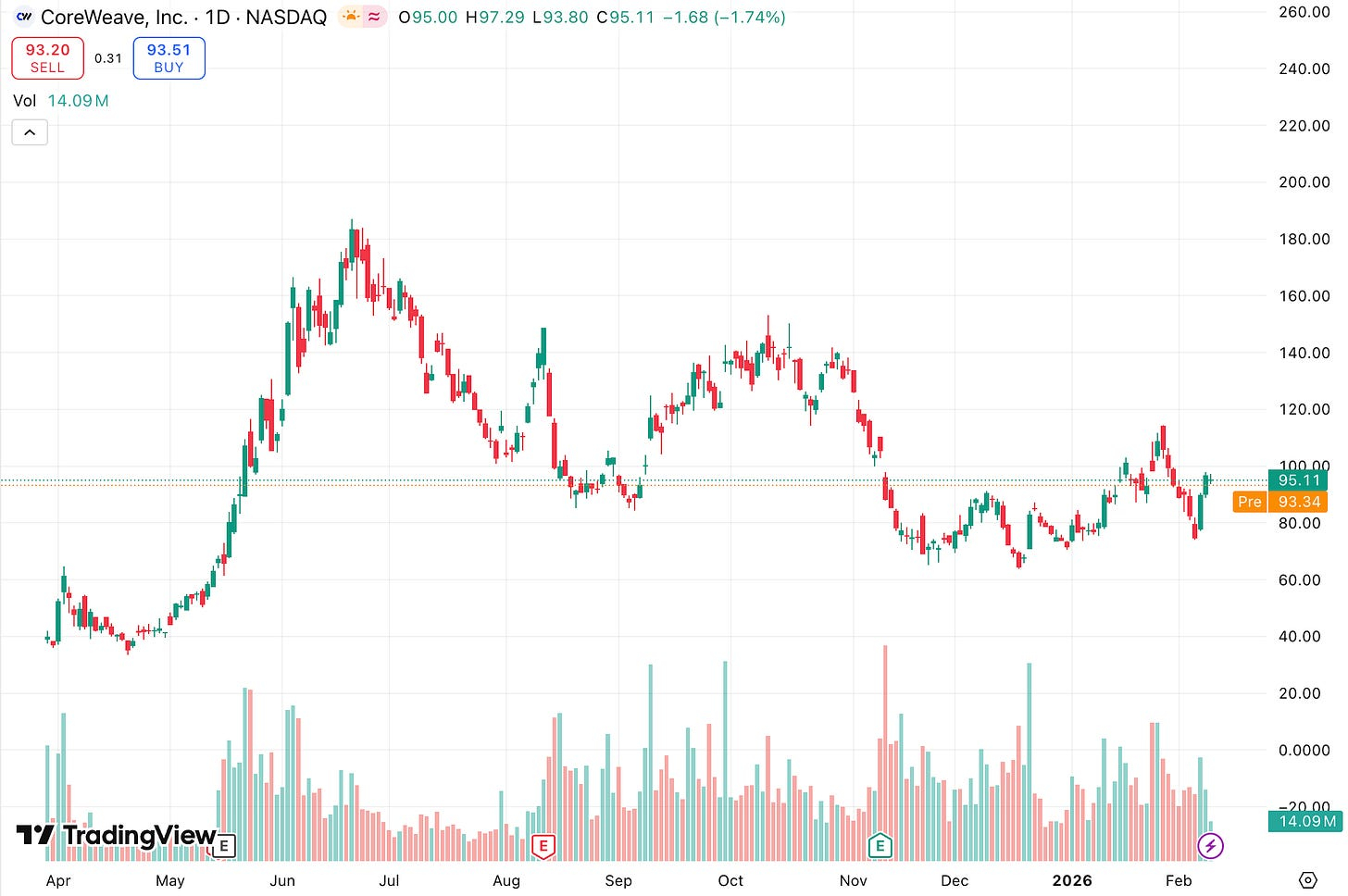
CoreWeave belongs in this comparison because it is both an AI infrastructure operator and a customer of data-center developers. It should not be treated as interchangeable with a miner converting sites into colocation facilities. Its customer contracts and supplier leases describe different sides of the same compute-delivery chain.
In its August 11 results, CoreWeave reported 1.5 GW of active power, approximately $104bn of backlog and Q2 revenue of $2.575bn. The same quarter included $640m of net interest expense and a $626m net loss. A September 17 update put contracted power at 4.2 GW as of August 11. The larger contracted figure is not additional active capacity. [14] [15]
What this means: commercial demand and current revenue are substantial, but backlog alone cannot establish delivery performance or cash returns. For landlords serving CoreWeave, customer concentration creates an additional link between the tenant's financing needs and the landlord's own construction schedule. Evaluate that relationship rather than assuming a prominent customer makes every project equally secure.
TeraWulf (WULF): operating conversion and a larger development commitment
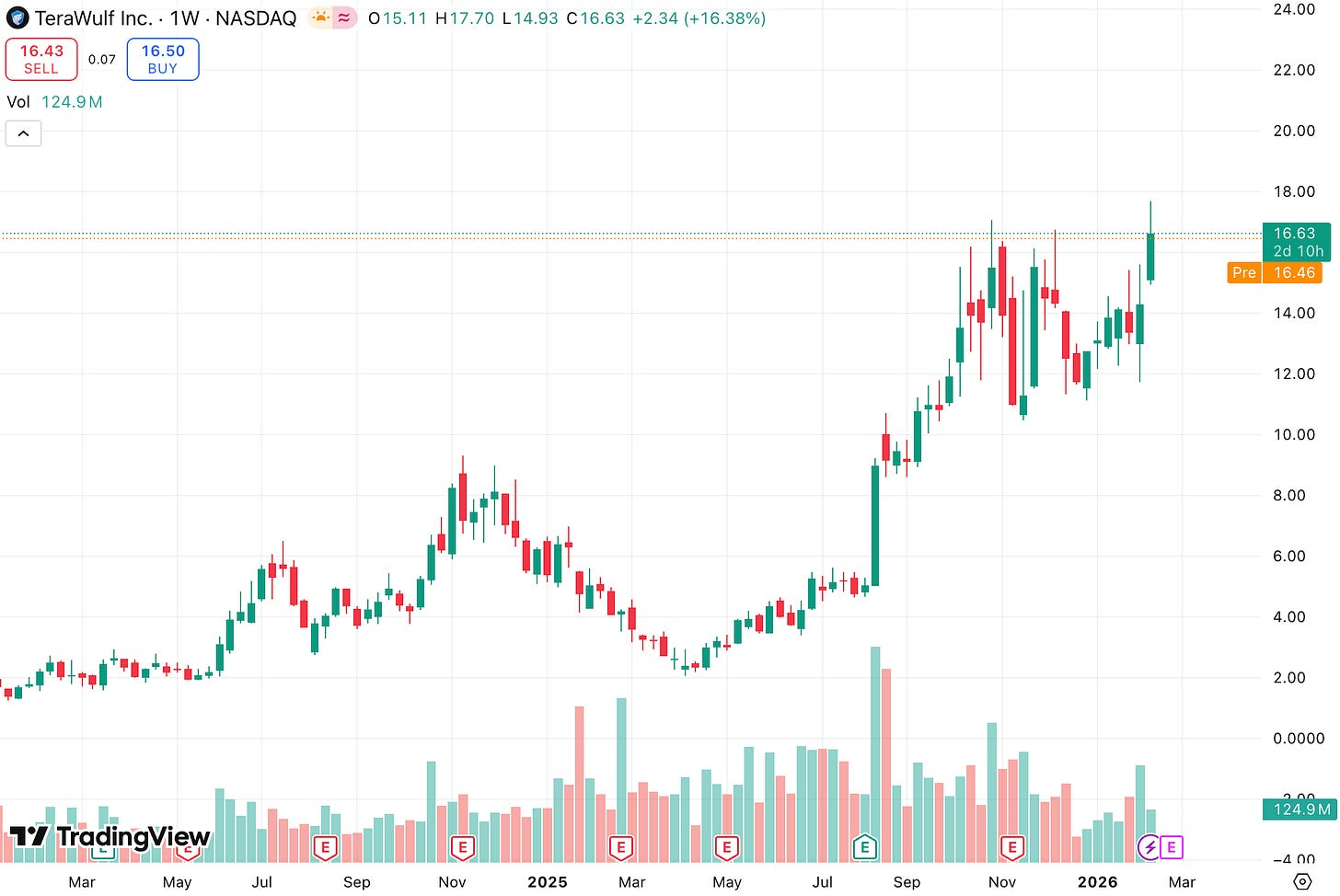
TeraWulf's August 5 disclosure showed $31.9m of HPC lease revenue in Q2, approximately 71% of total revenue. Lake Mariner reached 102 MW of revenue-generating IT capacity after an early-July delivery. A further 336 MW remained under construction. The company said CB-3 delivery activated $600m of Google's support for Fluidstack lease obligations. This is evidence of a specific milestone, not a blanket guarantee covering every project risk. [5]
The separate Justified project adds approximately 401 MW under a twenty-year Anthropic lease, with initial service expected in H2 2027 and full delivery in early 2028. TeraWulf also agreed to sell its Abernathy joint-venture interest. These changes make the original report's simple combined capacity and geography description obsolete. [6]
In August, TeraWulf reported approval for up to 482 MW of electric service at Justified and estimated $4.0bn–$4.5bn of site and initial-hall investment, excluding customer computing equipment. Its disclosed structure places project-specific power and infrastructure costs on the large-load customer. [16]
What to monitor: separately track rent commencement, remaining construction cost and the effectiveness conditions attached to credit support. The existence of an operating site is valuable evidence, but expansion into a new campus still requires its own financing, technical delivery and customer acceptance.
Hut 8 (HUT): contracted scale ahead of campus delivery
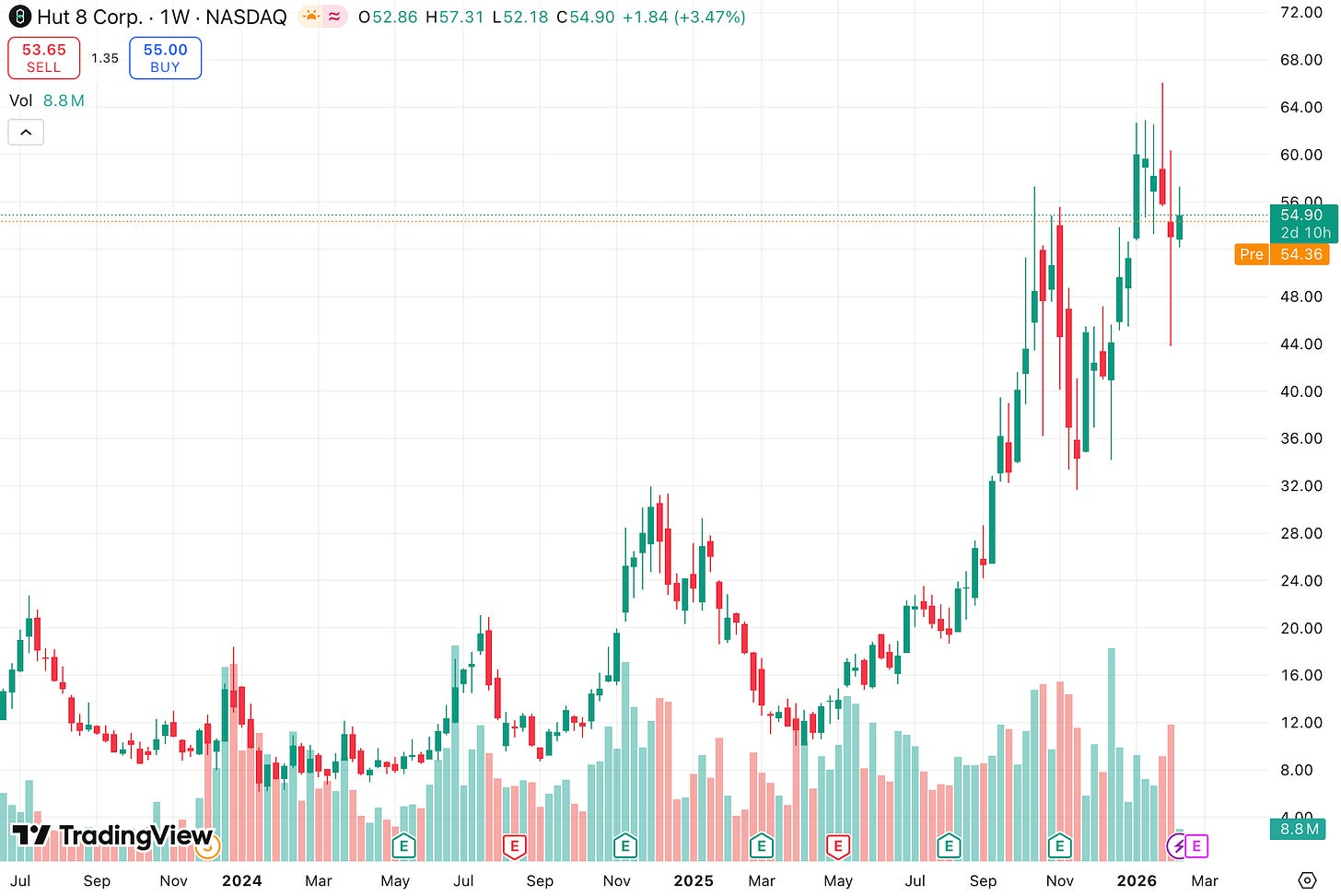
Hut 8's July Beacon Point expansion brought contracted IT capacity across Beacon Point and River Bend to 949 MW, with approximately $26.6bn of expected base-term contract value. The supporting utility capacity is 1,330 MW. These are distinct measures of the same campus development program, not two pools of capacity to add together. [11]
The August update targeted initial River Bend and Beacon Point deliveries in Q2 and Q3 2027, respectively. The June-quarter filing put initial delivery of Beacon Point Phase 2 in Q2 2028. It also distinguished the financed first phase from the later phase for which financing was still being pursued. [10] [17]
By June, Hut 8 had closed $7.5bn of project-level construction financing. The company characterized the Beacon Point notes as fully amortizing, non-recourse and non-dilutive. A separate September 28 announcement added a $1.07bn corporate revolving credit facility. A committed facility is borrowing capacity, not automatically cash drawn or proof that every future phase is funded. [18] [19]
What to monitor: Hut 8 illustrates why bankability and operational completion need separate columns. Non-recourse financing can limit the parent's legal exposure to project debt, while the parent's invested capital and expected distributions remain exposed to project outcomes. Watch the construction timetable and cash-flow waterfall alongside the headline lease value.
IREN (IREN): distinguish cloud ARR from recognized revenue
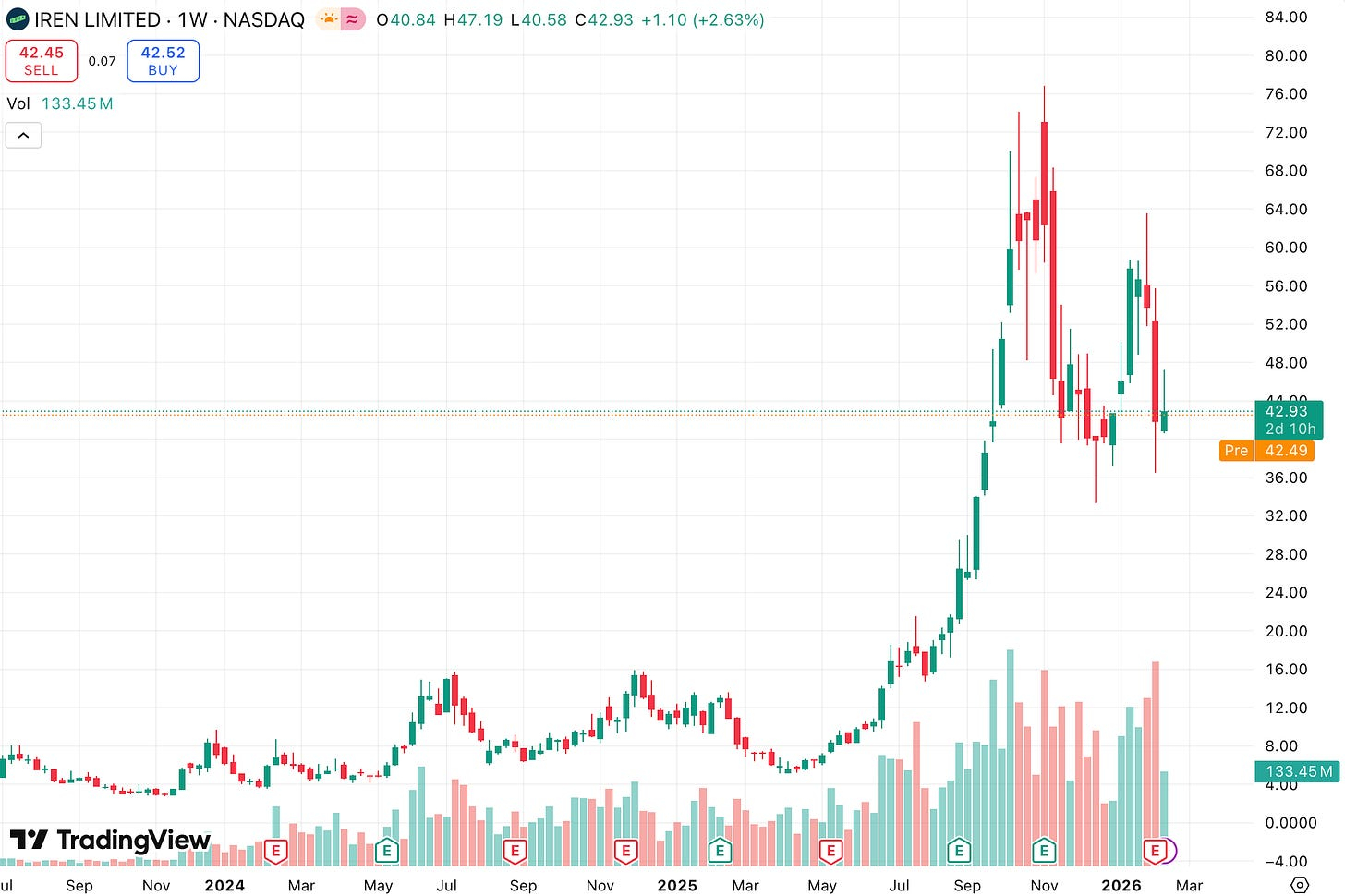
IREN delivered Horizon 1, a 50 MW IT deployment, to Microsoft in August. It is the first of four such deployments under the five-year, $9.7bn Microsoft arrangement. The milestone demonstrates customer delivery; it does not mean the entire contract or the wider development pipeline was operational. [7]
August 27 results reported $1bn of operating annualized run-rate revenue at August 26 and $4bn contracted ARR for capacity targeted to operate by December 31. Actual AI Cloud Services revenue was $128.8m for FY2026, including $70.5m in its final quarter. IREN explicitly cautions that ARR is an operating measure and recognized revenue can be materially lower. [8]
Financing is also contract-specific: the results disclosed $3.6bn of Microsoft-related GPU financing at a 6.0% weighted average rate excluding fees, and separate financing including $2.4bn at 9.0% for Mackenzie. The September Sweetwater update described conditional ERCOT inclusion and 300 MW gross of data centers under construction for targeted Q4 2027 delivery. An energized substation should not be counted as delivered AI halls. [8] [20]
What to monitor: acceptance, utilization, realized cloud revenue and hardware financing obligations. A cloud operator's apparent revenue advantage per megawatt comes with GPU ownership and service-delivery responsibilities. Evaluate those together rather than applying a property-lease valuation to a compute business.
Riot Platforms (RIOT): a larger lease book, with financing still material
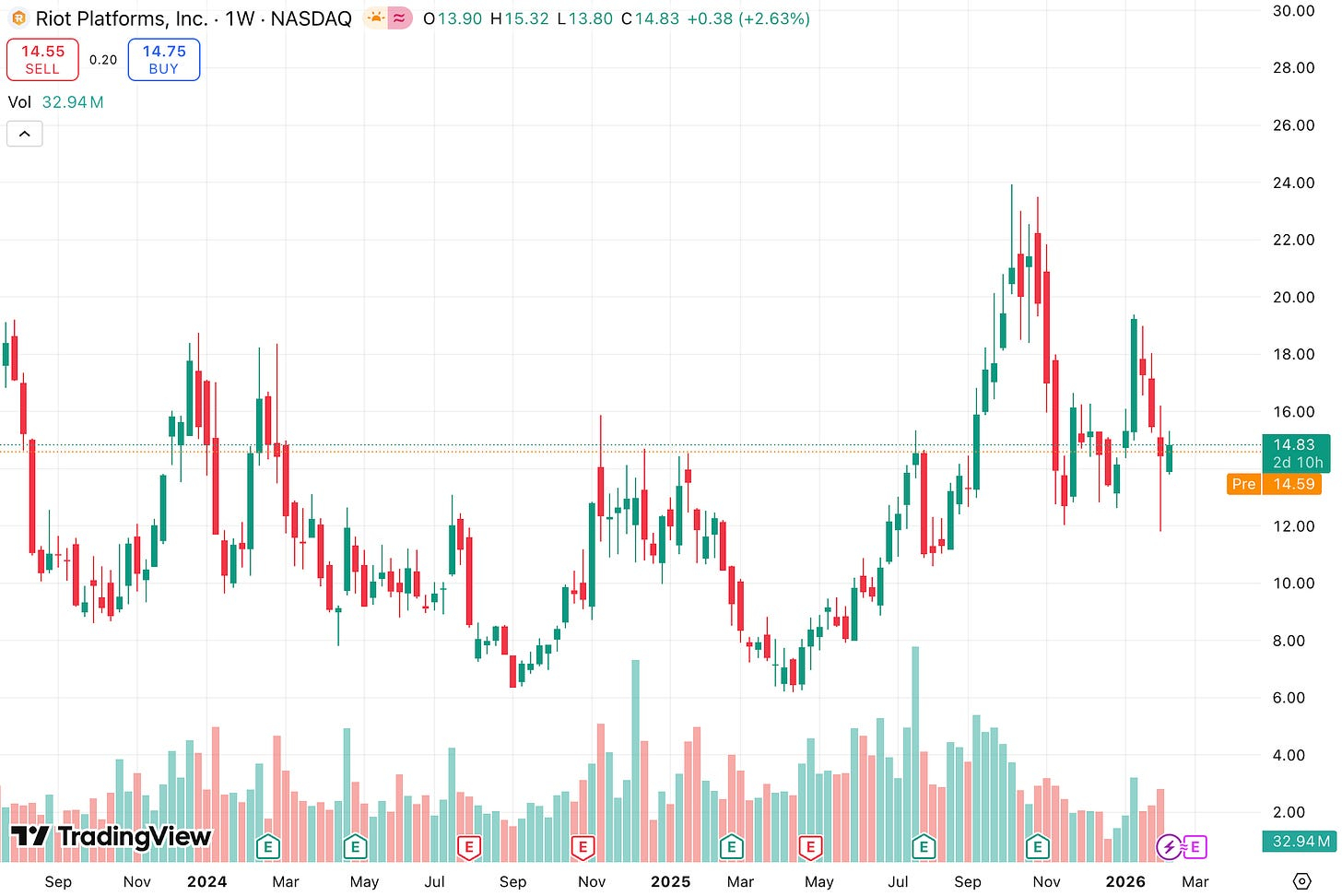
Riot reported 25 MW IT delivered to AMD by August 10, compared with 241 MW contracted overall: 50 MW for AMD and 191 MW for an unnamed frontier AI lab. The latter agreement carries approximately $9.1bn of expected revenue over twenty years, with delivery targeted from December 2027 through June 2028. We do not infer the unnamed tenant's identity. [9]
Q2 data-center revenue of $23.2m included $18.3m of tenant fit-out services and $4.9m of operating lease revenue. That breakdown matters more than the undifferentiated growth rate. It separates a construction-related revenue component from the recurring rent stream the company is building. [9]
The June-quarter filing describes a $573m interim project facility with a stated October 15, 2026 maturity, subject to extension provisions, and pricing at SOFR plus 2.75%. The August announcement described the investment-grade credit backstop as being finalized. Treat permanent financing as an execution item unless a later closing is established. [21]
What to monitor: refinancing, later AMD delivery and the transition from fit-out revenue to lease cash flow. A short-dated bridge can finance early works, but the economics of a twenty-year lease still depend on the cost and availability of durable capital. The September repayment of Riot's separate Coinbase facility should not be mistaken for repayment of this project bridge. [22]
Applied Digital (APLD): operational progress with a much larger lease portfolio
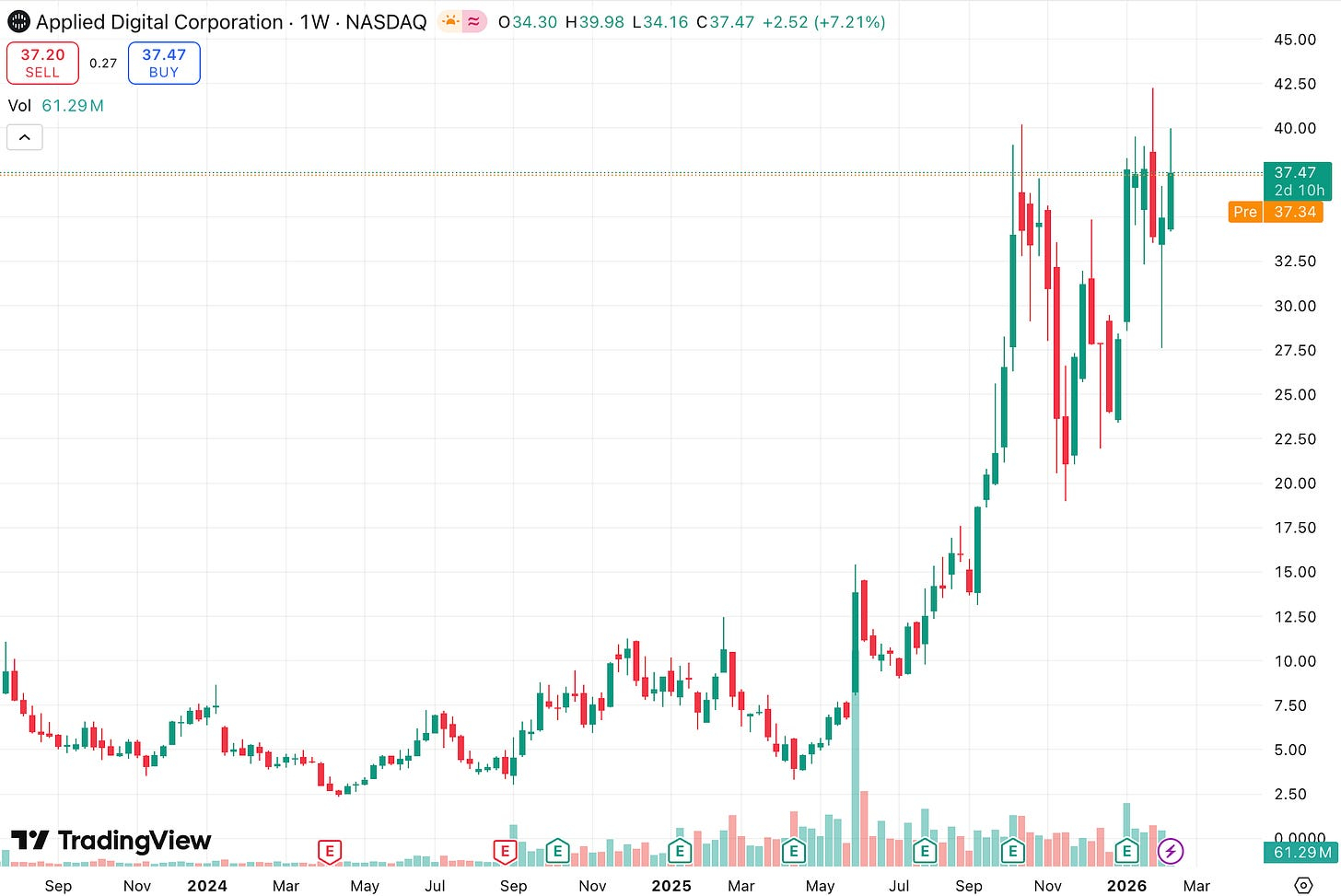
Applied Digital announced another 75 MW of critical IT capacity online at Polaris Forge 1 on October 2, taking that campus to 250 MW operational against 400 MW contracted. This is a concrete delivery milestone immediately before this review's cutoff. Its July full-year release reported 1,410 MW of contracted IT capacity across five campuses, much larger than the delivered figure at Polaris Forge 1. [3] [4]
The fiscal fourth quarter illustrates why revenue composition matters: $203.0m of HPC hosting revenue included $44.1m of base rent, $152.4m of tenant fit-out services and $6.5m of recoveries. The entire segment figure should not be annualized as stabilized recurring rental revenue. [4]
The annual filing describes delivery stages running into 2028 and capital structures including preferred units, minority economic interests and warrants. Describing a financing partnership as an available cash balance would miss both conditions on funding and the claims that other investors acquire. [23]
What to monitor: new service-ready halls, base rent growth, construction obligations and returns attributable to the parent. Demonstrated construction delivery strengthens the operating case. It does not remove the need to reconcile campus economics with the common shareholder's share after debt and preferred capital.
Core Scientific (CORZ): billing evidence changes the comparison
Core Scientific reported 395 MW billing at June 30 and 437 MW by mid-July. Q2 colocation revenue was $136.7m, compared with $164.2m of total revenue. The original February framing, centered on planned construction and takeover uncertainty, no longer describes the company's reported operating mix. [1]
Its July AMD partnership was anchored by approximately 530 MW under fifteen-year agreements, with deployments beginning in 2027. The potential 2.5 GW partnership expansion is larger than those anchor agreements and should remain in a separate category. [2]
August's $600m committed credit facilities comprised a $100m revolver and $500m of letters of credit. The company expected the structure to release approximately $300m of restricted cash. The distinction is important: a letter of credit supports an obligation; it is not the same as new unrestricted cash proceeds. [24]
What to monitor: continued billing expansion, customer concentration and cash conversion after capital expenditure. Billing is stronger evidence than a pipeline announcement, but a rising billing figure cannot by itself establish free cash flow. Future capacity still requires construction capital and timely customer delivery.
Cipher Digital, formerly Cipher Mining (CIFR): amended contracts change the delivery case
Cipher's August 4 update said initial capacity delivery and rent commencement had begun at Black Pearl. It did not disclose how many MW had entered service in that first phase. Reporting the entire contracted campus as operational would therefore overstate the evidence. [12]
The September 25 Barber Lake amendment is particularly consequential. An amendment and a separate binding commitment for an additional ten-year term brought combined contracted duration to twenty years and revenue to more than $9bn. The updated delivery schedule spans Q4 2026 through Q1 2027, with first rent expected in Q4. The larger contract value accompanies a changed delivery and cost arrangement. Cipher bears the first $359.3m above the initial budget; tenant reimbursement covers half of costs above that threshold over the aggregate lease term through additional rent. [13]
What to monitor: hall-by-hall acceptance, the revised construction budget and the timing of cost recovery. The amendment makes the old September 2026 completion expectation stale. Longer contracted revenue is useful, but it should be assessed against added capital obligations and the delay before cash is recovered.
This case also shows why a simple list of lease totals can mislead. An amendment can simultaneously improve long-term revenue visibility and increase the capital the developer needs before collecting rent. Its economic effect depends on both sides of that change.
CleanSpark (CLSK): the signed-lease threshold has been crossed
CleanSpark's July 14 agreement covers 175 MW IT at Sandersville, Georgia, with approximately $6.6bn of initial twenty-year contract value and first deliveries targeted for Q4 2027. The company estimated landlord construction cost at $10m–$12m per IT MW. Its separately described 885 MW Texas opportunity was subject to a letter of intent and exclusivity, not another executed lease. [25]
The original description of CleanSpark as lacking a major signed AI lease is consequently out of date. However, the signed Sandersville agreement does not yet establish operational AI delivery. These are consecutive stages, and the distinction should survive even when the investment narrative changes quickly.
What to monitor: financing, permitting, construction progress and conversion of Texas discussions into definitive commitments. The appropriate comparison is between funded contractual obligations and available resources, rather than between Bitcoin treasury value and an unqualified AI pipeline total.
HIVE Digital (HIVE): GPU cloud economics at a different scale
HIVE's BUZZ business signed an approximately $350m, five-year contract in August for 2,016 GB300 GPUs, targeted online in Q4 2026. The filed release estimated $185m of capital expenditure and a $35m customer deposit. It distinguished approximately $35m active ARR from $145m of contracted future ARR. Those categories should remain separate. [26]
A September update reported approximately $100,000 of daily GPU revenue on a preliminary, unaudited basis. Its higher future daily-revenue objective was a target, not the achieved figure. [27]
What to monitor: equipment deployment, customer acceptance and the conversion of future ARR into actual revenue. HIVE's smaller cloud business should be judged against its own capital base and execution obligations. A lower megawatt count alone does not establish inferior economics, just as a larger GPU count alone cannot establish attractive returns.
A better comparison than subjective scores
The original article assigned numerical execution scores without publishing enough underlying data to reproduce them. That approach gave unwarranted precision to companies with different business models and disclosure standards. The replacement framework below makes the investment questions explicit without converting incomplete evidence into a synthetic ranking.
| Dimension | Stronger evidence | What the headline alone misses |
|---|---|---|
| Power | Executed service rights, commissioning and clear gross/IT definitions | A pipeline or interconnection study can precede usable supply by years. |
| Customer demand | Executed agreement with disclosed term, delivery conditions and obligor | Options, exclusivity and letters of intent are not equivalent to a lease. |
| Operations | Accepted halls, billing capacity and recurring revenue | A leased building may still be under construction. |
| Financing | Closed facilities, draw conditions, maturities and remaining equity disclosed | A commitment can be restricted, conditional or short-dated. |
| Economics | Recurring cash flow after debt, maintenance and other investor claims | Backlog, fit-out revenue and property NOI are not shareholder free cash flow. |
| Expansion | Phased milestones with verified site-specific progress | Potential growth is not current operating capacity. |
Technical readiness: cooling, networking and customer acceptance
NVIDIA describes GB200 NVL72 as a rack-scale, liquid-cooled system combining 72 GPUs and 36 CPUs. Its hardware documentation also explains that some components continue to use air cooling. The original statement that Blackwell made all air cooling obsolete was too broad. The design requirement depends on the exact hardware configuration and workload. [28]
For a mining-site conversion, the practical checklist is wider than cooling. Power distribution, backup systems, fiber routes, network architecture, fire protection, physical security and the ability to maintain the customer's contracted service level all need validation. Equipment can be installed without the entire service being accepted. Conversely, a landlord can begin billing accepted space before every future building on its campus is complete.
Power Usage Effectiveness also needs context. As a simplified example, a site drawing 100 MW at a PUE of 1.25 would support 80 MW of IT consumption at that operating point. That arithmetic is illustrative, not an estimate for any project in this report. Design targets, measured performance, redundancy and actual utilization can differ. We therefore preserve disclosed gross and IT figures rather than applying one assumed PUE across all companies.
Innovative cooling systems or unusual locations should be assessed on reliability, maintainability, total delivered cost and customer acceptance. They are not substitutes for evidence that a particular mining campus can meet a particular AI tenant's specification. The same engineering discipline applies to alternative cooling concepts: a claimed efficiency advantage has limited analytical value without a clear baseline, operating conditions and evidence of commercially accepted service.
Financing risks: why a hyperscaler backstop is not a complete investment case
A strong payment obligor can materially improve a project's financeability. The next questions are which obligations are covered, when support becomes effective, how much it covers and what happens if the building arrives late. Credit support for a tenant's rent is not automatically a completion guarantee for the developer or protection against every overrun.
Three funding categories deserve separate treatment. Project debt is generally tied to specified assets and cash flows. Corporate liquidity supports the broader business but can have its own collateral and covenants. Customer prepayments fund future service obligations and should not be mistaken for unrestricted profits. Combining all three into a single liquidity headline can conceal which expenditure each dollar is allowed to finance.
Non-dilutive financing is also a narrower claim than it sounds. Ordinary debt may avoid issuing common shares at closing while introducing interest, collateral and repayment obligations. Preferred equity, project minority interests and warrants can transfer future economics even if the listed common share count does not immediately change. The complete capital structure matters more than the label.
Timing can change a project's economics sharply. If rent begins six months later, construction interest and overhead can continue while expected cash receipts are deferred. A tenant may also have contractual remedies. Analysts should stress delivery delays, higher build cost and refinancing spreads separately before combining them. A project that survives one isolated stress may be vulnerable when two occur together.
Finally, electricity is a contract and a regulatory relationship as well as a physical input. Who bears transmission upgrades, demand charges, interruption risk and future tariff changes? The Justified power agreement illustrates the need to read those allocations. A historically attractive mining power arrangement should not simply be assumed to remain economically identical under a larger, less interruptible AI load. [16]
What would demonstrate a durable pivot?
The sector has advanced beyond a uniform story of miners announcing AI ambitions. Public disclosures now show accepted deployments, billing capacity and recognizable AI-related revenue alongside large future construction commitments. The useful distinction is the stage of each project, not whether a company uses AI language in its strategy.
Our assessment favors evidence that can be checked again: accepted MW, recurring revenue by segment, funded cost to complete, and cash available after debt and preferred claims. These measures make progress visible without assuming that a long lease guarantees an attractive equity return. They also help identify where an apparently small change in a delivery date or financing term is economically significant.
The next decisive phase is repeated execution across several buildings and campuses. Can developers reproduce an initial successful delivery, keep customers, finance the remaining program and retain enough of the economics for shareholders? That is the test that connects today's infrastructure commitments to the broader AI capital-allocation cycle. A current comparison should be updated when those milestones change, not only when a new pipeline is announced.
Primary sources and reporting dates
Sources accessed October 3, 2026. Company forecasts and non-GAAP or operating metrics retain the qualifications discussed above.
- Core Scientific, Q2 results, July 28, 2026
- Core Scientific and AMD partnership, July 28, 2026
- Applied Digital, Polaris Forge 1 delivery, October 2, 2026
- Applied Digital, FY2026 results, July 27, 2026
- TeraWulf, Q2 results, August 5, 2026
- TeraWulf, Justified lease and Abernathy transaction, July 6, 2026
- IREN, Horizon 1 delivery, August 13, 2026
- IREN, FY2026 results and ARR definitions, August 27, 2026
- Riot Platforms, Q2 results, August 10, 2026
- Hut 8, Q2 results, August 4, 2026
- Hut 8, Beacon Point second lease, July 20, 2026
- Cipher Digital, Q2 business update, August 4, 2026
- Cipher Digital, Barber Lake lease amendment, September 25, 2026
- CoreWeave, Q2 results, August 11, 2026
- CoreWeave, contracting update, September 17, 2026
- TeraWulf, Justified power approval, August 24, 2026
- Hut 8, Form 10-Q for June 30, 2026
- Hut 8, Beacon Point financing closing, June 9, 2026
- Hut 8, corporate revolving facility, September 28, 2026
- IREN, Sweetwater power and construction update, September 8, 2026
- Riot Platforms, Form 10-Q filed August 10, 2026, Note 3
- Riot Platforms, Form 8-K filed September 25, 2026
- Applied Digital, FY2026 Form 10-K
- Core Scientific, credit facilities, August 27, 2026
- CleanSpark, Sandersville lease, July 14, 2026
- HIVE, filed BUZZ contract announcement, August 17, 2026
- HIVE, operating revenue update, September 10, 2026
- NVIDIA, DGX GB rack-scale hardware documentation, accessed October 3, 2026
Cover Artwork

The Y at Amsterdam, with the Frigate “De Ploeg”
Ludolf Bakhuysen, 1680–1708
Amsterdam as a capital hub: infrastructure, routing, and maritime power underwriting global commerce.
Risk Disclaimer:
insights4.vc and its newsletter provide research and information for educational purposes only and should not be taken as any form of professional advice. We do not advocate for any investment actions, including buying, selling, or holding digital assets.
The content reflects only the writer’s views and not financial advice. Please conduct your own due diligence before engaging with cryptocurrencies, DeFi, NFTs, Web 3 or related technologies, as they carry high risks and values can fluctuate significantly.
Note: This research paper is not sponsored by any of the mentioned companies.
Published by the insights4vc research team. See our research methodology, source standards and corrections policy. Dates and measurement periods are stated in each analysis.